
Firebase Bird
The Kim Son Valley cuts through the coastal highlands of Bình Định Province in central Vietnam, a narrow corridor of rice paddies and scrub surrounded by forested ridges. In December 1966, a U.S. Army firebase named Bird occupied one end of that valley. Its garrison — two artillery batteries and elements of the 1st Battalion, 12th Cavalry — was outgunned by what came for them in the early hours of December 27: three battalions of the People's Army of Vietnam, roughly 1,500 soldiers, moving through the dark with purpose. What happened next was decided in minutes, and the men who survived it earned some of the highest decorations the Army can give.
A Firebase in the Valley
Firebase Bird sat in the Kim Son Valley in the dry season of 1966, when the 1st Cavalry Division was deep in its campaign to contest Viet Cong and North Vietnamese control of Bình Định Province. The base was occupied by C Battery, 6th Battalion, 16th Artillery — operating 155mm howitzers — and B Battery, 2nd Battalion, 19th Artillery, with 105mm guns. Infantry protection came from elements of the 1st Battalion, 12th Cavalry. The valley it occupied was contested territory, one of many such positions the U.S. established in the highlands to provide fire support for operations and to deny the enemy freedom of movement. Firebase Pony sat nearby, close enough to provide supporting artillery fire if Bird came under attack. The setup looked defensible. Against what the PAVN had prepared, it almost wasn't.
The Morning of December 27
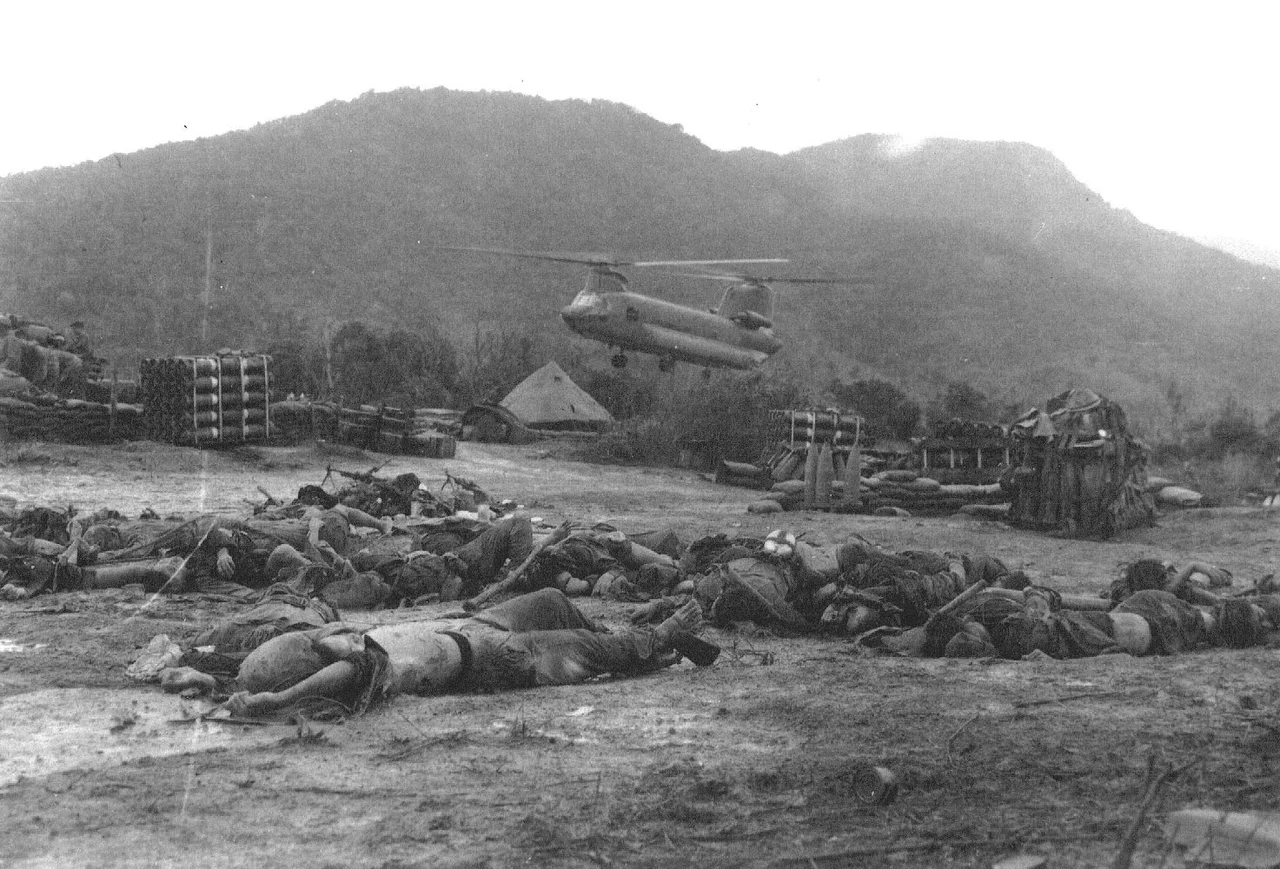
Before dawn, preparatory mortar fire announced what was coming. Then three battalions of the PAVN 22nd Regiment hit the wire simultaneously. They breached the perimeter quickly — too quickly for the garrison to organize a coherent defense at the outer edge — and pushed into the base itself. Enemy soldiers occupied all of the 155mm gun pits and some of the 105mm positions, seizing the most dangerous weapons on the base and using the gun emplacements as fighting positions. The attack had the structure and coordination of a force that had studied the target. The soldiers of B Battery, 2nd Battalion, 19th Artillery, found themselves fighting inside their own base, with enemy troops among their guns. The firebase had become a close-quarters battle.
Beehive at Point Blank
The gunners of B Battery, 2/19 Artillery, made a decision that turned the battle. The remaining 105mm howitzers — the ones not yet taken — were loaded with Beehive rounds: shells packed with thousands of small flechettes, designed for use against massed infantry at close range. The crews depressed the barrels and fired directly into the attacking PAVN troops inside the firebase's own perimeter. It was an act of technical desperation, the kind of thing artillerymen trained to avoid: direct fire at near-zero range, with their own position partly occupied by the enemy. It stopped the attack. Supporting fire from Firebase Pony and the arrival of helicopter gunships completed the PAVN withdrawal. The human cost at Firebase Bird was 27 Americans killed and 67 wounded — more than 60 percent of the defenders. The U.S. estimated 267 PAVN soldiers killed in the attack and the four-day pursuit that followed.
Valor Recognized
In the aftermath, the Army documented acts of courage throughout the fight. Piper and Crain both received the Distinguished Service Cross, the nation's second-highest military decoration. Silver Stars went to Spec. 4 Turnage, Campanella, Staff Sgt. Gregorio Nieto, Spec. 4 Frederick Weidman, and Spec. 4 David Osborne. Five of the soldiers who died also received Silver Stars. B Battery, 2/19 Artillery received a Presidential Unit Citation for its actions that morning. The highest individual recognition went to Staff Sergeant Delbert O. Jennings, who was awarded the Medal of Honor for his actions during the battle. Military historian S.L.A. Marshall — who had made a career of studying what actually happened in battles, as opposed to what after-action reports claimed — wrote a book about Firebase Bird. His account, simply titled *Bird*, documented the fight from the perspective of the soldiers who lived it.
Returned to Jungle
Firebase Bird is gone now. The Kim Son Valley remained contested through the war's end in 1975, and the firebase itself was long since abandoned before the last American troops left Vietnam. Today the site has reverted to jungle — the gun pits, the wire, the command posts, all dissolved into the vegetation of a valley that has been reclaiming such things for decades. Bình Định Province has been at peace for fifty years. The Kim Son Valley is farmland and forest again. Nothing marks the spot where B Battery's gunners depressed their howitzers and fired at point-blank range into the soldiers coming through the wire. The names of the twenty-seven Americans who died there that morning are on the Vietnam Veterans Memorial in Washington. They were young men who had come a long way from home to fight in a valley that has forgotten they were there.
From the Air
Firebase Bird was located in the Kim Son Valley in Bình Định Province, southern central Vietnam, at approximately 14.296°N, 108.888°E. The Kim Son Valley runs roughly east–west between forested ridgelines, opening toward the coastal plain near the South China Sea. From altitude, the characteristic valley-and-ridge terrain of Bình Định's interior is clearly visible — narrow agricultural valleys separated by forested mountain chains. Firebase Pony, which provided supporting artillery fire during the battle, was located nearby in the same valley system. Nearest airports: Phu Cat Airport (VVPC) near Quy Nhon, approximately 40 km northeast; Pleiku Airport (VVPK) approximately 90 km west. Recommended viewing altitude 5,000–7,000 ft MSL. The coastal city of Quy Nhon and its harbor are visible to the east on clear days.
Nearby Stories
- Battle of Mang Yang Pass 7.7 km away
- Camp Radcliff 19 km away
- Kon Tum 33 km away
- Operation Hawthorne 47 km away
- Măng Đen 56 km away
- Vũng Rô Bay 133 km away
- Vũng Rô Bay Incident 163 km away
- Battle of the Paracel Islands 325 km away