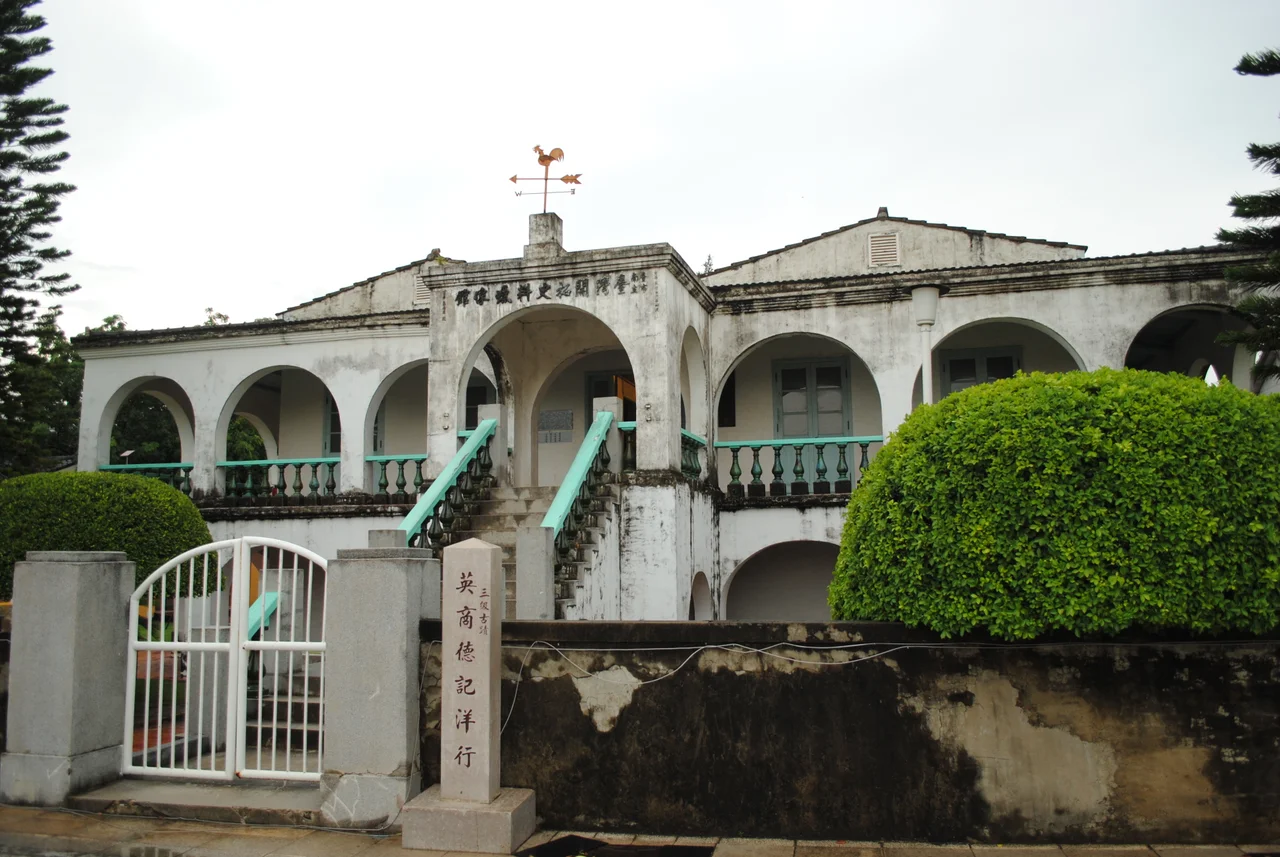

Former Tait & Co. Merchant House
The building at Anping has had more careers than most people. In 1867, it was a merchant house for Tait & Company, a British trading firm that had arrived in Taiwan after the Treaty of Tientsin pried open the island's harbors to foreign commerce. Then it became a Japanese salt company office. Then a Taiwanese government bureau. Then a wax museum. Each incarnation stripped away the previous one's purpose and layered on something new, but the building's white colonial facade has persisted through all of them -- a two-story structure with green-glazed arcade railings that looks like it could have been transplanted from any European trading outpost in Asia.
The Treaty That Opened the Door
In June 1858, the Qing dynasty signed the Treaty of Tientsin in Tianjin, and among its many consequences was the opening of several Taiwanese ports to international trade. Anping, the harbor district of what is now Tainan, became one of them. Foreign merchants flooded in, and Tait & Company -- a firm with deep roots in East Asian commerce -- was among the first to establish operations. By 1867, the company had built this two-story merchant house along with an adjacent warehouse. From here, they managed the export of granulated sugar and camphor, two of Taiwan's most valuable commodities. Camphor, derived from the island's vast camphor laurel forests, was in global demand for pharmaceuticals and the emerging celluloid industry. Sugar moved in bulk. The building was the nerve center of a colonial trade operation that connected Anping's harbor to markets across the world.
Salt, Opium, and the End of Foreign Trade
When Japan took control of Taiwan in 1895, the new colonial government moved quickly to monopolize the island's most profitable trades. Camphor and opium became state enterprises, and foreign trading houses like Tait & Company found themselves squeezed out. The company left Taiwan, and by 1911 its Anping properties had been converted into offices and storage for the Japan Salt Company. The merchant house that had once managed exports to the British Empire now tracked domestic salt production. After Japan's defeat in World War II and the handover of Taiwan to the Republic of China in 1945, the building entered yet another phase, becoming the office of the Tainan Salt Works. Salt, it seemed, was the one constant across colonial transitions.
Wax Figures and Immigrant Stories
In 1979, the building was transformed into the Taiwan Development Historical Materials Wax Museum. The ground floor now tells the story of immigration to Taiwan -- the waves of settlers from mainland China, the indigenous peoples who preceded them, the Dutch and Spanish colonizers who arrived in the 17th century, and the Japanese who governed for fifty years. Upstairs, wax sculptures depict humans, animals, and artifacts from Taiwan's layered history. The building was designated a Class 3 historical site, its western colonial architecture -- designed with a center pathway and three rooms on each side at ground level -- preserved as an artifact of the treaty port era. The upper floor's arcade railing, decorated with green-glazed vase-shaped balusters, reflects the aesthetic preferences of 1860s British commercial architecture adapted to a tropical climate. Next door, the warehouse that Tait & Company built alongside the merchant house has become the Anping Tree House, consumed by a banyan tree over decades of abandonment.
From the Air
Located at 23.00N, 120.16E in the Anping District of Tainan, on Taiwan's southwestern coast. The white colonial building sits adjacent to the Anping Tree House, forming a combined historical attraction. Nearest airport is Tainan Airport (ICAO: RCNN), approximately 8 kilometers to the east. From the air, the Anping historical district is identifiable by its cluster of old buildings near the harbor, including nearby Fort Zeelandia.
Nearby Stories
- Chung Li-ho Museum 0.7 km away
- Jingzaijiao Tile-paved Salt Fields 8 km away
- Wanchin Basilica of the Immaculate Conception 9.3 km away
- Namasia District 16 km away
- Battle of Penghu 21 km away
- Shoushan (Kaohsiung) 21 km away
- Penghu Air Raids 62 km away
- Daya Bay 512 km away