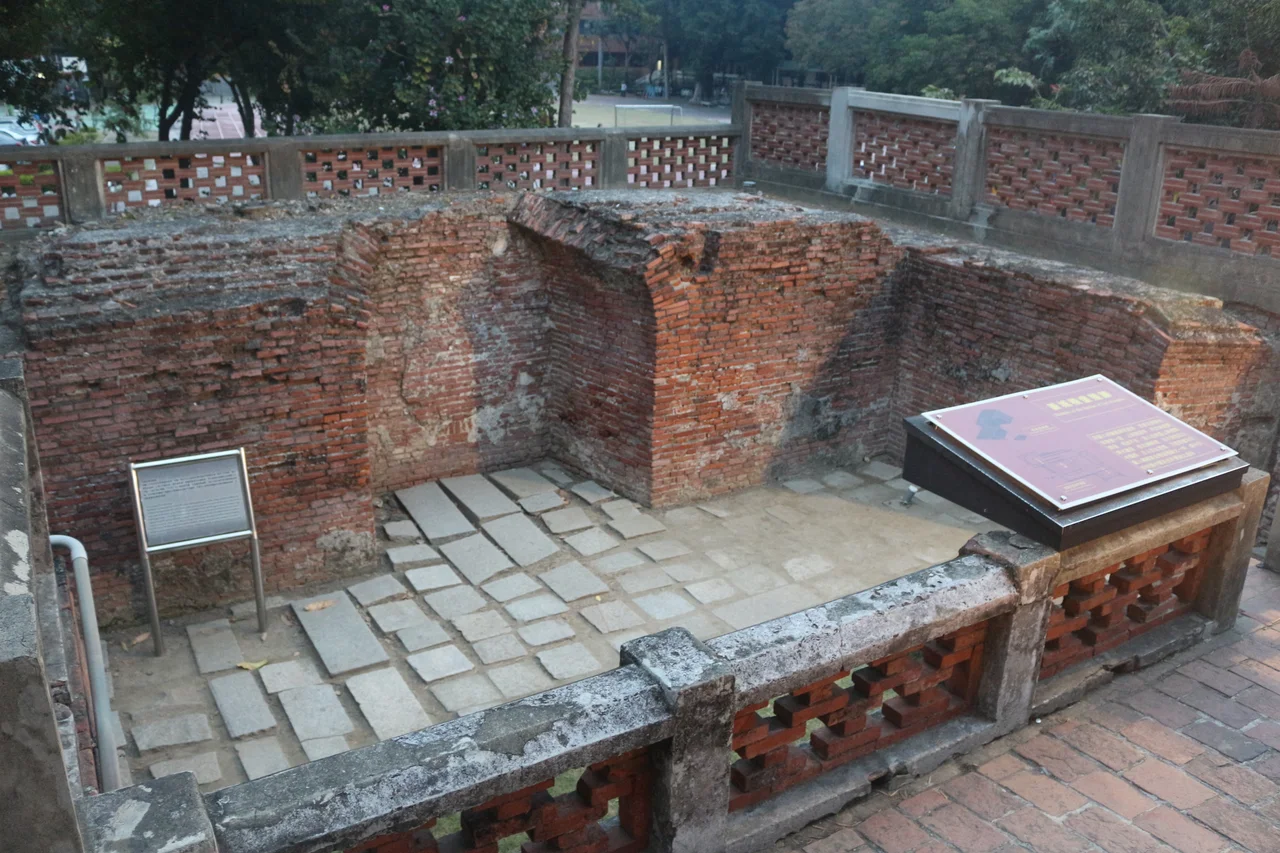

Fort Provintia
The Dutch built it. Koxinga took it. Rebels destroyed it. Earthquakes finished it. The Qing rebuilt it. And now a Taiwanese architecture firm with connections to the Netherlands is redesigning it as a museum -- a fitting symmetry for a fort whose 370-year history keeps circling back to the Dutch. Fort Provintia, better known today as Chihkan Tower, sits in Tainan's West Central District on a site that has been continuously significant since before Europeans arrived. The name Chihkan comes from Sakam, the Taiwanese aboriginal village the Dutch recorded when they chose this location in 1653 to strengthen their colonial foothold on Formosa.
The Village Called Sakam
Before it was a fort, before it was even a town, the site was Sakam -- a village of the Siraya people, the indigenous inhabitants of the southwestern Taiwanese plain. The Dutch East India Company established Fort Provintia about two miles east of their primary stronghold at Fort Zeelandia in Anping, creating a second defensive position that also served as an administrative center. The village grew. Trade expanded. Chinese settlers arrived in increasing numbers, calling the settlement Chhiah-kham and surrounding it with brick walls. It eventually became the capital of the entire island under the name Taiwan-fu. In addition to its architectural significance, the fort's library preserves dictionaries and business transaction documents that record the Siraya language -- a tongue spoken by the region's native inhabitants during Dutch rule that has since fallen silent, making these records among the last written traces of a vanished way of speaking.
Nine Years and a Siege
Fort Provintia lasted nine years under Dutch control. In 1662, Koxinga -- the Ming loyalist warlord, pirate-king, and military genius whose Chinese name was Zheng Chenggong -- laid siege to Fort Zeelandia and demanded the surrender of all Dutch positions on Formosa. Fort Provintia fell to his forces during the Siege of Fort Zeelandia, and the Dutch colonial chapter on Taiwan ended. Koxinga established the Kingdom of Tungning, transforming the former Dutch outpost into the seat of a Chinese-governed state that would last until the Qing dynasty's conquest in 1683. The fort that the Dutch had built to consolidate their power became the foundation of the very state that expelled them.
Earthquakes, Rebellions, and Rebirth
The centuries after Koxinga were not kind to the physical structure. A rebellion in the 18th century damaged the fort, and earthquakes completed its destruction. What visitors see today is largely a 19th-century reconstruction built under Qing rule, incorporating fragments of the original Dutch fortification. Remains of the original walls still stand, visible among the later additions, creating a layered archaeological record that mirrors Tainan's own history -- indigenous, Dutch, Chinese, Japanese, and modern Taiwanese, each era building on and partially obscuring the one before.
Four Hundred Years Coming Full Circle
The fort's latest transformation brings the story back to where it began. The Taiwanese architecture studio HOU x LIN, both of whose founding partners have connections to the Netherlands, is leading a redevelopment project to turn Fort Provintia into a museum. The project was planned for completion in 2024, timed to celebrate four hundred years of the relationship between Taiwan and the Netherlands -- a relationship that began with colonization and trade, passed through war and expulsion, and has arrived at a collaborative cultural project. The architects designing a museum inside a fort built by their predecessors' countrymen, on a site named after an indigenous village whose language survives only in documents preserved within its walls: the layers of history here are not just architectural but deeply human.
From the Air
Located at 22.998N, 120.203E in West Central District, Tainan, on Taiwan's southwestern coast. The fort site is in a dense urban area about 2 miles inland from the Anping coast where Fort Zeelandia stands. Nearest airport is Tainan Airport (ICAO: RCNN), approximately 7 kilometers to the southeast. From the air, the site is identifiable within Tainan's historic district, surrounded by the dense urban fabric of the old city center.
Nearby Stories
- Chung Li-ho Museum 0.7 km away
- Jingzaijiao Tile-paved Salt Fields 8 km away
- Wanchin Basilica of the Immaculate Conception 9.3 km away
- Namasia District 16 km away
- Battle of Penghu 21 km away
- Shoushan (Kaohsiung) 21 km away
- Penghu Air Raids 62 km away
- Daya Bay 512 km away