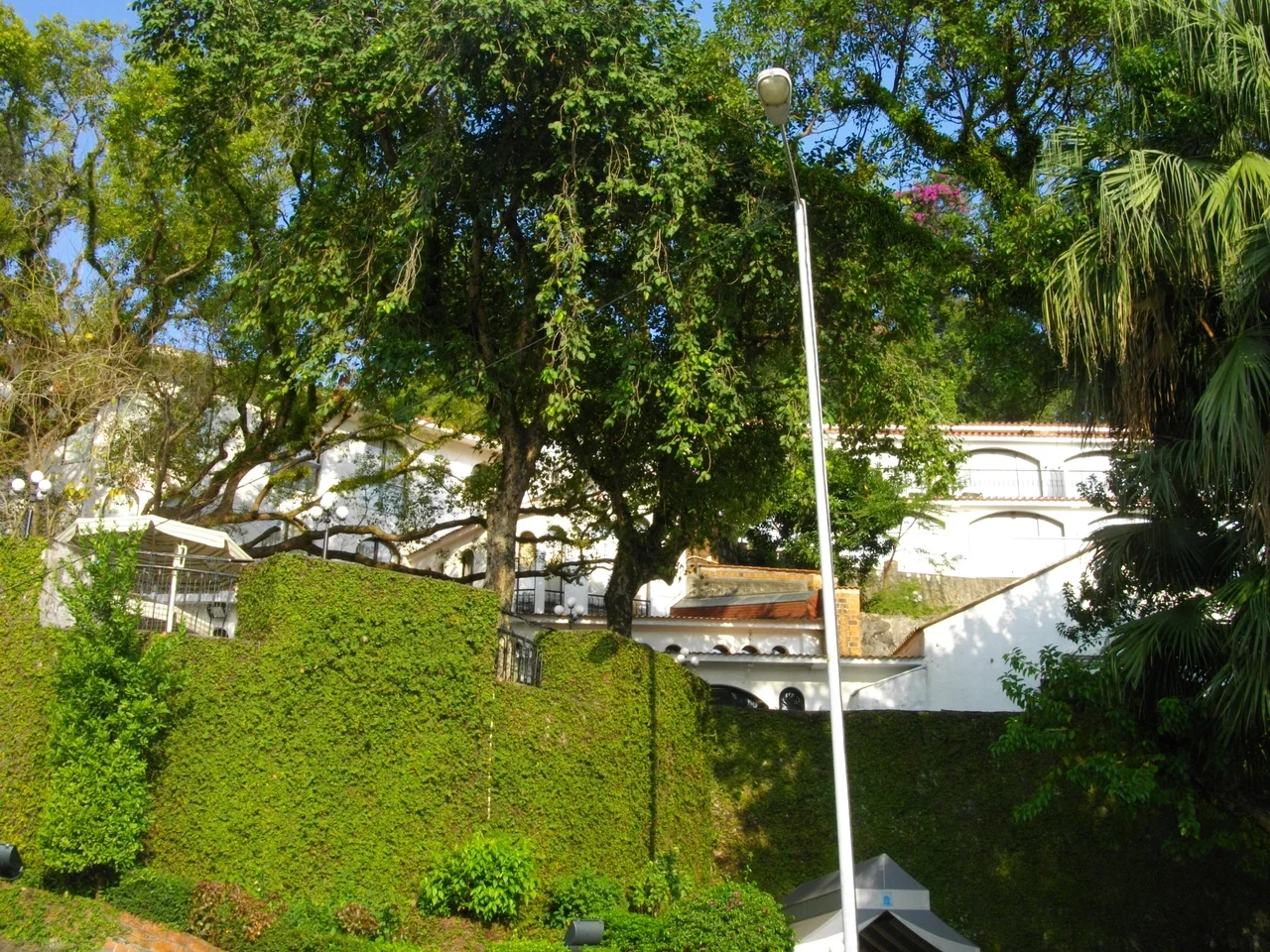

Fort São Tiago da Barra
The legend is stubborn and specific: the statue of São Tiago inside Fort São Tiago da Barra would leave at night to patrol the walls. By morning it would be back in its place — but with muddy boots. Whether the story is devotion, humor, or genuine folklore, it reveals something true about the fort: it has always been understood as something alive, a guardian rather than a ruin. Standing at the base of Barra Hill in southern Macau, overlooking the approaches toward Lapa Island, São Tiago da Barra has been watching the water since 1629.
Cannon and Channel
The fort was built in 1629, on the site of an artillery battery that had been thrown up in the immediate aftermath of the Battle of Macau in 1622 — a Dutch naval assault that the Portuguese repelled, but only barely. The lesson was clear: the inner anchorage needed permanent, serious defense. The Portuguese engineers built low to the water, placing bulwarks and gun platforms close to sea level so that warships passing through the channel would have no room to maneuver. They also blocked much of the channel itself, forcing any hostile vessel to sail directly past the fort's guns. Additional platforms were constructed up the hill to command the higher angles. It was a compact, thoughtful piece of military engineering for its era.
Centuries of Wear
Like most of Macau's colonial fortifications, Fort São Tiago da Barra spent long stretches in quiet decline. The threat from European rivals faded; the fort's strategic purpose diminished; maintenance lapsed. By the time of the Second World War, the old cannon still sitting on the ramparts were not symbols of power — they were an asset that could be liquidated. Portuguese Macau sold them for scrap metal to buy rice for refugees streaming in from Hong Kong and occupied mainland China. It was a practical decision made under real pressure, and it stripped the fort of its most visible military artifacts. The walls remained, but the weapons were gone.
What Visitors Find Today
The fort survived into the present in an unusual form: in 1981, the Portuguese converted it into the Pousada de São Tiago, a boutique hotel of twelve suites built into and around the old military structure. Guests sleep within the fort's thick stone walls, looking out over the Inner Harbour. The chapel inside remains the heart of the site: it holds an image of the Virgin and the statue of the patron saint for whom the fort is named — the same São Tiago said to patrol the walls after dark. In front of the fort stands an armillary sphere, relocated from Senate Square, its brass rings a relic of the Portuguese navigational tradition that brought these colonists to the Pearl River Delta in the first place.
Between Two Empires
Fort São Tiago da Barra is part of the Historic Centre of Macau, a UNESCO World Heritage Site encompassing the layered remnants of Portuguese colonial rule in China. The Barra Hill area, where the fort sits, is one of the oldest sections of Macau — the A-Ma Temple nearby predates the Portuguese arrival entirely, speaking to the much longer Chinese history of the place. The fort thus occupies a border zone: a piece of European military architecture in a Chinese city, now a monument inside a Chinese special administrative region, still watched over by a saint whose boots, according to tradition, are never quite clean.
From the Air
Fort São Tiago da Barra sits at 22.1825°N, 113.5307°E at the southern tip of the Macau Peninsula, at the base of Barra Hill near the A-Ma Temple. From the air, the fort is visible as a low stone structure at the water's edge, just north of the Inner Harbour entrance. The nearby Lapa Island (Wanzai area) provides orientation across the narrow channel to the southwest. Macau International Airport (VMMC) is approximately 6 km to the southeast. Approach from the south at 1,500–2,500 feet for a clear view of the Barra Hill cluster, including the fort, the A-Ma Temple, and the old Inner Harbour waterfront.
Nearby Stories
- 2024 Shenzhen Stabbing 0.8 km away
- Lantau Peak 1.5 km away
- Kweilin Incident 2.4 km away
- Taishan City 7 km away
- Wanshan Archipelago Campaign 38 km away
- Hong Kong 12 68 km away
- Battle of Nanpeng Island 82 km away
- Erhai Lake 1335 km away