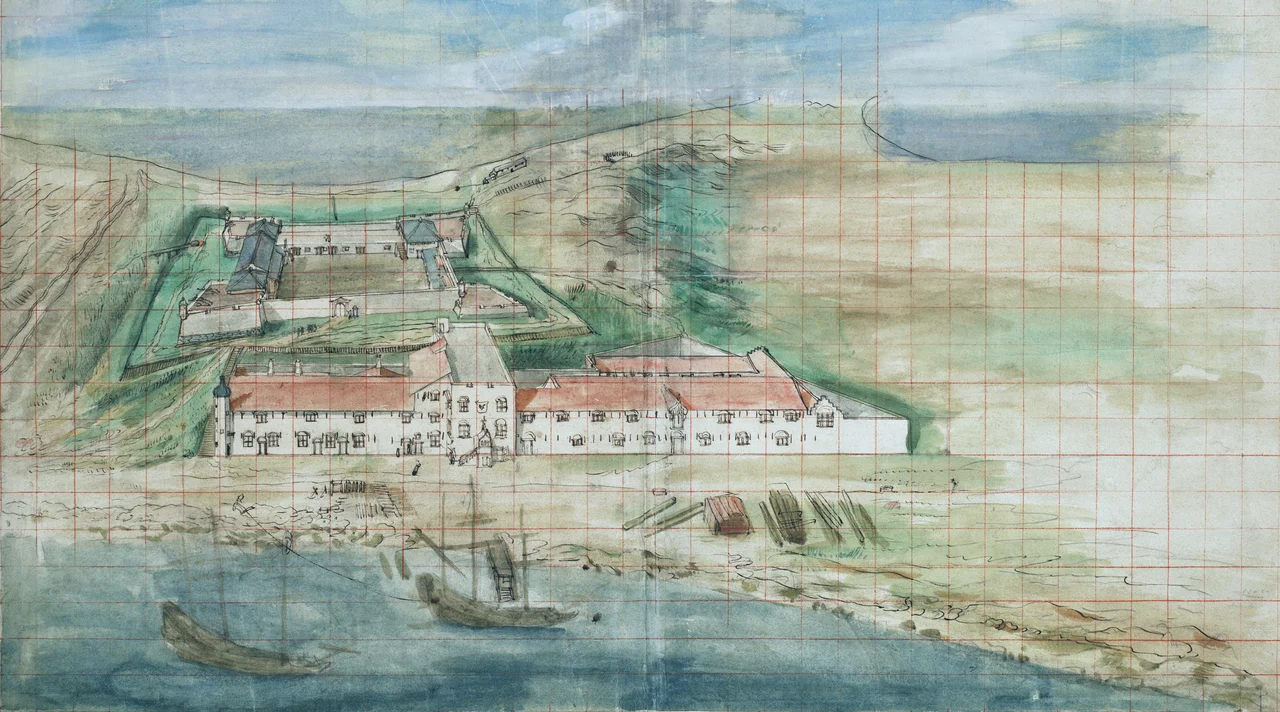

Fort Zeelandia
The mortar that holds Fort Zeelandia together is made of sugar, sand, ground seashells, and glutinous rice. That recipe, carried halfway around the world from Batavia, tells you everything about Dutch ambitions on Formosa: they intended to stay. Built between 1624 and 1634 by the Dutch East India Company on a sandy peninsula at the entrance to Tainan's harbor, the fortress served as the nerve center of a trading empire that stretched from Japan to Iran. From its bastions, the VOC could watch Spanish galleons bound for Manila, intercept Portuguese traders heading to Macau, and manage a lucrative commerce in silk, sugar, and deerskins. For 38 years it worked. Then Koxinga arrived with 25,000 men.
A Fortress Born from Failure
The Dutch did not come to Formosa by choice. In August 1624, expelled from the Pescadores after failing to strong-arm Ming China into a trade agreement, they sailed east under Martinus Sonck and landed at the settlement of Tayouan. They found 25,000 Chinese already living on the island. With no one willing to oppose a well-armed fleet, the Dutch set about building defenses on a raised sandbar overlooking the harbor. The result was Fort Zeelandia, a square, three-layered fortification with protruding bastions at each corner, cannons on the ramparts, and a watchtower at the southwest corner. Bricks came by ship from Java. A second, smaller fort called Fort Provintia went up nearby, and the two exchanged signals from their elevated positions. But for all its solid construction, Zeelandia had a critical weakness: no fresh water. Every drop had to be shipped from the Formosan mainland.
The Trading Crossroads
From Fort Zeelandia, VOC ships could sail north to Japan, west to Fujian, or south to Vietnam, Thailand, Indonesia, Cambodia, India, and beyond. Formosa's strategic value lay not in its own resources but in its position: a base from which the Dutch could harass Spanish and Portuguese commerce while protecting their own. The fort's outer walls enclosed a commercial plaza with residences, a hospital, and a market. Between the fortress and the town proper stood a slaughterhouse, a gallows, an execution ground, and a city weighing station. It was a self-contained colonial outpost where trade and military force were inseparable, and for decades the arrangement made the VOC enormous profits.
Nine Months of Siege
On 30 April 1661, Ming dynasty loyalist Koxinga brought 400 warships and 25,000 soldiers to Formosa. Inside the fort, Governor Frederick Coyett commanded just 2,000 defenders. The siege lasted nine months. Koxinga's initial assaults were repelled by the fort's bastion design, but no reinforcements came from Batavia, and the water supply dwindled. On 1 February 1662, Coyett signed the surrender treaty. The Dutch were permitted to leave with their personal belongings and enough provisions to reach the nearest Dutch settlement. On 9 February, the remaining colonists sailed away, ending 38 years of Dutch rule. The human cost of the siege was devastating on all sides. Among the 1,600 Dutch who perished was the missionary Antonius Hambroek, sent by Koxinga to persuade the garrison to surrender. Hambroek instead urged resistance, then returned to the Chinese camp knowing it meant his death.
Sugar and Seashells Still Standing
Today the site is known in Chinese as Anping Old Fort, a name that strips away the layers of colonial history and replaces them with something more local. The original Dutch bricks, laid in a precise alternating pattern called Dutch bond, are still visible in surviving wall sections. Their ten-day kiln firing produced a solid, compact texture and a deep red color that has weathered more than 390 years of subtropical humidity. A watchtower and a statue of Koxinga now mark the grounds. The fort's inner and outer walls, the bastion corners, and the remnants of the southern fortification remain as physical evidence of a time when European powers, Chinese merchants, Ming loyalists, and Formosan indigenous peoples all collided on a sandy peninsula at the edge of the Pacific.
From the Air
Fort Zeelandia sits at 23.0017N, 120.1609E in the Anping District of Tainan, along the coastline of southwestern Taiwan. From the air, the fort's rectangular footprint and watchtower are visible near the waterfront. Nearby airports include Tainan Airport (RCNN), approximately 5nm to the southeast. Best viewed at altitudes below 3,000 feet for detail of the remaining walls and bastions. The coastal setting with harbor and sandbars is distinctive from above.
Nearby Stories
- Chung Li-ho Museum 0.7 km away
- Jingzaijiao Tile-paved Salt Fields 8 km away
- Wanchin Basilica of the Immaculate Conception 9.3 km away
- Namasia District 16 km away
- Battle of Penghu 21 km away
- Shoushan (Kaohsiung) 21 km away
- Penghu Air Raids 62 km away
- Daya Bay 512 km away