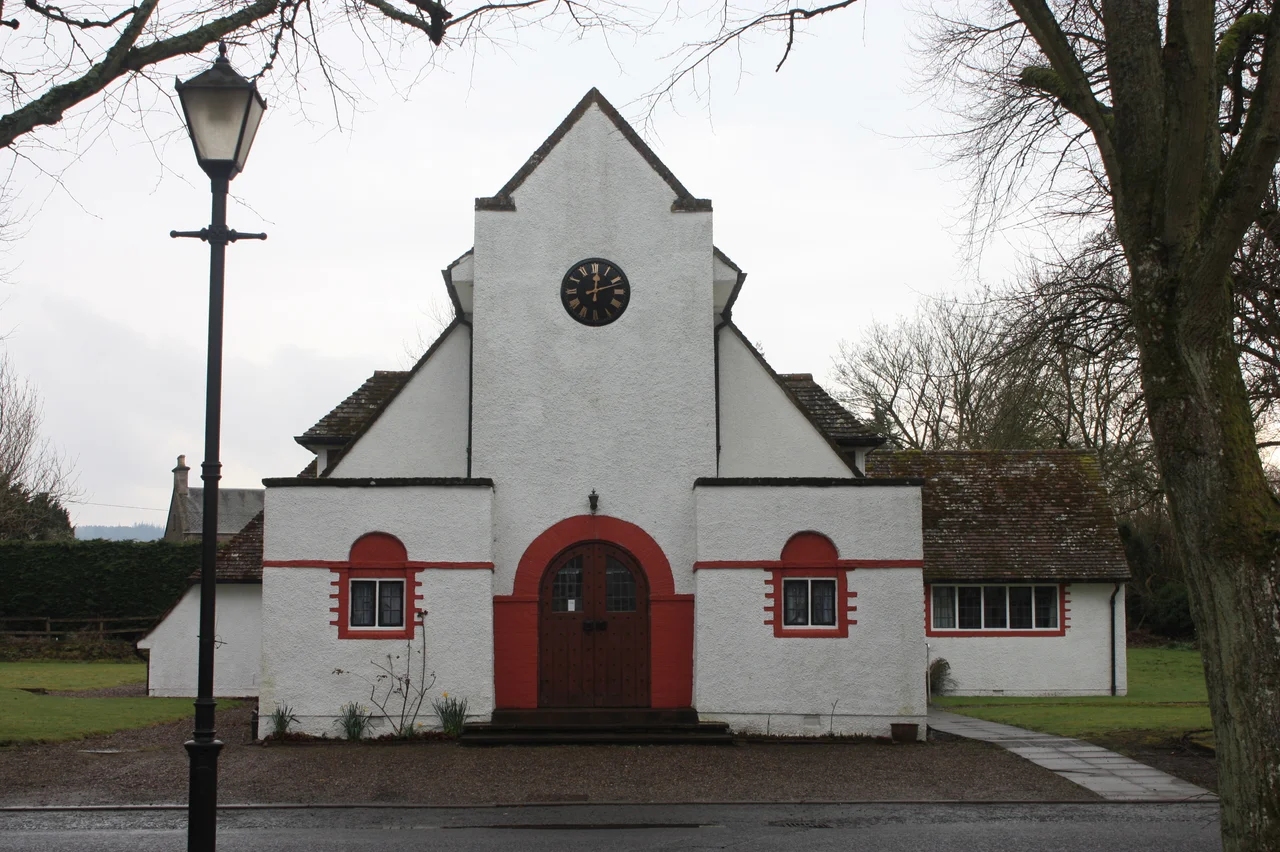

Forteviot
On 11 August 2009, archaeologists working a quiet field in Strathearn announced they had opened a royal tomb from the early Bronze Age. Inside, beside the bones of an ancient ruler, lay a dagger of bronze and gold, a wooden bowl, and a leather bag preserved by the peaty Scottish soil. The discovery confirmed what folklore had long whispered about this small village on the south bank of the River Earn: Forteviot is not just an Edwardian whisky-baron's model village. It is one of the most important royal sites in early medieval Scotland, layered under tidy 1920s cottages so neatly that you could drive through and never know.
A Palace on Haly Hill
By the 9th century, Forteviot was a Pictish royal centre. Kenneth mac Alpin, the king traditionally credited with uniting the Picts and the Scots into a single kingdom, is said to have died in the palace here in 858. The site stood on Haly Hill, a low terrace on the west side of the present village, overlooking the Water of May where it meets the Earn. Nothing of the palace survives above ground, but in the 19th century farmers ploughing the old riverbed turned up the Forteviot Arch, a single block of early-9th-century sandstone carved with human figures. It is the only surviving piece of monumental Pictish royal architecture in Scotland. Today it sits in the National Museum of Scotland in Edinburgh, evidence that the kings buried at Haly Hill once walked beneath carved doorways worthy of any continental court.
The SERF Project
The Strathearn Environs and Royal Forteviot project, run by Glasgow and Aberdeen universities, has spent more than a decade peeling back the layers around the village. They have mapped a vast prehistoric ceremonial complex, a henge older than Stonehenge by some measures, and the elite Bronze Age burial whose contents made headlines. The ruler's grave, sealed under a massive capstone, held that bronze and gold dagger along with personal effects almost never recovered in Scottish prehistoric burials, where acidic soil usually devours organic material. Forteviot's particular geology preserved leather and wood that should not exist. The picture emerging is of a place where authority concentrated for thousands of years before Kenneth mac Alpin's palace, as if every generation in turn recognised this bend of the Earn as a seat of power.
The Whisky Baron's Vision
The village you see from the road today is the work of one man and one architect. John Alexander Dewar, 1st Baron Forteviot of the Dewar's whisky family, hired Glasgow architect James Miller to rebuild the entire settlement in the 1920s as a Garden City model village. Cottages face inward around a square. The village hall, a category A listed building, sits opposite, an eclectic burst of 1920s ornament that looks almost too theatrical for so small a place. The parish church, dedicated to St Andrew, sits in its 1778 Georgian box-chapel form on foundations from the 13th century, with gravestones reaching back to 1690. Several pieces of early medieval Pictish sculpture, salvaged from earlier churches, are preserved inside. The contrast is startling: walk into the church and you stand in three centuries at once, while a thousand-year-old palace lies beneath the field next door.
Hidden in Plain Sight
The genius of Forteviot is its anonymity. The 1991 population was 160. There are no signposted ruins, no visitor centre, no gift shop. The kings of Alba died here, and the place looks like every other tidy Strathearn village. Drive past on a wet afternoon and you might notice the unusual coherence of the architecture, the way the cottages seem deliberately composed, and miss everything else entirely. The ruins of a castle associated with Malcolm III, who reigned from 1058 to 1093, were still visible in the 17th century before time took them. The henge has been ploughed flat for centuries. What remains is the shape of the land itself: the terrace, the river bend, the rising ground where palace stood, all unchanged since people first decided this was the place where kings should live and die.
From the Air
Forteviot lies at 56.34 degrees N, 3.54 degrees W in Strathearn, between Dunning and Perth on the south bank of the River Earn. Recommended viewing altitude 2,000 to 4,000 feet AGL to pick out the village square against the surrounding farmland. Nearest airport is Perth/Scone (EGPT) approximately 8 nm to the northeast. Dundee (EGPN) lies about 25 nm east. The Ochil Hills rise prominently to the south. Best visibility in autumn and winter when low sun rakes the field patterns and the buried henge and burial complex show as crop marks and shadows.
Nearby Stories
- Culross Abbey 4.5 km away
- Inner Tay Estuary 5.8 km away
- Airlie Castle 6.1 km away
- Lochearnhead 6.8 km away
- Pitlochry Festival Theatre 11 km away
- Union Canal (Scotland) 12 km away
- Mugdock Castle 14 km away
- Rannoch Railway Station 24 km away