.jpg)
Foxdale Mines
In 1877 a single set of mines on a small island in the Irish Sea pulled 186,019 ounces of silver out of the ground. The Isle of Man is 32 miles long. Foxdale is roughly in the middle of it, an unassuming village among heather and sheep. Yet for a stretch of the 19th century, what came out of the hill below it competed with Cornwall, Cumbria, and the great Welsh fields. Even with prices crashing at the end, the mines closed because they could be undercut, not because the ore was gone.
A Mineralised Stripe Across the Island
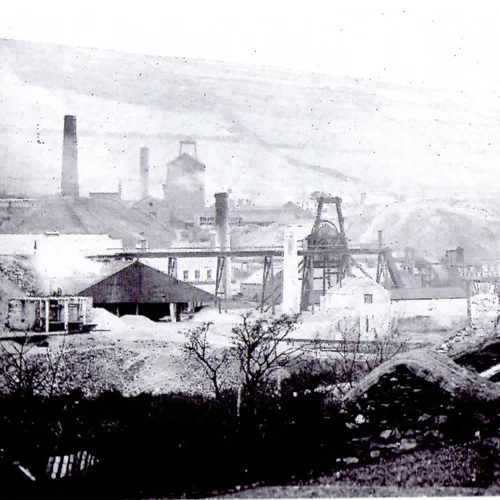
Foxdale is shorthand. The Foxdale Mines were really a chain of shafts and workings running east to west along a highly mineralised zone, from Elerslie Mine at Crosby in the east to Niarbyl on the coast near Dalby in the west. Mining anywhere on the island is old, with evidence of workings at Bradda Head from ancient times, but the recorded story at Foxdale starts in 1724, when Lord Derby granted permission for ore extraction to begin. From there, the operations grew across generations of Manx miners and Cornish migrants who brought the deep-mining know-how the island lacked. The hill above the village still carries the geometry of those workings, even when only ruins and spoil heaps remain.
Silver Years
By the late 19th century Foxdale was a serious operation. 11,898 tons of zinc blende came out in 1875. The 186,019 ounces of silver in 1877 followed soon after. By 1891, the Foxdale Mines produced ore worth £45,200. In 1900 the year's risings amounted to 3,610 tons, yielding £10,800 of profit, an increase of £2,000 on the year before and paying a 7.5 percent dividend. These were Liverpool-managed numbers in Manx hills, listed on share certificates and read out at company meetings across the water. Lead and zinc rode flat-bottomed wagons out of the workings, west and north to the harbour at Ramsey, or south through Foxdale Railway to St John's and on to Douglas. For a stretch of years the mines were genuinely among the richest in the British Isles.
Killed by Geography, Not by the Vein
Foxdale closed because the world got smaller. By the early 20th century it had become cheaper to ship ore from Spain and from Australia than to haul it up from the increasing depths under the Manx hills. Profits thinned. The Isle of Man Mining Company directors told the men that the operation could not continue without a wage cut. On Thursday 6 April 1911 the directors held an extraordinary general meeting at the Law Association Rooms on Cook Street, Liverpool, and appointed a liquidator. The company was wound up voluntarily. On Friday 28 July 1911 the Isle of Man Mining Company ceased operations at Foxdale. The mines were not worked out. The economics had simply moved past them. A small successor company tried to keep going with 22 men working around the clock, but the larger industry never came back.
The Spoil That Outlasted the Industry
Audits of the closed sites found roughly 400,000 tons of lead and zinc spoil heaped at the former pit heads of Laxey and Foxdale. The Beckwith mine, taking its name from William Beckwith, was one of the named workings within the chain. For decades, those spoil heaps were the most obvious sign that anything industrial had happened in this part of the island. The hills above Foxdale were dotted with shafts and tunnel mouths, and the mining village around them quietly emptied. Some of those former workings would have a strange second life. When the Royal Air Force built its base at Andreas in 1940, the Foxdale Railway carried mining spoil north to be used in the new runway. The lead and zinc were never fully done with the island.
Walking the Workings
What survives at Foxdale today is mostly landscape. Engine houses lie ruined among gorse. Stone walls trace foundations of buildings that no living person remembers in use. The 22 miners who held on after 1911 are footnotes in a story that once employed thousands. To stand on the moorland between Crosby and Niarbyl is to walk a corridor of geological luck and human labour. The vein of ore that made this stripe across the island still lies under the hills. So do the men who chased it, the children who packed lunches for fathers who worked underground, and the village that grew up to serve the operation and then, when the cheaper Spanish ore arrived, was left to manage on its own.
From the Air
The Foxdale Mines belt runs east to west across the central Isle of Man, roughly between 54.17°N and 54.20°N, near 4.64°W. From 3,000 to 6,000 ft AGL the line of former workings stretches from Crosby in the east to Niarbyl on the southwest coast. The southern face of South Barrule (1,585 ft) rises just south of the belt, and the village of Foxdale sits in a hollow on its northern slope. Nearest airport is Isle of Man (EGNS) Ronaldsway, about 10 nm to the southeast.
Nearby Stories
- Ballywalter 14 km away
- Pasages (steam trawler) 15 km away
- SS Georgetown Victory 19 km away
- Celtic Array 31 km away
- Raeberry Castle 34 km away
- German submarine U-1051 36 km away
- St Bees Lifeboat Station 49 km away
- PS Rothsay Castle 73 km away