
Franklin Dam Controversy
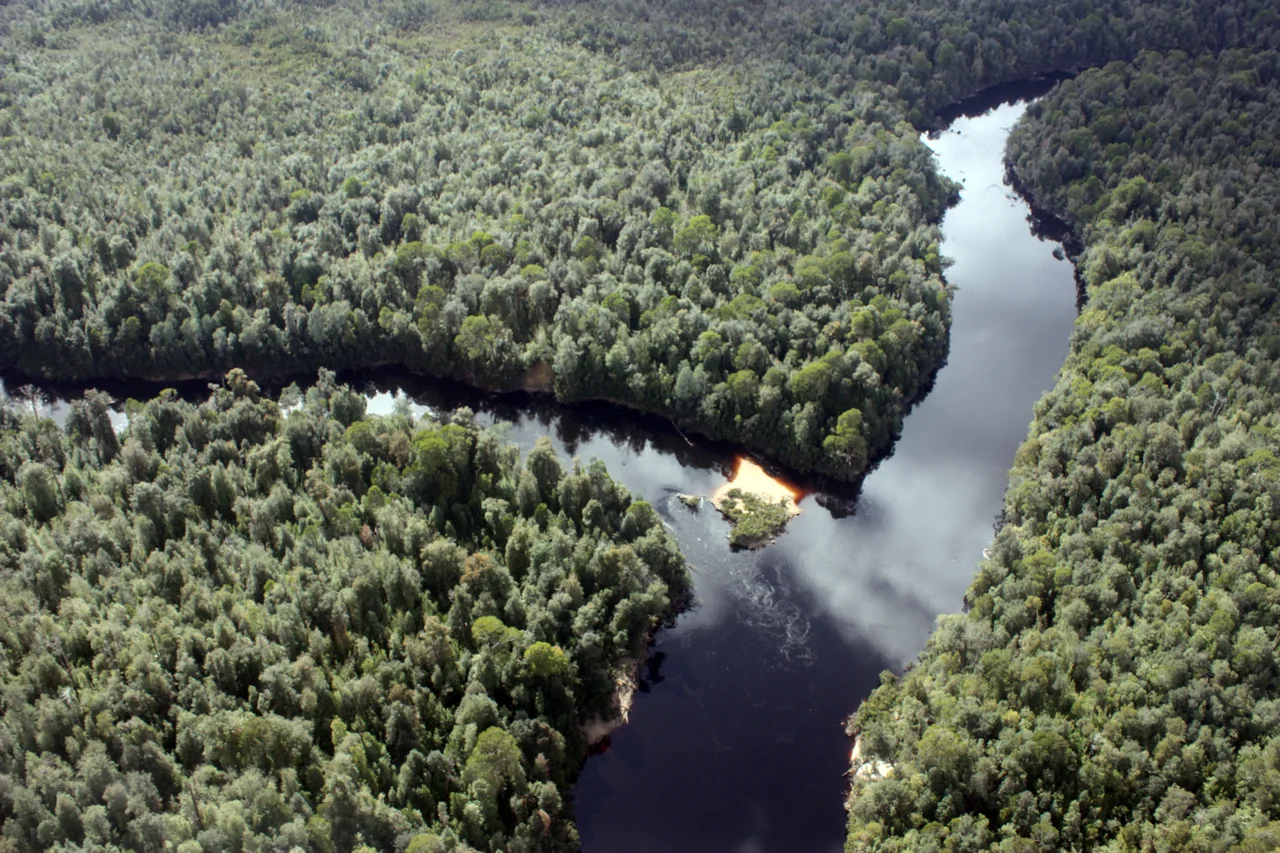
The advertisement asked a question that a whole country found it could not answer the wrong way. On the morning of 2 March 1983, full-page colour photographs appeared in newspapers in Sydney and Melbourne: a curl of river sliding between rainforest and bare rock, soft mist rising off the water. The image was Peter Dombrovskis's Morning Mist, Rock Island Bend, and beneath it ran a line that turned a landscape into a ballot question. "Could you vote for a party that would destroy this?" Three days later, Australians went to the polls. The river in the photograph was the Franklin, in Tasmania's southwest wilderness, and a state-owned utility wanted to drown it behind a hydroelectric dam. It never happened, and the fight to stop it became one of the defining campaigns in Australian history.
A River Worth a Fight
The proposal arrived in 1978: a dam on the Gordon River, below its junction with the Franklin, to generate 180 megawatts of electricity in a corner of the state that badly needed work. Early polls showed about 70 percent of Tasmanians in favour. But the wild rivers ran through country of staggering value, soon to be listed by UNESCO as World Heritage, and a small conservation movement, bruised a few years earlier by the loss of Lake Pedder, began to gather itself again. The Tasmanian Wilderness Society and its allies mounted a campaign built on the photographs of Dombrovskis and his mentor Olegas Truchanas, men who had carried cameras into places almost no one had seen. The campaign drew 30,000 letters of support in a fortnight. In June 1980, an estimated 10,000 people marched through Hobart, the largest rally the state had ever seen.
Deadlock and Defiance
Politics tied itself in knots. The Labor premier Doug Lowe offered a compromise dam further upstream, but the conservationists refused any dam at all, and the upper house refused his compromise, and the whole thing seized up between two houses of parliament that could not agree. A 1981 referendum offered voters a choice between two dams and no option to reject both, so a third of Tasmanians simply wrote "No Dams" across their ballots. When the pro-dam Liberal Robin Gray swept to power in 1982, he ordered the original plan ahead at once and threatened to secede from the Commonwealth if Canberra dared to interfere. Meanwhile, archaeologists working in caves that the rising water would flood found evidence of human life stretching back some 15,000 years, including the site renamed Kutikina at the suggestion of the Tasmanian Aboriginal Centre. The dam would not only drown a river. It would drown an ancient human story.
The Blockade
On 14 December 1982, as UNESCO in Paris prepared to list the rivers as World Heritage, the blockade began at Warners Landing on the Gordon. Around 2,500 people came, from across Tasmania and from overseas, to stand in the path of the machinery. Bulldozers were barged in under police guard. Day after day through the summer, protesters were arrested, until the total reached 1,217, and nearly 500 went to prison for breaching their bail, overflowing the cells of the region. The British botanist David Bellamy was jailed, and the world's press took notice. So was a doctor named Bob Brown, who walked out of prison one day and into the Tasmanian parliament the next, taking a seat in the Assembly that would launch one of the country's most consequential political careers. In February a Hobart rally against the dam drew some 20,000 people. The folk song "Let the Franklin Flow" carried the cause onto the radio.
The River That Won
On 5 March 1983, Bob Hawke's Labor Party won the federal election, having promised to stop the dam, and the question moved from the riverbank to the High Court. Tasmania argued that the environment was a matter for the states, and that Canberra had no constitutional power to intervene. The Commonwealth argued that by signing the World Heritage convention it had taken on an international obligation it was entitled to honour. On 1 July 1983, in the landmark case of Commonwealth v Tasmania, the court agreed by a vote of four to three. The dam was dead, and it has never been revived. The victory reshaped Australian law and Australian politics, but the river itself remains the truest monument: still wild, still running free through its gorge, the mist still rising at Rock Island Bend exactly as it did in the photograph that helped save it.
From the Air
The proposed Gordon-below-Franklin dam site lies in Tasmania's rugged southwest, near 42.38 degrees south, 145.76 degrees east, where the Franklin River meets the Gordon within the Franklin-Gordon Wild Rivers National Park. From the air the country is a maze of forested ridges and deep river gorges threaded with tea-coloured water; the Franklin winds north out of the ranges to join the larger Gordon, which flows west toward Macquarie Harbour. There is no airfield at the site; the nearest is Strahan Airport (ICAO YSRN) on the coast to the west, with Cambridge Aerodrome (YCBG) and Hobart International (YMHB) roughly 90 to 110 nautical miles east. This is among the wettest country in Australia, so cloud, rain, and strong westerlies are the norm and the gorges are often hidden; on a clear day a viewing altitude of 3,000 to 5,000 feet best shows the rivers cutting through the wilderness.
Nearby Stories
- Mount Lyell (Tasmania) 18 km away
- Mount Field National Park 36 km away
- Southwest National Park 37 km away
- Van Diemen's Land 65 km away
- Mount Wellington (Tasmania) 83 km away
- Cape Grim Massacre 174 km away
- Cataraqui 291 km away
- Chatham Islands 3080 km away