
Frans Kaisiepo Airport
The runway began as 2,000 meters of coral crushed into place by Romusha laborers - Indonesian and other Asian workers forced into service by the Japanese occupation during the Second World War. Today that same strip of ground, now stretched to 3,571 meters and renamed for a Papuan independence leader, still hosts the occasional wide-body jet on Biak Island. Frans Kaisiepo Airport has had three names, two air forces, and more history than any airport of its modest size has a right to claim. From Japanese bomber base to Allied forward airfield, from KLM refueling stop to Garuda's Trans-Pacific lifeline to Los Angeles, the runway keeps outliving its own purposes.
The Coral Strip
In 1942, as Japan swept through the Asia-Pacific, engineers chose a flat stretch of land near the village of Ambroben on Biak's southern coast and began building. The Romusha workers - many of them Javanese, Malay, and Chinese laborers forced from their homes - hauled coral and crushed it into a runway forty meters wide. They called it Mokmer Airfield, and for two years it supported Japanese aircraft patrolling the approaches to the Philippines. The workers who survived the construction rarely survived the occupation that followed. When the Allies stormed ashore in May and June 1944, the runway changed hands at the cost of thousands of lives on both sides, and the Royal Australian Air Force inherited a coral strip that had been paid for twice over.
The Stopover at the End of the World
Postwar, Mokmer became something stranger than a military relic. When KLM began its long-haul service from Amsterdam to Tokyo in 1951, Biak was a refueling point in the middle of nowhere - a coral speck just south of the equator where four-engine Lockheed Constellations topped off their tanks before pressing on across the Pacific. The island's isolation was its selling point. Airlines needed somewhere quiet and central, and Biak was both. That era ended in spectacular tragedy on 16 July 1957, when KLM Flight 844 lifted off from Mokmer and crashed into Cenderawasih Bay within minutes. Fifty-eight of the sixty-eight people aboard the Super Constellation died. For a while after, the airport's role as a transit point seemed finished.
Garuda's Hawaiian Bridge
In November 1986, Garuda Indonesia revived the strangest route in the airline's history: Jakarta to Los Angeles, via Bali, Biak, and Honolulu. Four times a week, Boeing 747-200 Combis and DC-10-30s thundered down Biak's runway with enough fuel to cross the Pacific. For travelers, the stop must have been surreal - stepping out of a wide-body jet at a small terminal without jet bridges, surrounded by rainforest, knowing that the next leg would take them to Hawaii. The financial crisis of 1998 killed the route. By the time Garuda pulled the last flight, Biak had been a Pacific stepping stone for nearly half a century.
The Man and His Airport
Frans Kaisiepo, born on Biak in 1921, became the fourth Governor of what Indonesia then called West Irian - a Papuan leader navigating the bruising transition from Dutch colonial rule to Indonesian administration. He died in 1979, and the airport took his name. It sits on Papuan ground, built by forced laborers for a Japanese empire, captured by Americans, handed to Australians, operated by Dutch, then Indonesians - and named, finally, for a Papuan man whose political life tried to give his own people a voice in deciding what came next. The runway is longer now. The terminal handles about 100,000 passengers a year. A mosque, some ATMs, a few souvenir shops. In September 2025, an Airnorth flight from Darwin landed with passengers from Australia, the UK, and the US, reopening Biak to international traffic.
Shared With Manuhua
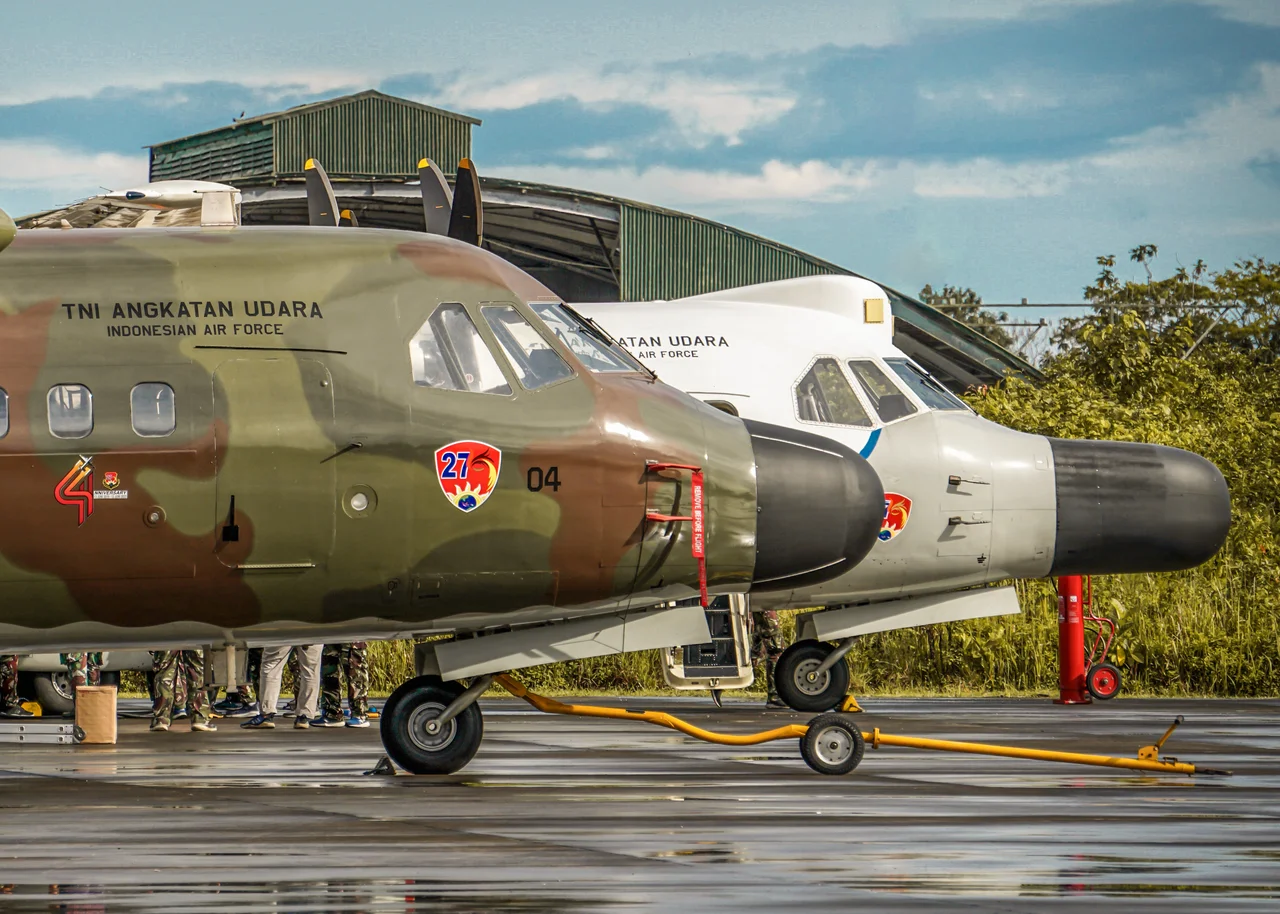
The runway is also a military base. Manuhua Air Force Base, named for Major Lambertus Manuhua - an Indonesian Air Force commando killed during the 1962 Operation Trikora campaign - shares the concrete. The 27th Air Squadron flies CN-235 transports from here. In December 2017, two Russian Tu-95 strategic bombers dropped in for an exercise, prompting RAAF Base Darwin to raise its alert level a thousand kilometers south. For a quiet airfield on a small island, Biak keeps attracting attention from the world's larger powers.
From the Air
Frans Kaisiepo Airport (ICAO: WABB, IATA: BIK) sits at 1.19 degrees south, 136.1075 degrees east, on the southern coast of Biak Island in Indonesia's Papua province. The 3,571-meter runway 11/29 runs parallel to the Yapen Strait coastline. From cruising altitude, look for the distinctive shape of Biak Island in Cenderawasih Bay, with the airport visible as a long east-west stripe near Mokmer village on the south coast. The field is shared with Manuhua Air Force Base. Tropical rainforest climate means afternoon convective activity is common; visibility can drop quickly with equatorial squalls.
Nearby Stories
- 1996 Biak Earthquake 30 km away
- Ambai Archipelago 61 km away
- Numfor: The Island That Spanish Galleons Glimpsed and War Transformed 91 km away
- Mamberamo River 127 km away
- Cenderawasih Bay 128 km away
- Manokwari: Where Empires Came and Went 180 km away
- Mapia Atoll 289 km away
- Mikura-jima 3876 km away