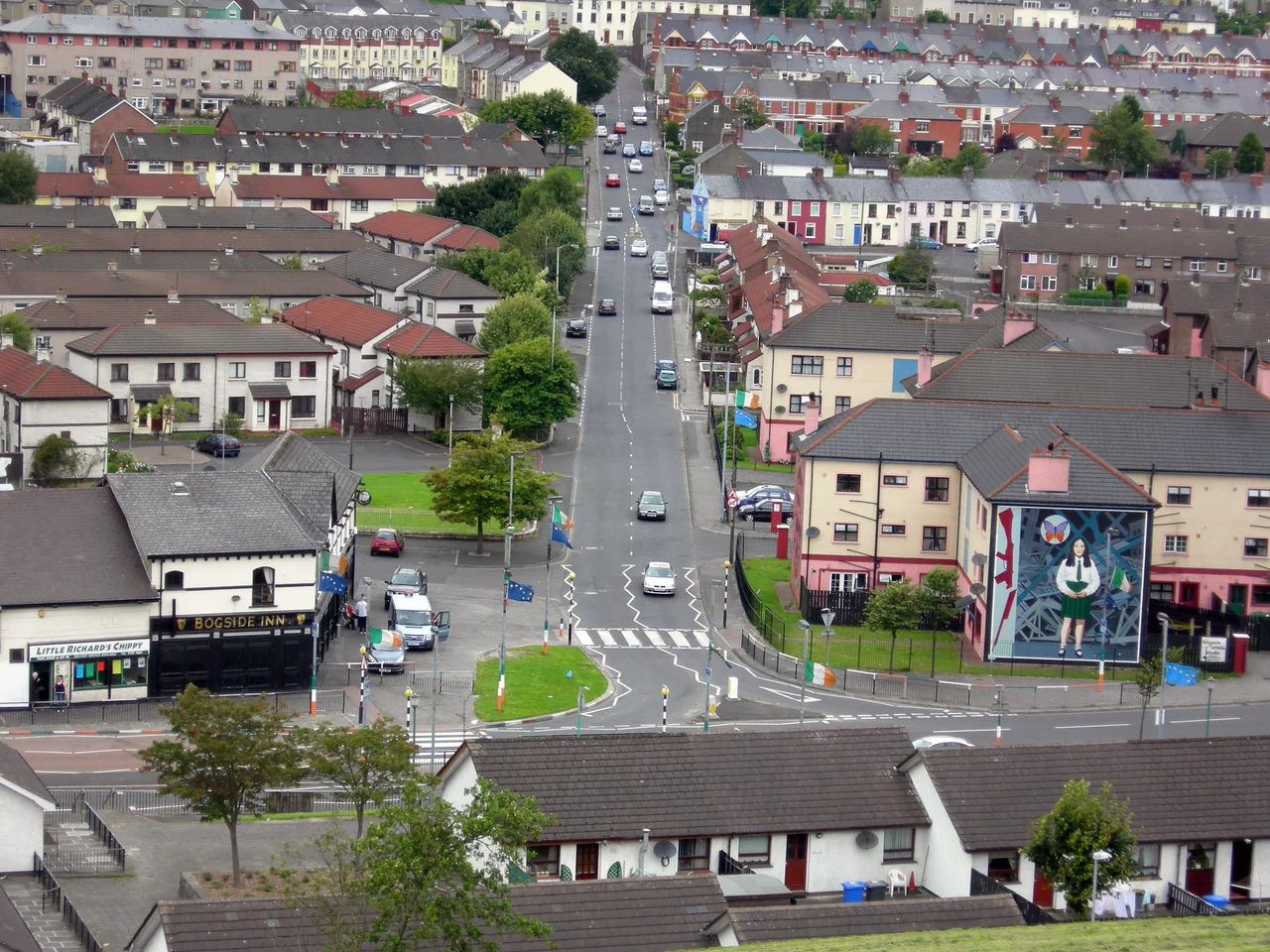

Free Derry
Someone painted the words on a gable wall in January 1969, a few days after Royal Ulster Constabulary officers had made an unauthorised midnight incursion into the Bogside and beaten residents in their homes. 'You are now entering Free Derry.' For years it was assumed John 'Caker' Casey had lettered the slogan; after his death it emerged the painter might in fact have been a young activist named Liam Hillen. Either way, the wall and its message became the most famous square of plasterwork in Ireland. For three turbulent years it marked the boundary of a place that operated, for stretches at a time, beyond the reach of the British state.
Two Thousand Families Waiting
To understand Free Derry, you have to understand the city it grew out of. Derry's population had been majority nationalist since at least the 1920 elections, but the Ulster Unionist Party controlled the local Londonderry Corporation from 1923 onward. They held that grip by gerrymander: the nationalist South Ward returned eight councillors while the smaller unionist wards returned twelve. Only ratepayers could vote, disenfranchising thousands of poorer Catholics. Council housing was denied to nationalists outside the South Ward, concentrating an entire community into a few crowded streets. By the late 1960s there were about 2,000 nationalist families on the housing waiting list - and almost no unionist ones. People lived in slum conditions while empty houses sat in unionist wards. This was the kindling. The Derry Housing Action Committee, formed in March 1968, struck the first match by parking a caravan with a family of four in the middle of the Lecky Road as a protest. Six months later, on 5 October 1968, the RUC batoned a civil rights march in Duke Street. Derry's quiet boiled over.
The Battle of the Bogside
The summer of 1969 brought the Apprentice Boys' parade - an annual unionist commemoration of the 1689 siege, with marchers passing along the city walls directly above the Bogside. On 12 August fighting broke out as the parade reached Waterloo Place. For three days residents fought the RUC across William Street and Rossville Street, throwing stones and petrol bombs while the police fired CS gas - the first time the substance had been used by UK police anywhere. Walkie-talkies coordinated the defenders. Doctors and nurses set up first-aid stations. Women and girls assembled milk-bottle crates of petrol bombs. A clandestine station called Radio Free Derry broadcast to the fighters. On 14 August, with the violence threatening to engulf Northern Ireland entirely, the Stormont government mobilised the feared B-Specials. The British Army arrived at the edge of the Bogside the same day, and the RUC withdrew. The Derry Citizens Defence Association told army officers they would not be allowed into Free Derry until the RUC was disarmed, the B-Specials disbanded, and Stormont abolished. Astonishingly, the army agreed not to enter.
A Place Without Police
For weeks the barricades stayed up. A 'peace corps' of volunteers patrolled the streets and manned the entrances. When the British Home Secretary James Callaghan visited the Bogside on 28 August he came without escort, having agreed not to bring police or soldiers. A surging crowd swept him up Rossville Street into a local house, from whose upstairs window he addressed the people. In preparation for his visit the famous gable wall was repainted white and the 'You are now entering Free Derry' slogan re-lettered in professional black lettering. Eamonn McCann later recalled that punishment for crimes within the area 'as often as not consisted of a stern lecture from Seán Keenan on the need for solidarity'. There was, by every contemporary account, very little crime. By September the barricades had been replaced by a white line painted on the road - a boundary held by neighbours rather than soldiers.
Bloody Sunday
The third Free Derry came after internment without trial began on 9 August 1971. This version was different. The Provisional IRA was now armed, organised, and operating from within the area. The British Army could not enter. The Provisionals, under a young Martin McGuinness, ran a bombing campaign so precise that Eamonn McCann wrote the city centre 'looked as if it had been hit from the air without causing any civilian casualties'. On 30 January 1972, a civil rights march from the Creggan to the city centre was met by soldiers of the 1st Battalion, Parachute Regiment. Both wings of the IRA had agreed to stand down for the day to keep the march peaceful. Some youths threw stones at a barrier on William Street. The paratroopers moved into Free Derry and opened fire, killing thirteen unarmed men and boys. A fourteenth would die of his wounds four months later. All of them lived in Free Derry. The Bloody Sunday memorial stands in Rossville Street where they died.
Operation Motorman
Free Derry ended on 31 July 1972. The Provisional IRA had bombed Belfast on Bloody Friday nine days earlier, killing nine people and injuring 130 in twenty-two devices. Political pressure to retake the no-go areas became impossible to resist. Both IRAs decided not to fight - they could not win a pitched battle against the British Army. Thousands of British troops moved into Free Derry under the cover of darkness with armoured cars and armoured Royal Engineers bulldozers, ripping out the barricades that had stood for nearly a year. After Motorman the army stayed, conducting large 'search' operations as intelligence-gathering and setting up more than a dozen covert observation posts. The Local Government Act of 1972 redrew the electoral boundaries that had kept the Unionists in power for fifty years, and in May 1973 nationalists won a majority on the council for the first time since 1923. The gable wall still stands at the corner of Lecky Road and Fahan Street, repainted by the Bogside Artists over the years but still bearing the same five words. The Museum of Free Derry, a short walk away, keeps the rest of the story.
From the Air
Free Derry refers to the Bogside and Creggan neighbourhoods on the west bank of the River Foyle in Derry, centred near 54.997 N, 7.326 W. The Free Derry Wall stands at the junction of Lecky Road and Fahan Street, immediately below the western city walls. City of Derry Airport (EGAE) lies six miles north on Lough Foyle; Belfast International (EGAA) is sixty miles east-southeast. From altitude, the Bogside is the dense network of streets immediately west of the historic walled city, climbing toward the Creggan hill.
Nearby Stories
- Portrush Lifeboat Station 1.9 km away
- Main Street, Letterkenny 2.1 km away
- Inishowen 6 km away
- Rosguill 6.3 km away
- County Tyrone 7.1 km away
- St Patrick's College, Maghera 9.6 km away
- St Patrick's Purgatory 11 km away
- Coalisland Canal 17 km away