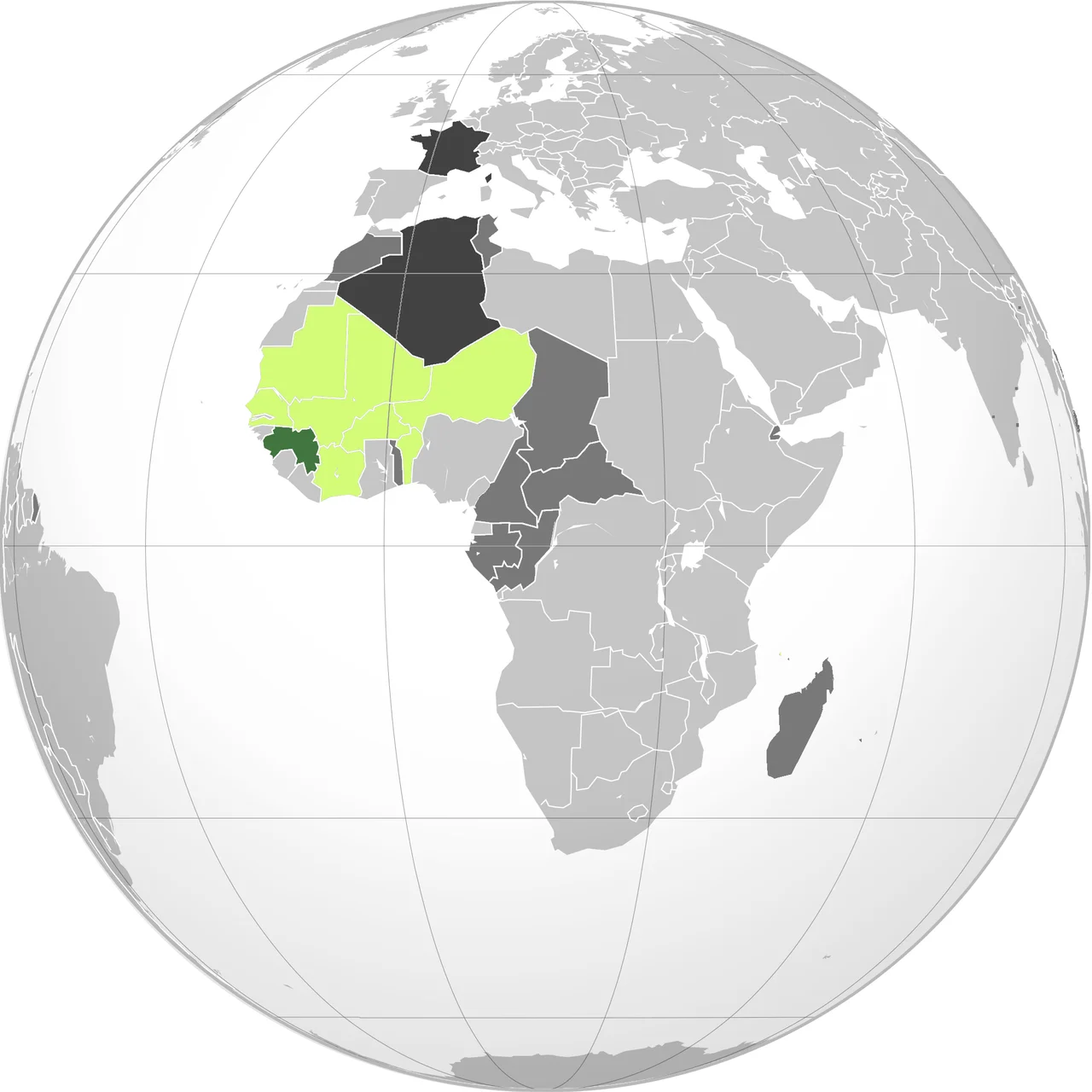

French Guinea
"We prefer freedom in poverty to riches in slavery." When Sékou Touré spoke those words to Charles de Gaulle's face in 1958, he was committing an act of political suicide that became an act of national birth. France was offering its African colonies a deal: vote yes to a new constitution and stay inside the French Community, or vote no and be cut loose entirely. Every territory blinked and voted yes. Guinea alone, this stretch of West African coast and highland that France called French Guinea, voted no.
A Colony Assembled from Pieces
French Guinea was stitched together over decades. Its coastal lands first belonged to the colony of Senegal, then in 1882 were reorganized as a territory called Rivières du Sud, the "Rivers of the South." In 1891 that territory was placed under the colonial authority in Dakar, and in 1894 it was renamed the Colony of French Guinea. A year later it became one of several dependent colonies answering to a Governor-General in Dakar, and in 1904 the whole arrangement was formalized as French West Africa, a federation in which Guinea sat alongside Senegal, Dahomey, Côte d'Ivoire, and others. For half a century, Guinea was a line item in an empire administered from a city hundreds of miles away.
The Day Guinea Said No
On 28 September 1958, the colony went to the polls. De Gaulle had been blunt during his visit: a no vote meant secession, and France would withdraw its money and its administrators. He expected the threat to work, and across Africa it did. But Sékou Touré's Democratic Party of Guinea had campaigned hard for rejection, and the colony voted overwhelmingly, around 95 percent, against the new constitution. Of all France's African territories, Guinea was the only one to refuse. On 2 October 1958, Guinea declared its independence, and Sékou Touré became its first president. A single ballot had turned a colony into a country.
The Scorched Departure
France did not leave gracefully. Stung by Guinea's defiance, the departing administration carried out a vindictive withdrawal that became infamous across the continent. Within months, French officials pulled out almost everything they could move and destroyed much of what they could not. Telephone lines were torn out, medicines and medical files were burned, files and equipment were carried off, and even fixtures in government buildings were stripped. The message was meant to be a warning to any other colony that might consider the same path: independence on your own terms would come at a brutal price. Guinea began its national life nearly bare, a country forced to build from almost nothing.
What the Vote Left Behind
French Guinea ceased to exist in 1958, but its choice echoed for generations. The country kept French as its official language, a thread of the colonial past woven permanently into independent Guinea. Sékou Touré's defiance made him a symbol of African self-determination, even as his own long rule grew authoritarian and harsh. The borders France had drawn became the borders of the modern nation. Guinea's lonely "No" remains one of the defining moments of decolonization in Africa, the instant when one territory chose dignity over security and dared the empire to do its worst.
From the Air
French Guinea corresponded to the borders of modern Guinea, with its colonial capital at Conakry on the Kaloum Peninsula, roughly 9.51°N, 13.71°W. Ahmed Sékou Touré International Airport (ICAO: GUCY) serves the capital today. From altitude the coastline reads as low, green, and river-laced, the old 'Rivers of the South' that gave the early colony its name. The administrative parent city of Dakar, Senegal, lies well to the northwest. Best viewing 3,000-6,000 ft over the Conakry peninsula; clearest in the December-April dry season.
Nearby Stories
- Pongo River (Guinea) 30 km away
- Kindia 60 km away
- Bunce Island 90 km away
- King's Yard 116 km away
- Sierra Leone River 121 km away
- Poilão 182 km away
- João Vieira and Poilão Marine National Park 208 km away
- Rocas Atoll 2601 km away