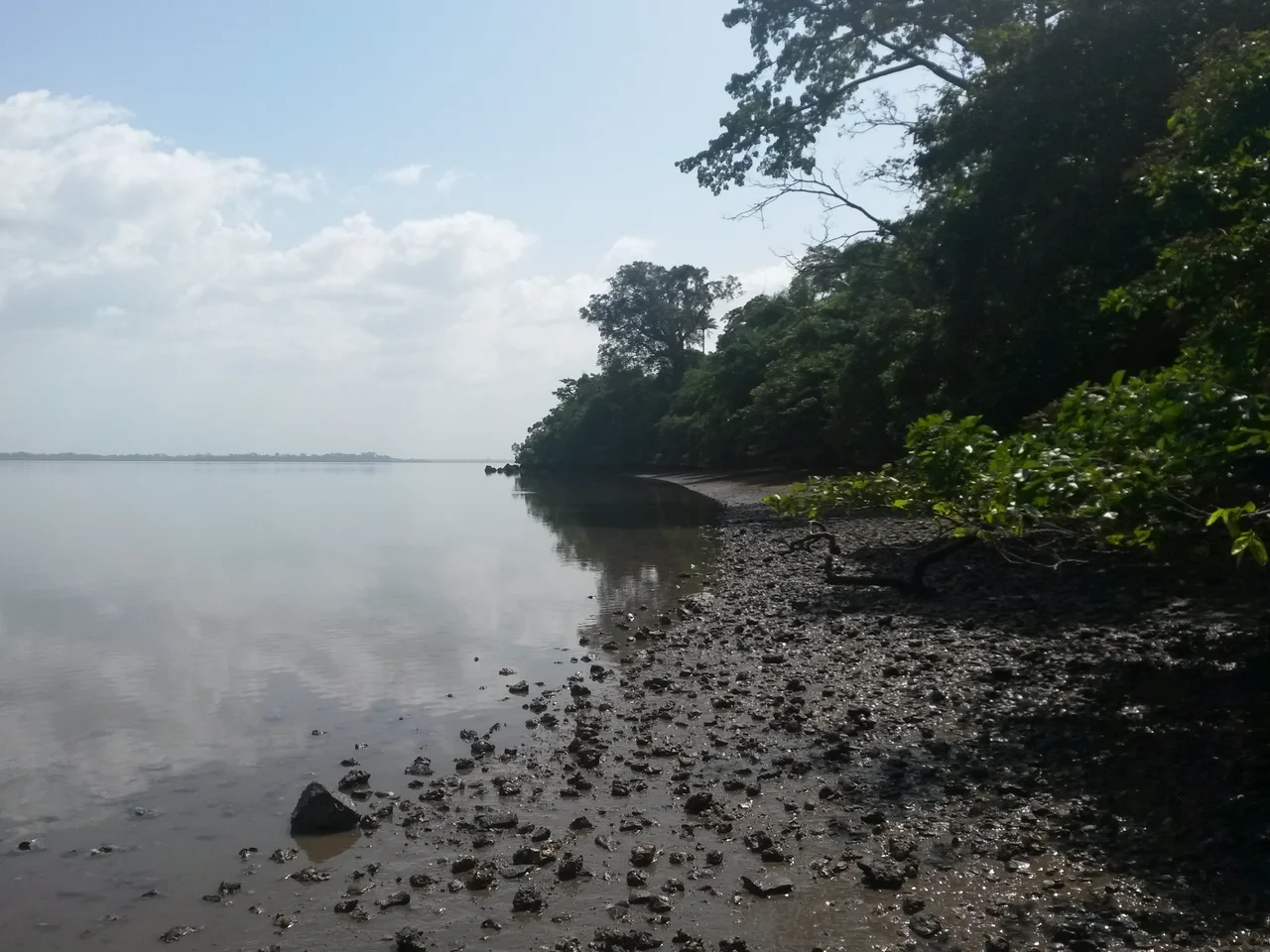

Bunce Island
It is a small island, barely a quarter-mile of crumbling stone and creeper vine, set in the broad estuary where the Rokel River meets the sea. Birds nest in the roofless walls now, and the tide laps at the foundations as if nothing happened here. But something did. From this single island, tens of thousands of West African men, women and children were loaded onto ships and carried across the Atlantic into slavery. Many went to the rice plantations of South Carolina and Georgia. Their descendants are alive today, and many can trace their roots back across the ocean to this exact place.
The Limit of Navigation
Bunce Island sits about twenty miles upriver from Freetown, at the precise point where ocean-going ships could sail no farther inland. That geography made it valuable to people who valued the wrong things. English traders fortified the island around 1670, and the Royal African Company and its offshoot the Gambia Adventurers ran it as a trading post — what the records coldly called a "factory." The castle was never very profitable, and in 1728 it was destroyed in a raid led by José Lopez da Moura, a Luso-African merchant and the richest man in the region. It lay abandoned for years. But the trade did not end. In 1748 the Scottish firm of Grant, Oswald & Company rebuilt it, and Bunce Island entered the chapter for which it is now remembered.
The Rice Coast
The people sold here were not chosen at random. Planters in the South Carolina and Georgia Lowcountry wanted rice, and rice is one of the most knowledge-intensive crops on Earth — when to flood the fields, when to drain them, how to thresh and winnow the grain. The farmers of West Africa's "Rice Coast," stretching from Senegal down to Sierra Leone, had been growing it for centuries. So planters paid premium prices for captives from exactly this region, prizing their expertise even as they denied their humanity. African farmers were seized from inland villages, marched to the coast, and held at Bunce Island or its scattered outposts. They arrived as skilled cultivators. They were sold as property.
Across the Water
Slave ships carried them to Charleston and Savannah, where auction notices openly advertised cargoes from "Bance" or "Bense" Island. The castle's business agent in Charleston was Henry Laurens, a wealthy planter who would later preside over the Continental Congress and help negotiate American independence. In one of history's bitter ironies, the chief British negotiator across the table at the Treaty of Paris was Richard Oswald — the principal owner of Bunce Island, and Laurens's friend of thirty years. The men who built a nation on liberty had, between them, profited from the largest British slave castle on the Rice Coast. Northern ports were entangled too: ships from Newport, New London, Salem and New York called here to take on water, provisions, and people.
The Language You Cry In
Those captives carried something the chains could not take: their farming knowledge, their foodways, their words. On the isolated Sea Islands off Carolina and Georgia, their descendants forged the Gullah culture — a distinct language, cuisine, and craft tradition that survives to this day, and whose roots run straight back to Sierra Leone. The connection is not metaphor. DNA testing has linked Gullah families to specific Sierra Leonean communities, and "homecomings" have reunited their descendants with the homeland. In 1992, General Colin Powell stood among these ruins and spoke of what he felt: "I am an American... but today, I am something more... I am an African too... I feel my roots here in this continent."
What Remains
Britain abolished the slave trade in 1807, and the following year Freetown became a Crown Colony where the Royal Navy established its anti-slavery operations, which would formally become the West Africa Squadron, to hunt down slavers still violating the ban. Bunce Island was put to other uses — a cotton plantation, a sawmill — none successful, and by 1840 it was abandoned to the forest. The walls have been falling ever since. Today the ruins stand as a memorial and an open wound: a place where the human cost of the Atlantic slave trade is not abstract but physical, written in fallen stone above the waterline. Preservation efforts continue, and a museum in Freetown tells the island's story. People come to grieve, to remember, and to find their way home.
From the Air
Bunce Island lies at 8.57°N, 13.04°W in the Sierra Leone River estuary, about 20 miles upriver from Freetown. The nearest airport is Freetown–Lungi International (GFLL), roughly 15 miles to the northwest near the river mouth. From the air the island appears as a small green landmass in the wide estuary, with the ruined castle walls visible near the western tip. Best viewed at low altitude on a clear morning; the estuary is broad and easy to follow inland from the Atlantic coast.
Nearby Stories
- Tombo, Sierra Leone 11 km away
- Mabilafu 50 km away
- Makeni 68 km away
- Îles de Los 75 km away
- Bonthe 83 km away
- Sandervalia National Museum 98 km away
- Loos Islands 106 km away
- Rocas Atoll 2605 km away