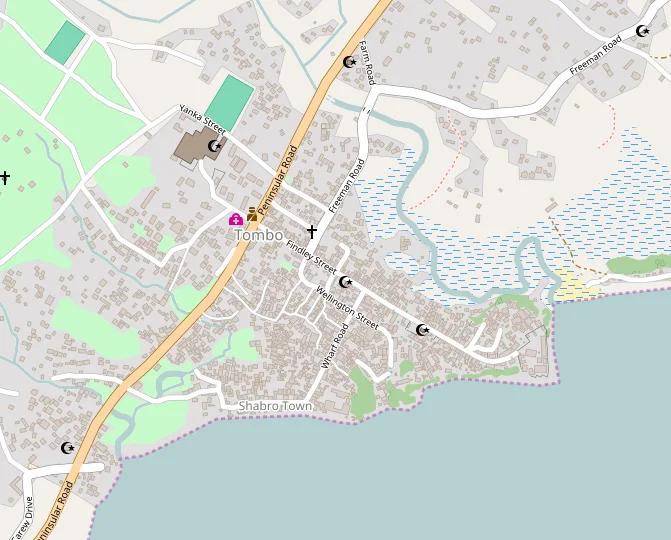

Tombo, Sierra Leone
Before dawn the harbour at Tombo is already loud. Wooden boats nose in heavy with the night's catch, traders shout prices over the slap of water, and the smoke of drying fires hangs over the beach. This is one of the busiest fishing towns on Sierra Leone's coast, a major hub where boats from up and down the shore unload and the catch fans out across the country. Tombo sits on the southern edge of the Western Area Rural District, about 49 kilometers southeast of Freetown, and for five hundred years its fortunes have risen and fallen with the sea.
A Town Built on Fish
Fishing is not just an industry in Tombo; it is the town's reason for being. The harbour functions as a trade and transport hub, drawing fishing boats from across the region and sending fish inland by the truckload. Farming and coal mining add to the local economy, but it is the daily theater of the landing beach - boats, nets, salt, smoke, and bargaining - that gives the place its pulse. Tombo is a cosmopolitan settlement by Sierra Leonean standards, home to Temne, Sherbro, and Limba families living side by side. Many arrived as the fishing economy grew, drawn by the promise of work on the water. In the late colonial era, Temne and Limba traders and fishermen moved down from Freetown, layering new communities over a town that had been almost entirely Sherbro for centuries, and the mix has given Tombo a restless, market-town energy.
Faith, Airwaves, and the Town Head
Tombo is overwhelmingly Muslim, and known for the depth of its Islamic faith - the call to prayer carries over the rooftops as reliably as the gulls. The town runs much of its own affairs: although it falls under the Western Area Rural District council, Tombo elects its own town council led by a directly chosen Town Head. Mohamed D. Mansaray held the post in 2013, and in 2019 Sarah Bah was elected to lead the town. Local life has its own voice, too. Radio Tombo broadcasts on 96.1 MHz, and the Tombo hospital serves the town and the villages around it - the quiet infrastructure of a community that governs and looks after itself.
The Name That History Left Behind
The town was founded by the Sherbro people in the early sixteenth century, generations before any colonial flag was raised here, and its very name is thought to come from the Sherbro word thomboc. But Tombo's history carries a heavier inheritance. In the 17th and 18th centuries the settlement fell under the control of the Caulkers - the wealthy Afro-European dynasty that grew rich on the Atlantic slave trade along this coast. Their influence ran so deep that many Sherbro families in Tombo took the surname Caulker, and their descendants carry it to this day. It is a name worn by ordinary fishermen and traders now, a small, living trace of how the slave trade reshaped even the names of the people whose ancestors lived under its shadow.
Room to Run
Tombo's story is not only a backward glance. In 2008 the Craig Bellamy Foundation - founded by the Welsh footballer - built a football academy here, and it has become a point of pride. Girls and boys train side by side, receiving an international-standard education and elite-level coaching entirely free of charge, a rare door opening onto a wider world. On a coast where opportunity can be scarce, the academy plants a different kind of hope in the same soil that has fed fishing families for five centuries: the idea that a child from a Tombo fishing household might run, study, and dream as far as the ocean reaches.
From the Air
Tombo lies at roughly 8.22 N, 13.10 W on the southern coast of the Freetown Peninsula, about 22 nm south-southeast of Lungi International Airport (GFLL). From the air, look for a dense coastal town fronting a busy harbour crowded with small fishing craft, with the green peninsula hills rising behind it and the Banana Islands offshore to the southwest. Best viewed at 2,500-5,000 ft in dry-season conditions (November-April); the May-October rains bring cloud and haze along this shore.
Nearby Stories
- Freetown Fuel Tanker Explosion 2.5 km away
- Turtle Islands 38 km away
- Bonthe 46 km away
- Mabilafu 55 km away
- Sierra Leone 71 km away
- Îles de Los 114 km away
- Loos Islands 145 km away
- Rocas Atoll 2585 km away