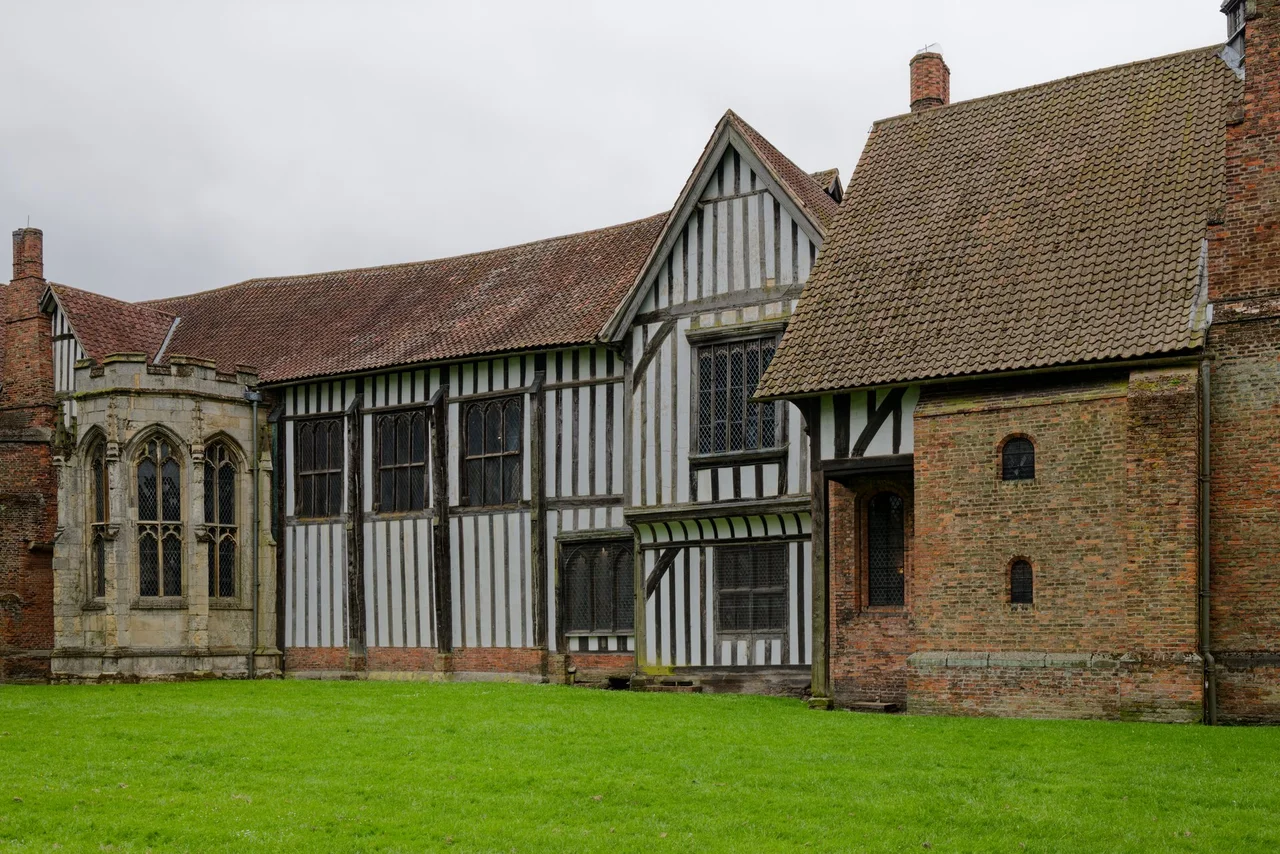

Gainsborough, Lincolnshire
Sweyn Forkbeard, King of Denmark and briefly King of England, died at Gainsborough on 3 February 1014. He had landed here the previous summer with his son Cnut and an army of conquest, defeated the English resistance, driven King Ethelred into exile, and been declared king of the whole country. Then, before he could be properly crowned at the West Saxon capital, he fell ill at his Trent-side encampment and died. He had ruled England for about five weeks. His son Cnut was acclaimed king at Gainsborough by the Danish fleet but had to fight to keep it. Gainsborough, in those few months at the end of 1013 and the start of 1014, was something close to the capital of England.
The Capital That Never Was
The place-name first appears in the Anglo-Saxon Chronicle of 1013 as Gegnesburh - Gegn's fortified place - and in the Domesday Book of 1086 as Gainesburg. It had been a Mercian centre in the Anglo-Saxon period before the Danes came, and its choice as a Viking administrative seat may have had to do with its position near the Danish stronghold at Torksey, on the same side of the Trent. There is a famous and almost certainly apocryphal story that it was here that Cnut staged his demonstration of trying to turn back the tide - or rather, of failing to. Historians who do not dismiss the story altogether suggest the tide in question may have been the Trent Aegir, a tidal bore that races upriver as far as Gainsborough on big tides and would have made a vivid prop for a king trying to instruct his courtiers that even kings cannot command the sea. The story was first written down a century later by Henry of Huntingdon, who placed it nowhere in particular, so the connection to Gainsborough remains a guess. The Aegir still runs.
Pilgrims, Real and Imagined
Non-conformist worship flourished in Gainsborough in the early 17th century. For generations it has been claimed that some of the Mayflower Pilgrims worshipped in secret at the Old Hall before sailing for Holland in 1609, but no firm evidence for that specific connection has been found. What can be documented is that the congregation of John Smyth that met in the town developed into the Baptists, some of whom eventually returned to England. The town remembers all of this with the John Robinson Memorial Church on Church Street, dedicated in 1897 with a cornerstone laid by Thomas F. Bayard, then United States Ambassador to Britain. The church was named for John Robinson, pastor of the group that became the Pilgrim Fathers before they left on the Mayflower. John Wesley, founder of Methodism, preached here several times between 1759 and 1790, and Gainsborough's first Methodist chapel opened in 1788. Non-conformism in this town is not historical decoration. It is the story of a quietly contrary place sending people out into the world.
Civil War on the Trent
In the English Civil War Gainsborough mattered for the same reason it had mattered to Sweyn Forkbeard six centuries earlier: it commanded a crossing of the Trent. The town was garrisoned for the King in January 1643 and used to harass Parliamentary forces by raiding from Newark. Parliament took it on 20 July, lost it again three days later to a Royalist siege, retook it on 18 December, and abandoned it again in March 1644, razing the defences as they left. The Earl of Manchester's army passed through here in May 1644 on its way to the bloody Parliamentarian victory at Marston Moor. Between the second and third Parliamentary captures came the battle that made Oliver Cromwell's name - the action on Foxby Hill in late July 1643 where his disciplined cavalry charge against a Royalist reserve killed Charles Cavendish and announced a new kind of commander. After the war Sir Willoughby Hickman, who held the Old Hall and had been created the first Baronet of Gainsborough by Charles I in 1643, was fined for his Royalist sympathies. The town settled back into trade.
A River, a Mill, a Novel
George Eliot came to Gainsborough in 1859 and stayed in a shipbuilder's house in Bridge Street that still survives as the United Services Club. The town became the basis for St Ogg's in her novel The Mill on the Floss, published the following year. The stone bridge and the willow tree are recognisable, the Old Hall is described, and the great climactic flood that drowns Maggie and Tom Tulliver may have been inspired by Eliot's encounter with the Trent Aegir. Gainsborough at its 19th-century peak was a river port - sometimes claimed as Britain's furthest inland - and the rivertrade left behind a town hall built in 1892, a 90-foot west tower from the medieval church demolished in 1736, and a long industrial history that included Rose Brothers, who invented the world's first packaging machine in 1893. The actor Dame Sybil Thorndike was born here in 1882; the dual carriageway Thorndike Way is named for her. Today the town's population is around 23,000, and the Old Hall, run by English Heritage, is its single most famous building - half medieval timber, half brick tower, and richer in surviving 15th-century detail than almost anywhere else in England.
From the Air
Located at 53.40°N, 0.77°W on the east bank of the River Trent in west Lincolnshire, 18 nm north-west of Lincoln. Nearest airports: Humberside (EGNJ) 23 nm N, Doncaster Sheffield (EGCN) 17 nm NW, East Midlands (EGNX) 47 nm S. From 3,000-5,000 ft the broad bend of the Trent and the town's compact riverside grid are clearly visible, with Foxby Hill rising to the east. The Trent Aegir, on spring tides, races upriver as a visible wave - one of the few tidal bores in Britain, and a striking sight from low altitude when conditions are right. Approach via the A631 from the M180.
Nearby Stories
- Nunnery Colliery 4.4 km away
- Newark Castle 4.5 km away
- Sandal Castle 7.5 km away
- Belper North Mill 8.4 km away
- Flixborough Disaster 12 km away
- Heckington Windmill 13 km away
- Hull Minster 14 km away
- RAF Binbrook 14 km away