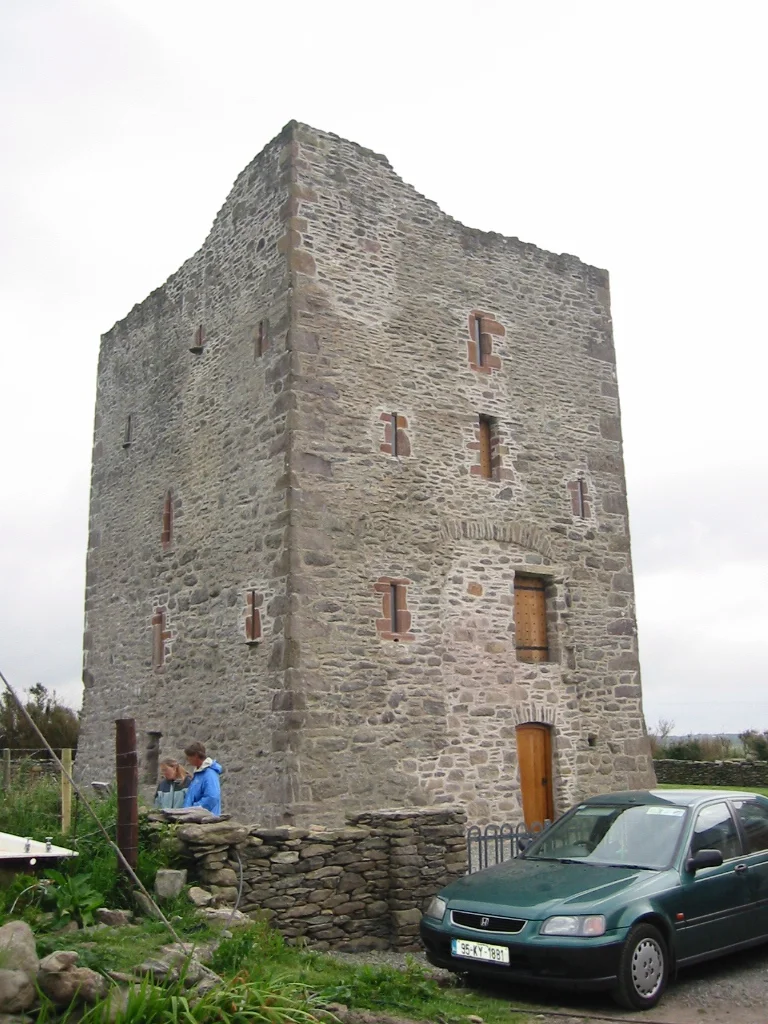

Gallarus Castle
Most of the Dingle Peninsula's fortified buildings are gone. The Atlantic, the Cromwellians and seven hundred years of weather have flattened them or stripped them to grass-grown mounds. Gallarus Castle is one of the few survivors. It rises four storeys above the fields at Baile na nGall, a rectangular stone tower built by the hereditary Knight of Kerry in the 15th century. A kilometre to the west sits Gallarus Oratory, a small drystone chapel that gets all the attention. The castle is the older brother who stayed home, unloved by the guidebooks, still pulling itself upright six hundred years later.
The Knight of Kerry
The Knight of Kerry was no ordinary title. Hereditary knighthoods are rare in the British Isles - rarer still in Ireland - and the holders belonged to the Geraldine dynasty, the great Norman-Irish FitzGerald family that controlled Munster for centuries. The title was conferred by the Earl of Desmond, the family's senior branch, on a kinsman who held land in the far west. It passes by primogeniture to this day. The 15th century, when Gallarus Castle was built, was the FitzGerald high tide. They were a self-confident lordship at the edge of the world, building tower houses across Kerry as both residence and statement: we are here, we are armed, we are not leaving.
Tower House Architecture
An Irish tower house is a fortified residence in a single vertical stack - a defensive ground floor, living quarters above, sleeping chambers at the top. Gallarus Castle has four storeys, with vaulted ceilings on the third and fourth floors. A mural stairway is built into the thickness of the east wall, climbing in a tight spiral inside the masonry itself. Curiously, no evidence survives of a stone stairway below the second floor. The original entry was probably by a ladder that could be pulled up in moments of trouble, leaving the ground floor as a windowless stone shell that no attacker could quickly breach. The walls are thick. The windows are narrow. Every architectural decision serves the same goal - keep the people inside alive when the people outside arrive uninvited.
Restoration and Compromise
The castle as you see it today is a restored building. A new rectangular doorway has been inserted in the north wall, more useful for tourists than for medieval defenders. Other interventions have stabilized walls that were threatening to slump after centuries without a roof. Heritage restoration in Ireland operates under tension: do you put the building back the way it was, or do you keep its weathered look and just stop it falling down? Gallarus Castle splits the difference. The bones are original. The detail work is honest about what is new. The result feels like neither a museum mockup nor a Romantic ruin, but a tower house that has been allowed to stay standing on terms it can live with.
A Kilometre from Fame
About a kilometre west, across rough pasture and a low rise, sits Gallarus Oratory - the small, perfect drystone chapel that draws coach tours and academic monographs in roughly equal measure. The oratory is the famous building. The castle is the one most visitors never quite reach. The juxtaposition is the kind of accident that makes Irish landscape feel layered. A medieval secular fortification built by a Norman-Irish knight stands within sight of an early Christian religious building constructed by anonymous monks, separated by a kilometre and possibly seven centuries. Neither building was planned with the other in mind. Both are simply still here, sharing a field, doing nothing in particular except being old together.
What Survives
Few fortified structures on the Dingle Peninsula made it through the Cromwellian wars of the 1640s and 1650s, the Williamite confiscations of the 1690s, or the long centuries of agricultural improvement that followed. Most tower houses were pulled down for their stone, their lime burned for fields, their carved details broken up and used to build the small farmhouses that now occupy the same land. Gallarus Castle survived because it was lived in, then because it was useful as a barn or storehouse, then because nobody quite got around to demolishing it, and finally because the Irish state decided fortified buildings of the 15th century were worth keeping. It is now an Irish heritage site, owned and maintained by the National Monuments Service. The Knight of Kerry's tower has outlasted the Knight of Kerry's relevance, and that is exactly the kind of victory medieval architecture knows how to win.
From the Air
Gallarus Castle sits at 52.176°N, 10.356°W in the townland of Baile na nGall (Ballynagall), about 7 km west-northwest of Dingle town. The four-storey rectangular tower stands prominently above surrounding pasture and is visible from low altitudes, especially against open green fields with no other tall buildings nearby. The nearest airport is Kerry (EIKY) about 42 nautical miles east near Farranfore. For visual identification, descend below 2,000 feet AGL and look for the tower roughly 1 km east of Gallarus Oratory - the two monuments make a useful pair from the air. Atlantic weather rolls in fast; expect crosswinds along the Smerwick coast just to the north.
Nearby Stories
- Ballyheigue Castle 1 km away
- Killemlagh Church 2.8 km away
- Pouldergaderry Sinkhole 6.8 km away
- Derreen Garden 11 km away
- Kilkee 59 km away
- The Laki Eruption: The Volcano That Changed World History 1366 km away
- The Northern Lights: The Sky Show That Vikings Thought Was Bridge to the Gods 1469 km away
- Sao Miguel 1935 km away