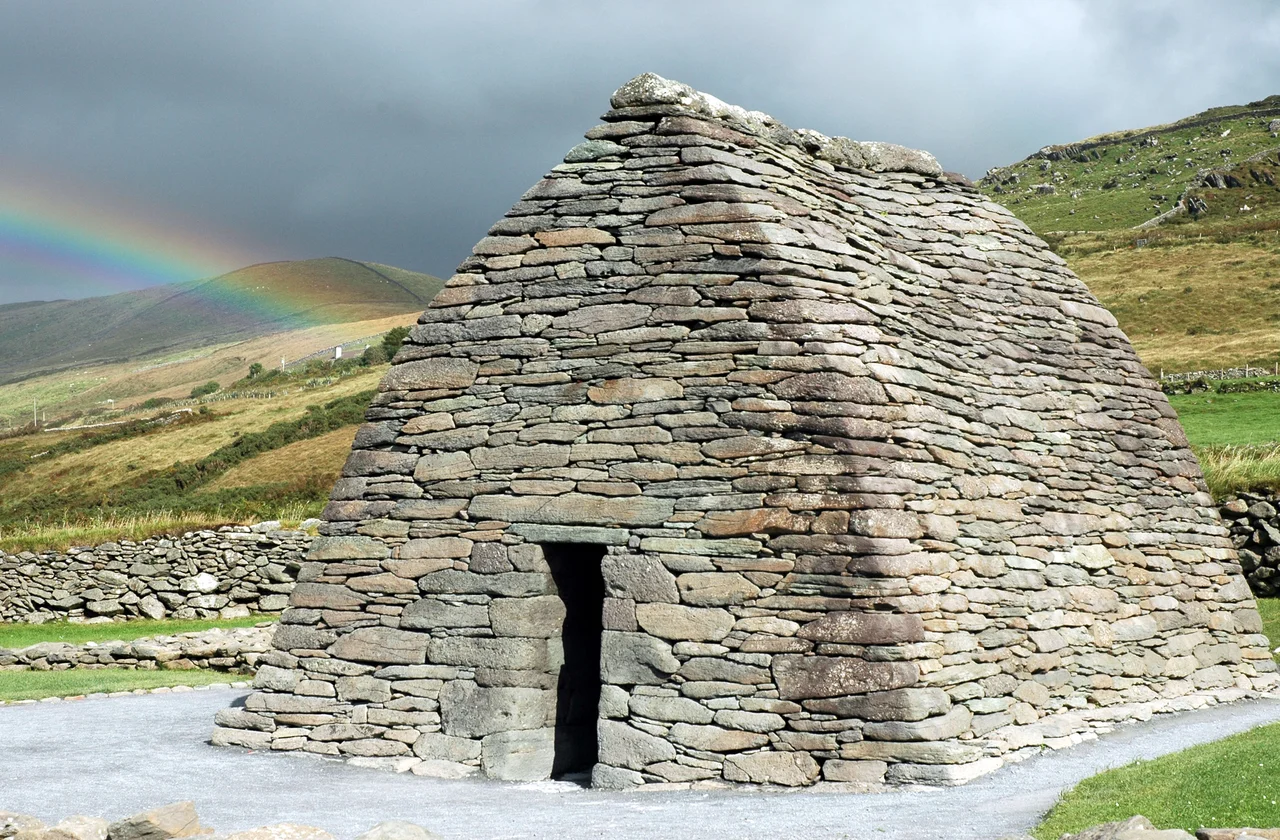

Gallarus Oratory
The roof is the proof. Heavy Atlantic rain blows against the south wall of the Gallarus Oratory and runs off down stones that overlap each other in tiny calibrated steps - a corbelled vault built without a single arch, with very little mortar, by people whose names we will never learn. Inside, the floor stays dry. It has stayed dry for centuries, by some estimates a thousand years. The oratory is the only intact specimen of its kind anywhere, a small drystone chapel shaped like the inverted hull of a boat, sitting in a field of the Dingle Peninsula as though nothing important is happening. Nothing important is happening. That is exactly the point.
An Upturned Boat in a Field
The oratory is small enough to walk around in a minute. The east and west gables converge into the roof in a single sweep, the side walls curving inward from base to ridge so that the building looks - everyone says it - like an upturned boat hauled up on land. The walls are four feet thick at the base. The stones, cut from the Dingle Beds of Upper Silurian Old Red Sandstone, are dressed on every face and laid in courses that slope very slightly downward to shed water. Inside, a single round-headed window in the east wall lets light fall on what would once have been a small altar. A narrow door, square-headed, opens to the west. There is no other ornament. The geometry is the ornament.
How Drystone Survives a Millennium
Drystone walls, built without mortar, are not supposed to outlast empires. They are supposed to be field boundaries that lean and gap and need annual mending. So how does an entire vaulted building, built largely without mortar, stay watertight for centuries? The technique is called corbel vaulting. Each course of stones projects a little further inward than the one below, the way a child stacks blocks to make a tunnel. The Gallarus stonemasons added two refinements. First, they cut each stone to slope slightly downward on the outside, so that water running across the wall ran out rather than in. Second, recent analysis shows they used a thin layer of lime mortar inside the wall as a hidden binder, even though the wall faces remain mortarless. The result is a structure that breathes, sheds water and stands. The same techniques are still used by the farmers of Dingle to build agricultural clocháns today, on a much smaller scale.
How Old Is It, Really?
Nobody is sure. The antiquarian Charles Smith, who 'discovered' the oratory in 1756 and described it in his book on County Kerry, called it an early Christian church and said it might be as old as the 7th or 8th century. For two centuries that was the accepted view. Then in 1970 the archaeologist Peter Harbison upended things, arguing the oratory could date to as late as the 12th century. His evidence included the east window's rounded head, made of two carved stones rather than a true arch - a feature he thought more consistent with later Romanesque building. By 1994 Harbison had moved again, abandoning the 12th-century church idea and proposing instead that the building was a shelter for pilgrims travelling the Saints' Road to Mount Brandon. Trial excavations in November 1970 turned up nothing dateable. The chapel keeps its secret.
What the Name Says
Even the name is contested. The archaeologist Peter Harbison thought Gallarus came from Gall Aras, meaning 'the house of foreigners' - pilgrims from outside the peninsula, sheltering on their way to climb Mount Brandon. The lexicologist Pádraig Ó Siochfhradha, known by the pen name An Seabhac, disagreed. He read the name as Gall-iorrus, 'rocky headland,' a straightforward topographic description. Local tradition in Charles Smith's time told yet another story - that the chapel was built by or for one Griffith More, as a funerary chapel for his family burial place. An English traveller named Richard Pococke, who visited the oratory two years after Smith publicized it, was shown a grave nearby that locals called 'the tomb of the Giant' and identified with this Griffith More. Three different etymologies, three different histories. The oratory has outlasted all of them and acquired none of them.
The Saints' Road
Less than three hundred metres from the oratory runs the Cosán na Naomh - the Saints' Road - an ancient pilgrimage route that climbs to the summit of Mount Brandon, the great pyramidal peak that rises northeast of the chapel and is visible behind it in every photograph. Mount Brandon was sacred long before Christianity reached Ireland. After Christianity arrived, the mountain was claimed by Saint Brendan the Navigator, the 6th-century monk who is said to have sailed from this peninsula in a small leather boat in search of the Land of Promise. Pilgrims have climbed the mountain in his name for at least a thousand years. The Gallarus Oratory may have been their resting station - a place to pray before the ascent, a place to shelter when the weather closed in. Whether it was built for that purpose or simply borrowed for it, the chapel and the mountain share a single horizon line.
Just Standing There
What is striking, walking up to the Gallarus Oratory in person, is how modest it is. It is taller than you think when you see photographs - perhaps fifteen feet at the ridge - but it is small enough that an outstretched arm reaches across the doorway. The slight sag in the northern roof slope, accumulated over centuries, is visible if you know to look for it. Otherwise, the building has the unflustered air of something that finished its job a long time ago and has not been asked to do anything since. It does not advertise. It does not interpret itself. It is simply a small stone vault, four feet thick at the base, completely watertight after roughly a thousand years, sitting in a field on the Dingle Peninsula and waiting for the next visitor to come and notice.
From the Air
Gallarus Oratory sits at 52.173°N, 10.349°W on the Dingle Peninsula, about 1 km west of Gallarus Castle. Together the two monuments make a useful navigational pair from the air. The oratory itself is small - roughly the size of a single-car garage - and best identified by its position overlooking Smerwick Harbour (now called Ard na Caithne) with Mount Brandon rising prominently to the northeast. The nearest airport is Kerry (EIKY) about 42 nautical miles east near Farranfore. For sightseeing, descend below 1,500 feet AGL and use Mount Brandon as your visual anchor; the oratory is in the field landscape below the mountain's southwestern slopes. The Atlantic weather here is fast-changing - check Brandon's summit visibility before committing to a low pass.
Nearby Stories
- Ballyheigue Castle 1 km away
- Killemlagh Church 2.8 km away
- Pouldergaderry Sinkhole 6.8 km away
- Derreen Garden 11 km away
- Kilkee 59 km away
- The Laki Eruption: The Volcano That Changed World History 1366 km away
- The Northern Lights: The Sky Show That Vikings Thought Was Bridge to the Gods 1469 km away
- Sao Miguel 1935 km away