
Gardens of Monticello
Thomas Jefferson kept a book called the Garden Kalender, and in it he recorded triumphs and failures with the same patient hand he used to draft the Declaration of Independence. The empress tree from China. The pattypan squash. The vines coaxed up from the Mediterranean. Monticello's gardens were less a flourish of beauty than an open-air laboratory, and from 1808 to 1812 - during the final year of his presidency and the first years of his retirement - Jefferson directed an experiment in horticulture that ran across a thousand-foot terrace cut from the side of a Virginia mountain.
A President's Mountain Garden
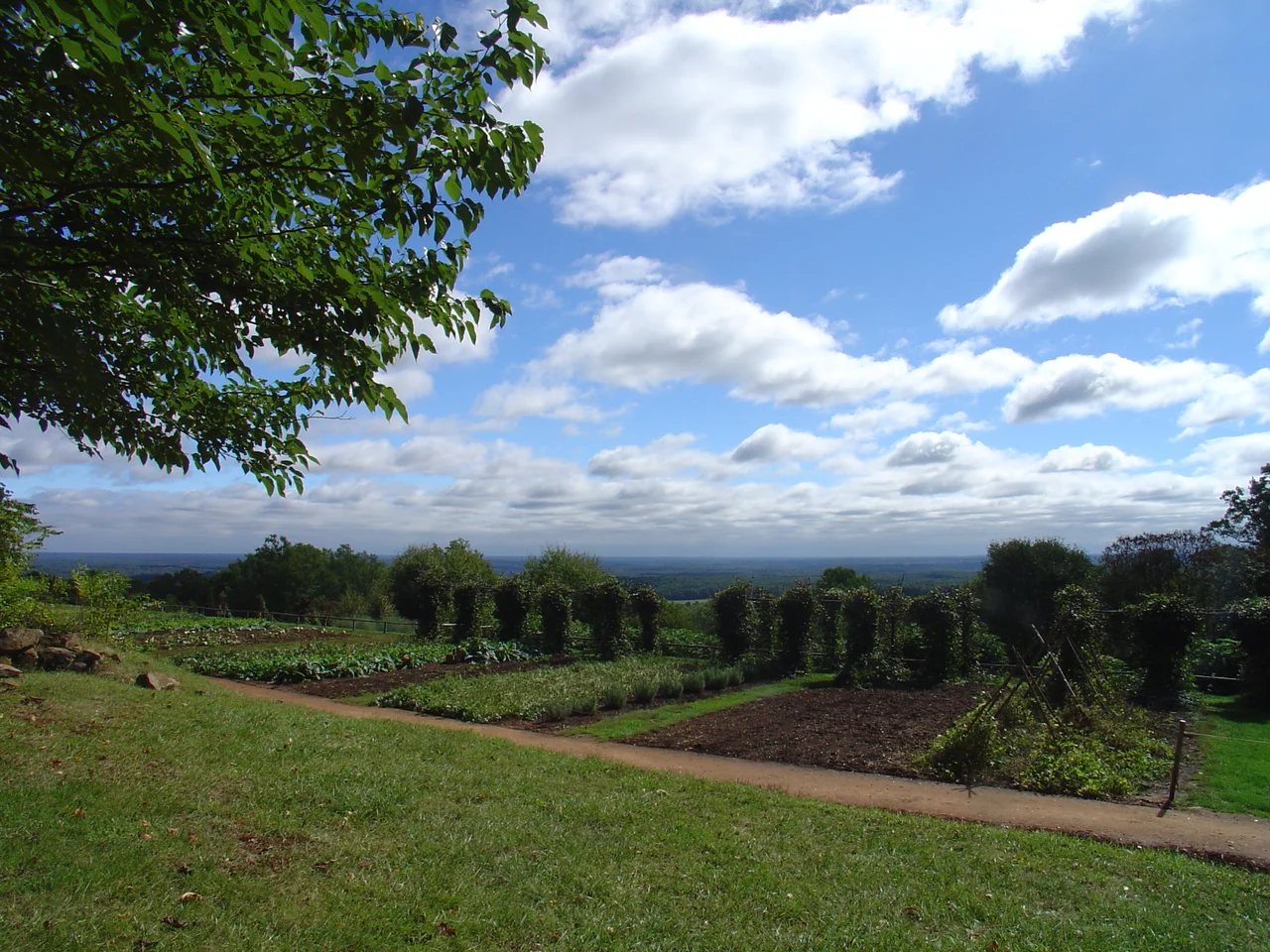
The site itself was an act of engineering. In 1806 enslaved laborers began carving a flat plateau into the hillside, hauling stone for a retaining wall that still holds the garden against gravity two centuries later. Above the terrace sit oval and circular flower beds tucked at the corners of the house - twenty of them, each planted with a different species, the bulbs and seeds shipped from Bernard McMahon's Philadelphia nursery. A winding walk borders the flower beds, designed in the naturalistic English style Jefferson had fallen for during his 1786 tour of British gardens. He preferred curving paths to French symmetry, wild edges to tight parterres. Bringing that vision to fruition on a Virginia ridge meant cisterns to catch roof water, roads carved through woods, and decades of patience.
The Garden Book
Jefferson began keeping garden notes in 1766, when he was twenty-three. He never really stopped. From 1766 to 1824 he documented the dates flowers opened, the weather that killed seedlings, the yields of squash and the fates of imported figs. He wrote his overseer Edmund Bacon long letters from Washington about which beds needed turning and which trees needed pruning. André Thouin, superintendent of the Jardin des Plantes in Paris, became a kind of pen pal in seeds, posting packets across the Atlantic for Jefferson's beds. Apples and pears in the north orchard fed the cider press. Beneath the vegetable terrace stretched a vineyard of native and European vines. Jefferson grew tropical fruit in berry squares to see what Virginia's climate would forgive.
Who Worked the Ground
The story Jefferson's garden book tells is only one of several being told at Monticello at the same time. The plantation ran on the labor of enslaved people, and the gardens were no exception. The winding flower border laid out in 1808 was tended by Jefferson's daughters and by elderly enslaved workers. Around the slave quarters, smaller gardens fenced with saplings and vines produced the food families needed to supplement rations they were given: lima beans, collards, cymlings, peanuts, sweet potatoes, watermelons, peaches. Records kept by Jefferson's granddaughter Anne Carey Randolph show she purchased produce and eggs from more than forty enslaved people - a thin economy of their own labor, conducted around the margins of the labor extracted from them. The terrace wall and the cisterns and the carefully tilled beds existed because of work that Jefferson did not do himself.
Ruin and Restoration
When Jefferson died on July 4, 1826, his estate was deep in debt. Parts of the property were sold and replanted with paper mulberries to feed silkworms, briefly promising profits that never came. The terrace went wild. The oval beds disappeared under grass. The vineyard died back. For more than a century the gardens existed mostly as a memory and a few overgrown lines on a hillside. Then in 1923 the Thomas Jefferson Memorial Foundation bought the property, and in 1938 its president Stuart Gibboney wrote to the Garden Club of Virginia and asked them to bring the gardens back. While they worked, the club members made an extraordinary discovery: Jefferson's Garden Book, left behind, with the planting plans intact. They followed his instructions. The terrace returned. The oval beds bloomed again at the corners of the house. The Garden Club still tends the grounds today.
What You Can See From Above
From the air the layout still reads like a diagram. The thousand-foot terrace runs along the south side of the mountain like a long green sentence. The orchards step down the slope to the west. The house sits at the crown, its dome a small white period at the end of the ridge. Charlottesville is three miles to the west; the Blue Ridge rises beyond. On a clear afternoon the terrace catches the low light and the stone wall casts a shadow as straight as Jefferson's surveyor's chain. The mountain remained, in his own phrase, the only thing he could not change - so he gardened it instead.
From the Air
Monticello sits at 38.0092 N, 78.4522 W, about 3 miles southeast of Charlottesville, Virginia, atop a 285-meter (935-foot) ridge in the foothills of the Blue Ridge Mountains. Recommended viewing altitude is 2,500 to 4,000 feet AGL for the best look at the thousand-foot vegetable terrace cut into the south slope and the small white dome of the main house. The nearest airport is Charlottesville-Albemarle (KCHO), about 7 nautical miles north-northwest. Shenandoah Valley Regional (KSHD) lies roughly 25 nm to the west. Approach from the east or south offers the clearest view of the terraced gardens running across the hillside. Mountain wave and afternoon convection in summer can produce turbulence over the Blue Ridge to the west - plan early-morning passes for the calmest air and the longest shadows on the terrace wall.
Nearby Stories
- Augusta County Training School 10 km away
- A. P. Hill Boyhood Home 18 km away
- Reddish Knob 20 km away
- Amherst County, Virginia 21 km away
- Appalachian Trail 21 km away
- Fork Union Military Academy 28 km away
- Huguenot Memorial Chapel and Monument 39 km away