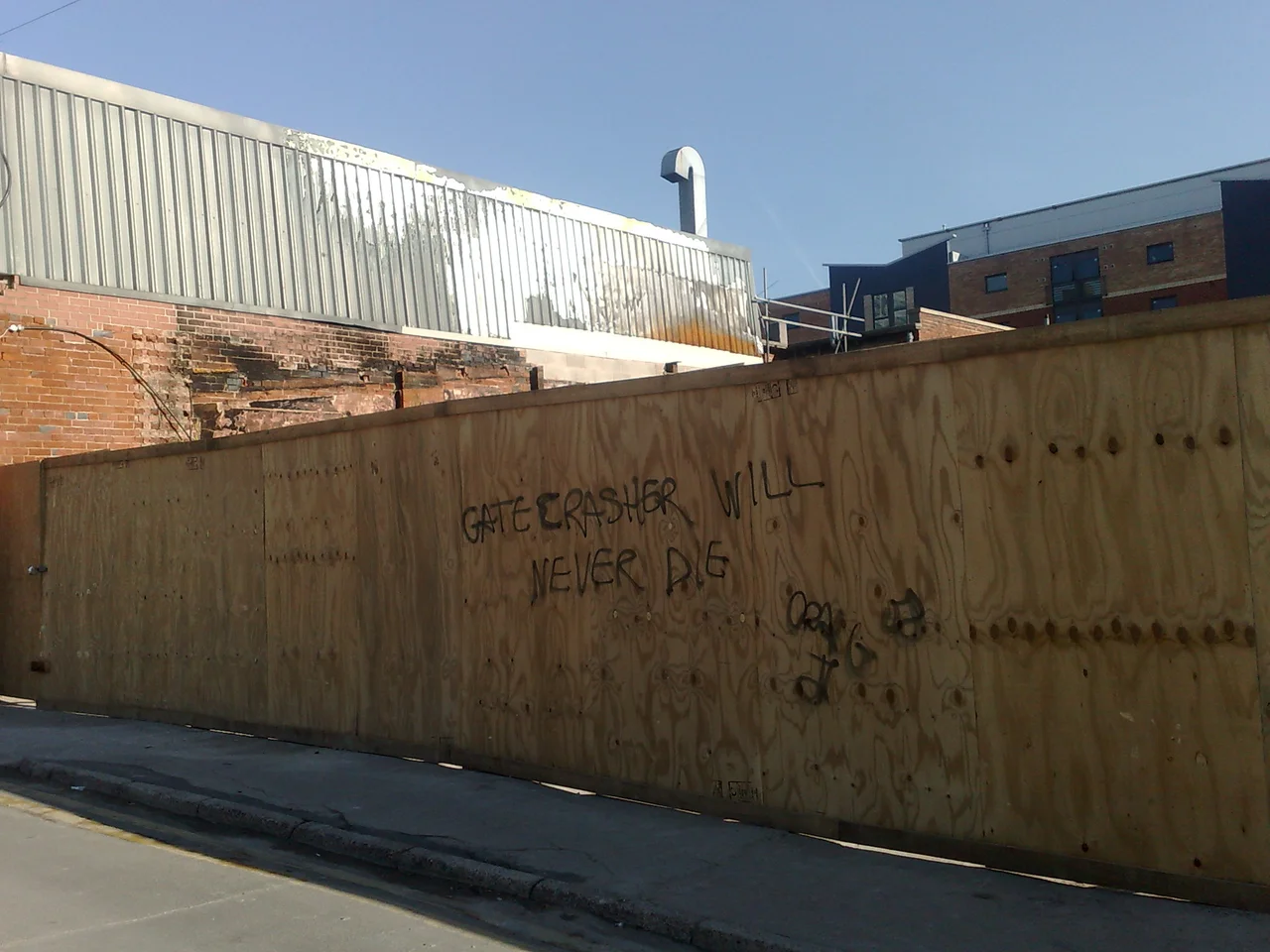

Gatecrasher One
After the fire, someone left a single bunch of flowers tied to the security fence with a handwritten note: "The music, the lights, the spirit of the people. We will always remember you." The building behind the fence was a hollow shell, its roof collapsed, its dance floor open to the Sheffield sky. For ten years the Roper and Wreaks works on Matilda Street had been Gatecrasher One - the club that defined trance in Britain, the place where teenagers from all over the country came to find what they could not find at home: ten thousand watts of bass, lasers that turned smoke into sculpture, and a crowd that danced like the morning would never arrive.
From Warehouse to Republic
The building had stood since around 1910, a plain two-storey brick warehouse built for Roper and Wreaks, a Sheffield steel and tool firm. For three quarters of a century it housed ordinary industry. By 1986 the work had moved on and the building stood empty. A 1991 plan to convert it to offices went nowhere. Eventually a different idea took hold - that what this oddly stepped warehouse on its sloping site really wanted to be was a nightclub. The conversion opened on 1 December 1995 as The Republic. The Manchester architects Mills Beaumont Leavey kept the old industrial bones and added a postmodernist extension, splitting the interior into five rooms set on different floor levels - foyer, main room, Electric Box, Lounge, VIP Pod - linked by a tangle of stairs, doorways and the raised foyer bridge that became one of the club's signature features.
The Saturday Night That Changed Everything
The Republic struggled. The numbers never quite arrived. Then in 1996 a Saturday night called Gatecrasher, run by a small Sheffield promoter, started using the venue for occasional events. Word travelled. The Gatecrasher crowd - drawn by uplifting trance and a culture of dressing-up and abandon - turned occasional bookings into a permanent residency. By the late 1990s coaches from Glasgow, Cardiff and Plymouth pulled up on Matilda Street on Saturday nights. When the warehouse's financial troubles caught up with its owner, Gatecrasher bought the venue outright. The original overhead crane in the main room was ripped out and replaced with sweeping arches of lighting rig. A bespoke Opus sound system went in. Lasers - top-tier, almost dangerously bright - became the club's visual signature.
Trance Nation
By 2003 Gatecrasher had grown beyond a single venue into a brand: clothing, compilation CDs, satellite nights, and ambitions for a chain. A £1.5 million refurbishment relaunched The Republic as Gatecrasher One - the 'one' marking it as the flagship, the first of a planned ten. The other clubs never quite got the numbered names they had been promised; venues in Leeds, Nottingham, Birmingham and Watford carried the Gatecrasher banner under their own identities. But Gatecrasher One remained the mothership. The flagship Crasher night ran monthly, and the building's reputation - all those stairs, those stages, that walkway bridge above the foyer - turned an ordinary Saturday into a kind of pilgrimage.
Fire, Flowers, and What Came After
On the evening of 18 June 2007 the building caught fire and partially collapsed. The walls held but the roof was gone, the dance floors charred, the lasers melted. There was nothing to rebuild. The site sat empty for years, a ruin in the middle of Sheffield's Cultural Industries Quarter, before being demolished and redeveloped into student housing that opened in 2016. The developers chose the name Gatecrasher Apartments, with a logo in the shape of a vinyl record. In the courtyard, a garden feature is shaped like a turntable. The four wings of the new building are called Opus, Mezzo, Vivo and Accent - musical names for what used to be the noisiest, most luminous Saturday night in the north of England.
From the Air
Coordinates 53.3761°N, 1.4696°W. The former site sits on Arundel Street/Matilda Street in Sheffield's Cultural Industries Quarter, half a mile south of the railway station. Best viewed from 1,500-2,500 feet AGL. Now occupied by Gatecrasher Apartments, a four-block student development. Nearby airports: Sheffield/Doncaster (EGCN) 18 nm east, Manchester (EGCC) 35 nm west. The site is densely surrounded by city-centre buildings - look for the modern apartment block whose courtyard contains a turntable-shaped garden feature.
Nearby Stories
- Rochdale Pioneers Museum 3.4 km away
- Adlington Hall 4 km away
- National Coal Mining Museum for England 4.2 km away
- Sneyd Colliery Disaster 6.6 km away
- Southwell Minster 6.8 km away
- Belper North Mill 9 km away
- Selby Rail Crash 13 km away
- RAF Finningley 15 km away