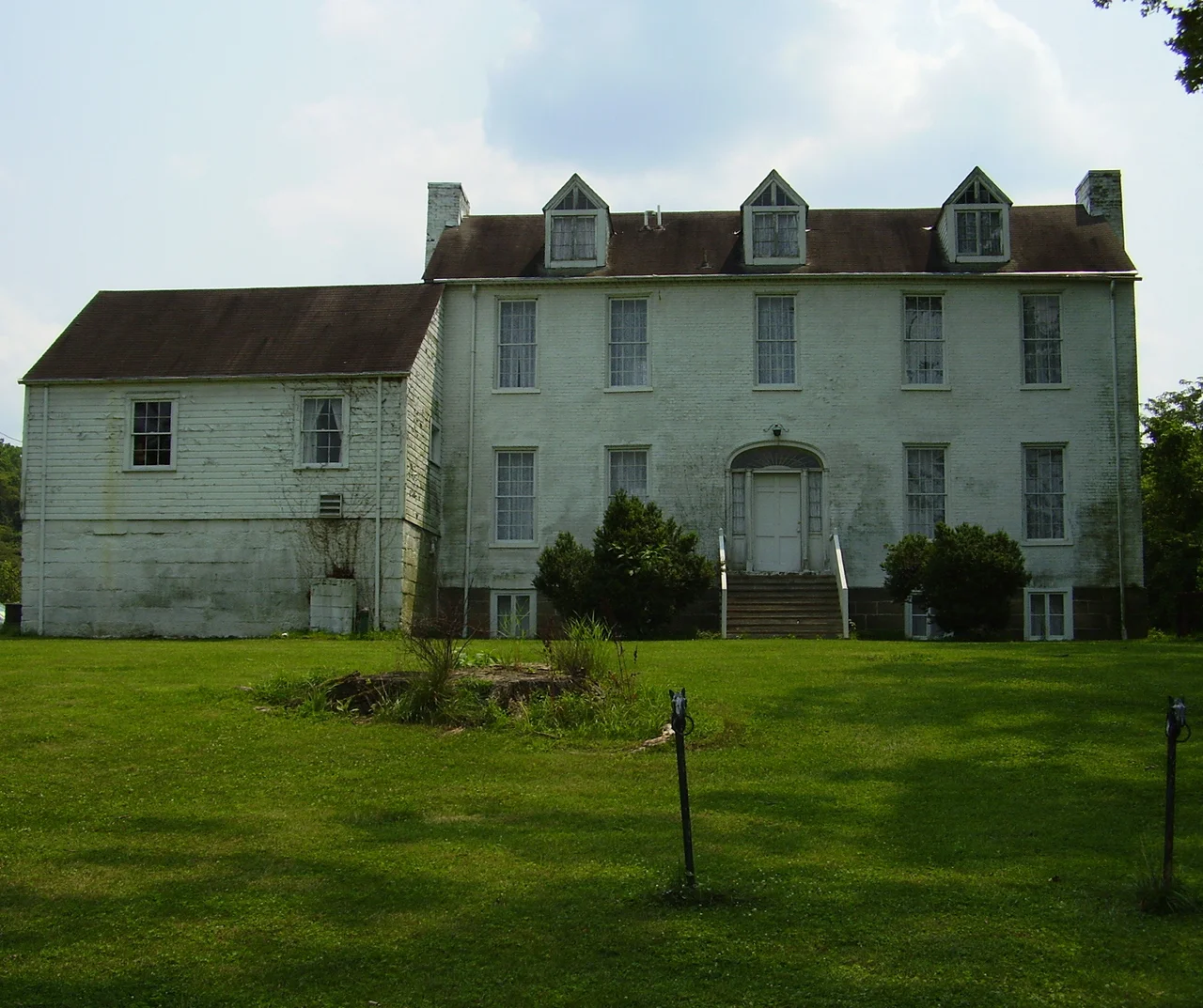

Gen. Albert Gallatin Jenkins House
On a long bottomland bench above the Ohio River, fifty miles upriver from the Kentucky line, a brick plantation house has stood since about 1835. The estate was called Green Bottom for the rich alluvial soil along this stretch of the river, all 4,395 acres of it. The house's most famous resident was Albert Gallatin Jenkins, a two-term U.S. congressman from Virginia who in 1861 walked out of the Capitol, rode home to Green Bottom, and joined the Confederate army. By 1862 he had raised a regiment of cavalry. By 1863 he was a brigadier general. By 1864 he was dead, mortally wounded at the Battle of Cloyd's Mountain. The house at Green Bottom outlived him by more than a century and a half, and it is now open as a museum.
A Brick House on the Bottoms
The Jenkins family began assembling Green Bottom in the early 1800s, and the surviving house was built around 1835 by Albert's father, William Jenkins. It is a two-story rectangular brick dwelling in the late Federal style, set on a sandstone foundation. The interior is a center-hall, single-pile plan - a single room deep on either side of a central passage, typical of Federal-era houses in the upper South. From the front porch, the Ohio River runs north-northwest in a wide silver bend. Steamboats once tied up at the property's landing to take on hogs, tobacco, and grain. The estate at its height covered more than four thousand acres of bottomland and the bench above it. The plantation was worked by enslaved African Americans whose labor produced the wealth that built the brick walls, planted the gardens, and educated Albert Jenkins for the political life he would eventually pursue.
The Congressman Who Became a Cavalryman
Albert Gallatin Jenkins was born at Green Bottom in 1830, about five years before his father finished the house. He attended Jefferson College in Pennsylvania and Harvard Law School, then returned home to practice law in Charleston, Virginia. In 1856 he was elected to the U.S. House of Representatives as a Democrat, and served two terms before secession overtook his politics. When Virginia left the Union in April 1861, Jenkins resigned his seat and traveled home to organize a cavalry company. He was elected to the first Confederate Congress that fall but soon left politics again for full-time military service. In August 1862 he was commissioned a brigadier general and given command of a cavalry brigade. He led raids through what is now West Virginia and Ohio, harassing Union supply lines and gathering recruits. At Gettysburg his brigade was part of the long cavalry screen on the army's flank.
The People Who Built the House
The full story of Green Bottom is also the story of the people who were enslaved here. The 1860 federal slave schedules recorded the enslaved population on the Jenkins property. Their labor cleared the fields, raised the crops, tended the livestock, served in the kitchen and the laundry and the main house, and made the wealth that gave Albert Jenkins his political career and his Harvard education. The plantation house is the visible artifact of that arrangement; the people who actually built it left fewer written records, but their work is in every brick and every harvested acre. When the West Virginia Division of Culture and History reopened the property as the Jenkins Plantation Museum, the interpretation grew over time to include their lives more fully. A museum that tells the Civil War story without the labor that made the war's economics possible is telling only half of it. The house's center hall is the same on both ends of that story.
Cloyd's Mountain and After
On May 9, 1864, at the Battle of Cloyd's Mountain in southwestern Virginia, Union forces under General George Crook attacked Jenkins's cavalry and infantry across a steep hillside. Jenkins was struck in the arm and captured. The wound became infected; surgeons amputated, but he died on May 21. He was thirty-three. The Confederate war effort in western Virginia lost one of its most active raiders. Green Bottom, like most large plantation estates in the postwar South, was broken up over the decades that followed. The brick house, however, remained. It was added to the National Register of Historic Places in 1978 and now operates as a museum under the West Virginia Division of Culture and History. The Ohio River still runs by the front porch in its long slow bend. The bricks are still laid in their original Flemish bond. The history is more complicated than the house alone could tell.
From the Air
The Gen. Albert Gallatin Jenkins House sits on the east bank of the Ohio River at 38.59 degrees north, 82.25 degrees west, about seven miles north of Lesage and twenty miles north-northeast of Huntington, West Virginia. Best viewed at 2,500 to 4,500 feet AGL: look for the bottomland bench along a clear westward bend of the Ohio, with the brick house set back from the riverbank and surrounded by remnant farm fields. Tri-State Airport (KHTS) is about twenty-five miles south. The wide curve of the Ohio River is the dominant visual reference; Ohio is on the far bank.
Nearby Stories
- Malden, West Virginia 2.2 km away
- Point Pleasant 3.5 km away
- Ironton, Ohio 8 km away
- Salt Reservations 22 km away
- Beech Fork State Park 22 km away
- Robey Theatre 25 km away
- Burning Springs, West Virginia 26 km away
- Yatesville Lake 28 km away