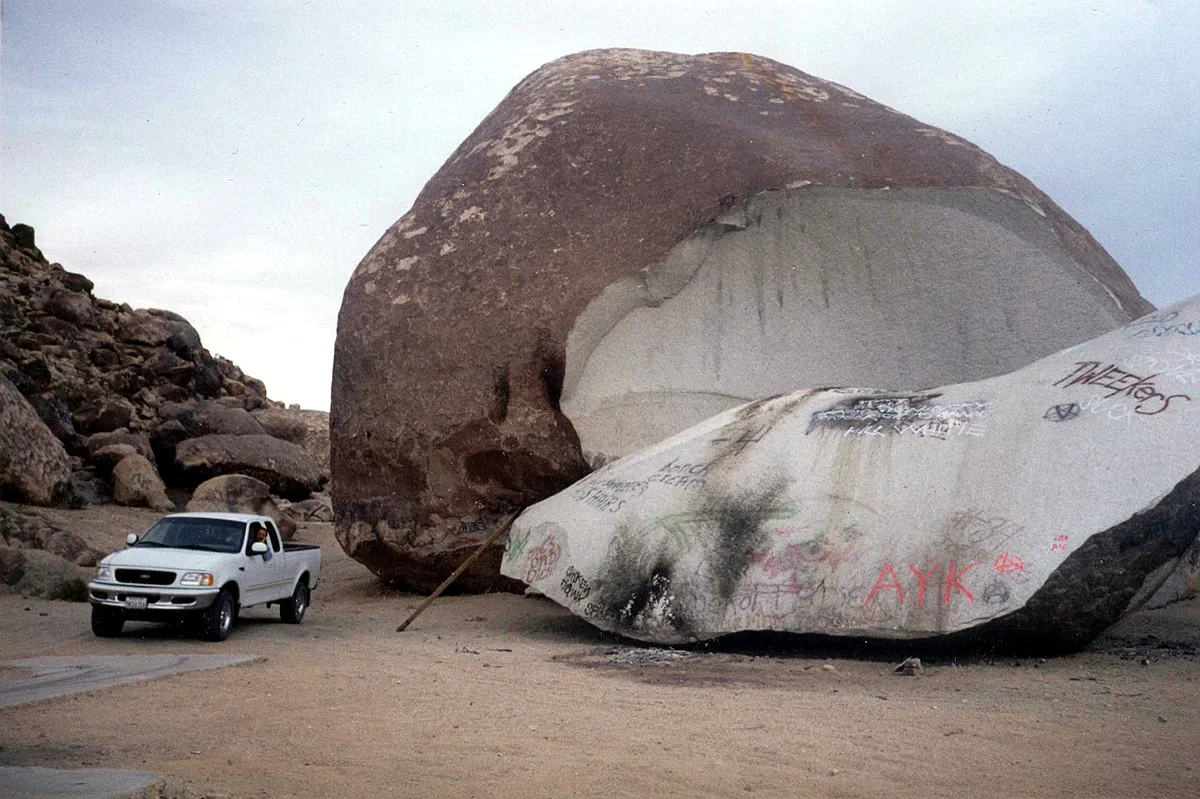

Giant Rock
Frank Critzer noticed desert tortoises digging holes to escape the heat, and decided to do the same. Using dynamite, he hollowed out a space beneath the north face of Giant Rock in the 1930s. The room he created was reportedly never hotter than 80 degrees, never cooler than 55 — a feat of unintentional passive engineering beneath the largest freestanding boulder in North America.
Seven Stories of Stone
Giant Rock covers 5,800 square feet of ground in the Mojave Desert near Landers, California. Seven stories high, it does not look like much from a distance — a pale dome rising from the flat creosote plain. Up close, it is overwhelming. The stone is a single mass of granite, untethered to any larger formation, sitting in the desert as though dropped there by something careless and colossal. Its origins are geological rather than dramatic — Mojave granites are old, and erosion shapes them into improbable forms — but knowing that does nothing to diminish the strangeness of the thing in person.
The Man Beneath the Rock
Critzer's underground home had a rainwater collection system, a ventilation tunnel, and reportedly good acoustics. He built an airstrip on the nearby ancient lakebed and, by 1941, was averaging a plane a day. His story ended violently and ambiguously during a wartime standoff with law enforcement. His friend George Van Tassel arrived later. Van Tassel was a former aircraft inspector who had worked for Howard Hughes and Lockheed. In 1947 he leased the land from the Bureau of Land Management, moved his wife and three children to Giant Rock, and opened a cafe, a store, a gas station, and an airport. He also, soon after, began meditating beneath the rock — which Native peoples of the area had long considered sacred — and receiving what he later described as communications from space.
Spacecraft Conventions and Strange Science
Through the 1950s, Van Tassel organized the Giant Rock Spacecraft Conventions, annual gatherings that drew thousands of UFO enthusiasts to the desert. The conventions ran for nearly 25 years, making Giant Rock the most improbable gathering place in Southern California. Meanwhile the airport — FAA-certified for emergency use by commercial airliners — hosted about one flight per day in the early 1960s. Between November 1961 and October 1962, it served as the launch site for helium balloons sent up by researcher R. F. Miles Jr. to measure neutron density in the Earth's atmosphere at altitude. Somewhere between the saucers and the science, Giant Rock hosted both with equal sincerity.
What Remains
Van Tassel died in 1978, and the airport closed three years earlier. Giant Rock is still there — enormous, immovable, now partially covered in graffiti that arrived sometime around 2000. Artists have been drawn to it regardless: Australian artist Tina Havelock Stevens won the Blake Prize for a video work made at the site; the desert rock band Yawning Man recorded a live album nearby. Tim Powers set a science fiction novel here. The rock itself does not care about any of this. It has been sitting in this spot for longer than the Mojave has been a desert, and it will be here after the graffiti weathers off and the memory of the conventions is gone.
From the Air
Located at 34.33°N, 116.39°W near Landers, California. The pale dome of Giant Rock is visible from moderate altitudes against the flat desert floor. The ancient lakebed where Van Tassel built the airstrip is identifiable as a lighter, smoother surface nearby. Nearest airports: Twentynine Palms (TNP) ~15 miles east, Desert Resorts Regional (PSP) ~35 miles south. Best viewed at 4,000–6,000 ft in clear, low-humidity Mojave conditions.
Nearby Stories
- Morongo Valley 6.3 km away
- Hector Mine 14 km away
- Ruby Lee Mill Site 20 km away
- Project Carryall 23 km away
- Amboy Crater 29 km away
- San Bernardino Train Disaster 36 km away
- Bell Canyon 61 km away
- Edwards Air Force Base 80 km away