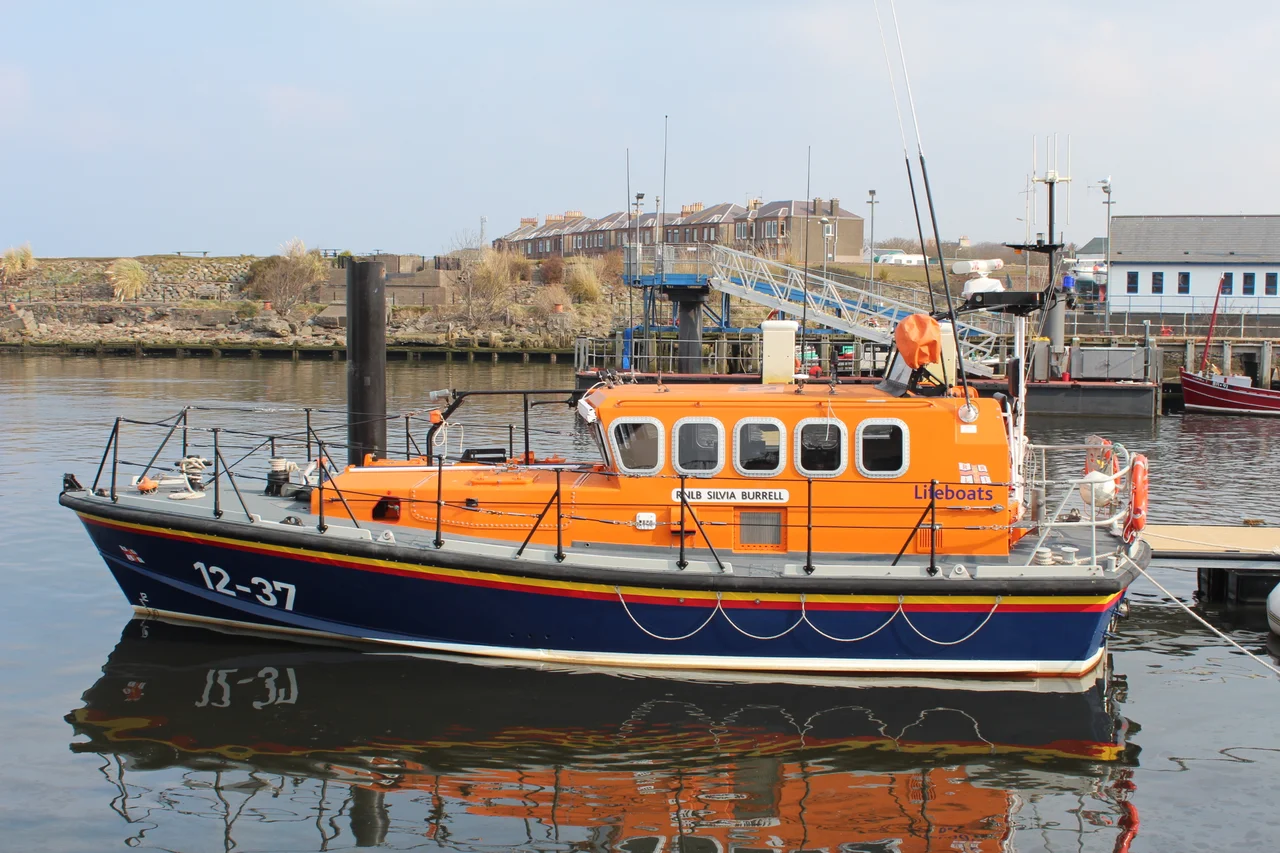

Girvan Lifeboat Station
A Glasgow insurance broker named Alexander Kay paid for it, a French Duchesse provided the ground it stood on, and a Glasgow woman who knitted nearly four hundred pairs of mittens for lifeboatmen lent her name to its boat a century and a quarter later. Girvan Lifeboat Station was never built by an institution alone. It was built by the unusual generosity of specific individuals - a pattern that began in 1865 and has not really ended.
A Coast Without Cover
South-west Scotland had almost no lifeboats in the 1850s. The RNLI placed one at Ayr in 1859, and in 1865 the institution decided Girvan was an obvious second choice. The town was full of fishermen who could form a crew on short notice, and a road close to the coast meant a launch carriage could be hauled north or south to wherever it was needed. Alexander Kay, an insurance broker in Glasgow, paid for the boat. The Duchesse de Coigny - the French aristocrat who had come into the local estate by marriage - donated the land for a boathouse. The first pulling-and-sailing lifeboats Girvan operated, dating from 1865, would save fifty-five lives in the decades that followed.
Engines on the Water
The boathouse was rebuilt in 1910. Soon after, the RNLI began converting its fleet to motor lifeboats - boats that could cover much larger areas more efficiently than the old crews of rowers could. Girvan's turn came on 16 May 1931. The new motor boat was inaugurated with appropriate ceremony, and the change had quick consequences: the station at Ayr closed the following year, redundant now that Girvan's engines could reach where Ayr's oars used to. The boats had names and numbers that crews remembered the way some people remember the names of horses. James Stevens No. 18 served from 1901 to 1931. The first motor lifeboat carried on through the Second World War and after.
Mittens for the Crew
A new facility, on a different site, opened in 1993. The lifeboat that took up station that year was named Silvia Burrell - after a Glasgow woman who had died the previous year. She had been a long-standing supporter of the RNLI and, in a quiet, persistent way that nobody asked her to maintain, she had knitted nearly four hundred pairs of mittens for lifeboat crews around the country. The boat carried her name from 1993 until 2018. When her time on station was up, she was sold; by 2022, she had ended up on the Isle of Wight under a new name, Ailsa Craig, after the volcanic plug that rises out of the sea ten miles off Girvan. The current station boat, since 2018, is the Shannon-class RNLB Elizabeth and Gertrude Allan.
Open Day
Every summer Girvan throws a Lifeboat Harbour Gala in July - music, stalls, a fun fair, rescue demonstrations, the emergency services parading along the harbour. Children climb into the lifeboat and try the radios. Crews who go out on the worst nights of the year wave back from the deck on the sunniest. It is the kind of event that does not just raise money for the RNLI; it weaves the station back into the town's calendar, the way it has been for over 150 years. There is something appropriate about a coastal town remembering, once a year and in fine weather, that the sea has always been the largest fact in its life.
From the Air
Girvan Lifeboat Station sits at 55.24 degrees north, 4.86 degrees west, on the South Ayrshire coast. The volcanic island of Ailsa Craig is unmistakable about ten miles offshore - a sharp dome of granite rising 338 metres out of the Firth of Clyde. The Arran mountains form the horizon to the north-west. Glasgow Prestwick (EGPK) lies roughly 20 nautical miles to the north; the Isle of Man's Ronaldsway (EGNS) is about 85 nautical miles to the south.
Nearby Stories
- Troon Lifeboat Station 4.1 km away
- Battle of Drumclog 9.7 km away
- Knockshinnoch Disaster 13 km away
- Lochranza 18 km away
- Threave Castle 18 km away
- Wigtownshire 21 km away
- Dunaverty Castle 24 km away
- SM UB-85 27 km away