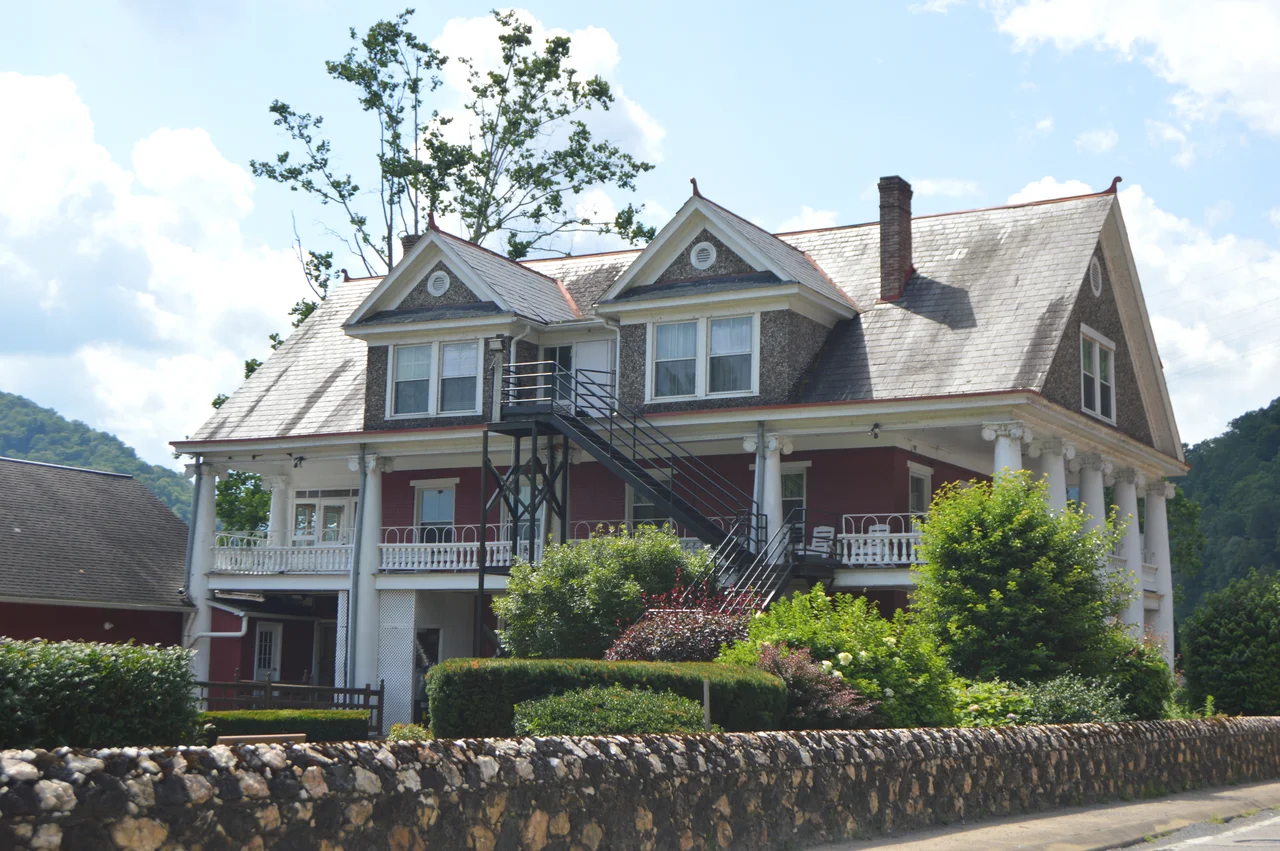

Glen Ferris Inn
It might be as old as 1815. The earliest section of the Glen Ferris Inn - a three-story painted-brick block on the bank of the Kanawha River, looking out over the wide cascade of Kanawha Falls - was built sometime in the early nineteenth century to serve travelers on the stagecoach road between the Ohio River and the Virginia heartland. Documentation is incomplete; even the original builder's name is uncertain. The building has been called Stockton's Inn, Stockton's Tavern, Hawkins's Hotel, and finally the Glen Ferris Inn. It served stagecoach passengers in the antebellum era. It became a Union quartermaster's depot during the Civil War. It housed managers and workers when the early twentieth century built hydroelectric and aluminum plants on the falls below. Two centuries on, after a long closure, it reopened in 2018 and is again taking reservations.
Stagecoach Road
Before the railroads pushed through the New River Gorge in the 1870s, the principal route from the Ohio Valley into central Virginia followed the Kanawha River upstream from the Ohio. Stagecoaches stopped at relay stations every fifteen or twenty miles to change horses, feed passengers, and let travelers sleep. Glen Ferris occupied a natural stopping point - just below the impressive cascade at Kanawha Falls, where the road had to detour around the unnavigable water, with a wide flat shelf for buildings on the riverbank. The original inn, however old it actually is, was placed exactly where a stagecoach proprietor would have placed it. Successive owners added wings and updated the accommodations as the road's traffic grew through the 1830s, 1840s, and 1850s.
Civil War Depot
When the Civil War came to the Kanawha Valley, the building was commandeered by the Union Army as a quartermaster's depot. The Kanawha route was strategically important - it connected the western Virginia coalfields to the Ohio River and was contested by both sides through 1861 and into 1862. Union supply officers used the inn as a warehouse, an officers' billet, and a paymaster's office. The wraparound porch with its thirteen stuccoed brick columns - a number that seems likely a deliberate echo of the original thirteen colonies, though the date of the porch's construction is uncertain - became a place where troops moved goods on and off wagons. The building survived the war. Many similar antebellum hostelries did not.
Industrial Boom on the Falls
In the early twentieth century, the Kanawha Falls just below the inn became one of West Virginia's earliest hydroelectric sites. A dam was built across the falls. Power generated there fed an aluminum plant operated successively by Electro-Metallurgical Company, Union Carbide, and Elkem Metals through most of the twentieth century. The plant brought a wave of managers, engineers, and skilled tradesmen to Glen Ferris - and Union Carbide bought the inn to house them. For decades, the inn functioned as a corporate guesthouse: rooms for visiting executives, a dining room for the supervisory staff, hosting the social functions of an industrial company town. The plant continued operating through the late twentieth century before closing in stages. The inn closed too, sat empty for years, and went through several ownership changes.
Reopened in 2018
The building had been on the National Register of Historic Places since 1991, but listing does not pay maintenance. By the early 2010s, the structure was in serious need of restoration. A new ownership group acquired the property in 2017 and undertook the restoration of the historic rooms, the dining areas, and the wraparound porch. The inn formally reopened on December 16, 2018, with a small dining room, twelve or so guest rooms, and views of the Kanawha Falls that have not changed essentially since the inn was first built. The aluminum plant below the falls has been demolished, leaving the falls themselves more visible than they were for most of the twentieth century. The inn now markets itself as one of the oldest hotels in West Virginia.
Flying Over the Falls
From the air, Glen Ferris is a small riverfront community on the south bank of the Kanawha River, with the broad cascade of Kanawha Falls immediately downstream. The inn's brick block stands out from the surrounding wooden houses, with its long wing extending to the southeast along the river. The river above the falls is broad and slow; below the falls, it accelerates through a narrower channel. U.S. Route 60 - the modern descendant of the stagecoach road - runs along the south bank past the inn. The terrain on both sides of the river rises into the New River Coalfield's ridges. From cruising altitude, the falls and the inn together form a compact little ensemble of geological, transportation, and industrial history.
From the Air
Located at 38.15°N, 81.21°W in the small community of Glen Ferris, on the south bank of the Kanawha River just above the Kanawha Falls in Fayette County, West Virginia. U.S. Route 60 runs along the south bank past the inn. Nearest airports: Yeager Airport (KCRW) at Charleston about 25 nm northwest, Raleigh County Memorial (KBKW) at Beckley about 20 nm south. Best photographed from 2,500-4,000 feet AGL where the falls, the inn, and the river bend are all in frame.
Nearby Stories
- Summersville, West Virginia 5.8 km away
- Westsylvania 13 km away
- Toyota Motor Manufacturing West Virginia 13 km away
- Upper Big Branch Mine Disaster 14 km away
- Logan County, West Virginia 16 km away
- Hobet Coal Mine 18 km away
- Robey Theatre 26 km away
- Greenbrier County, West Virginia 36 km away