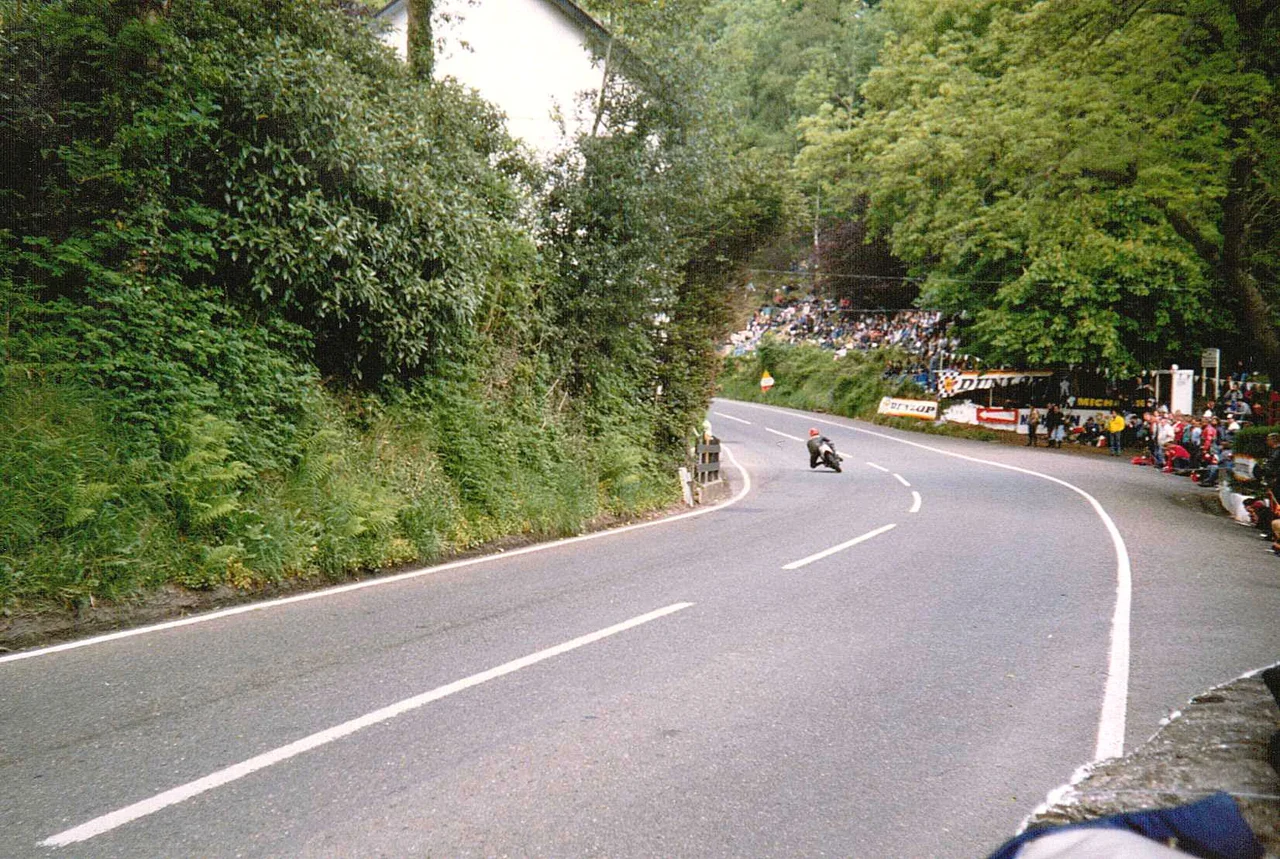

Glen Helen, Isle of Man
In 1933, the aviator Amy Johnson planted a tree at the mouth of a Manx glen. Most things she did happened at a few thousand feet, alone in a wooden-framed cockpit; this one happened with a spade in her hands and her feet on Isle of Man soil. The tree is still there. So is the glen she planted it in, a long green corridor of sequoia, Douglas fir, and rushing water carved into the hills west of the Mountain Course. Glen Helen is both nineteenth-century Victorian arboretum and twentieth-century racing landmark, and once a year tens of thousands of people lean against ropes here to watch motorcycles pass within feet of each other at extraordinary speeds.
A Glen Made by Hand
Glen Helen was originally Lambfell Glen, named for the mountain whose southern slope it sits on. In the 1860s a consortium of Manx businessmen with a passion for arboriculture took it in hand. They planted trees and shrubs they thought would thrive in the damp shelter between the hills, laid paths along the rivers, built bridges over the water, and renamed the whole valley after a name from Greek myth chosen for its beauty. In 1867 they opened the place to the public. Today the result is a 67-acre stand of mature sequoia, thuja, spruces, Douglas fir, oak, sycamore, and beech, threaded by paths that follow the Neb and the Blaber rivers down to the river-side entrance on the A3. The Isle of Man Forestry, Land and Mines Board bought it for the public in 1958 for £4,300.
The Rhenass Waterfall
Three-quarters of a mile up the glen from the road, the path arrives at the Rhenass Waterfall, the most dramatic feature in the valley. The Lambfell stream, the Blaber River, and the River Neb converge near the road, but the falls upstream are what most visitors come for. The Rhenass falls drop in stages through dark stone, the water still cold even in summer. The glen is part of the Manx National Glens system, a network of eighteen public glens owned and maintained by the Forestry Amenity and Lands Directorate of the Isle of Man Department of Environment, Food and Agriculture. The system protects pockets of woodland and water across the island. Glen Helen, with its mature trees and theatrical falls, is among the most-visited.
Where the Course Meets the Glen
Walk back to the road at the foot of the glen and you arrive at one of the most famous corners in motor sport. The section of the A3 Castletown to Ramsey road that runs past the Glen Helen entrance was part of the St John's Short Course used for the very first Isle of Man TT races, from 1907 to 1910. It was then part of the 37.50 mile Four Inch Course used for the RAC Tourist Trophy automobile races between 1905 and 1922. In 1911, the Auto-Cycling Union adopted the Four Inch Course for the Isle of Man TT motorcycle races, which is when the 37.73 mile Isle of Man TT Mountain Course was born. Every year since, except in wartime and other disruptions, motorcycles have raced past the gates of Glen Helen at speeds ordinary roads were never designed to support.
Laurel Bank, Black Dub, Sarah's Cottage, Creg Willey's Hill
The names along this stretch read like an incantation to anyone who has watched TT footage. Laurel Bank. Black Dub. Sarah's Cottage. Creg Willey's Hill. Each is a tiny part of the course, marked by a roadside feature or a long-vanished building, with a corner profile riders have memorised for generations. The Glen Helen section combines a tight right-hand turn entering the corner, a slight rise, and a long descent on the far side. From the spectator banks, riders appear from the shaded glen mouth, hit the turn, then power away uphill into trees. The car park beside the road is shared with what used to be a restaurant. The Manx Grand Prix has used the same course since 1923. The Manx Grand Prix runs in late August, on the same roads as the TT in June.
Two Different Visits
Glen Helen invites two completely different kinds of visit. In quiet months it is a hush of trees and falling water, with paths wide enough for prams and viewing benches near the bridges. The mature conifers planted in the 1860s have grown into a high canopy. In TT and Manx Grand Prix weeks the same gate becomes a viewing point for tens of thousands of people watching the Mountain Course unfold at speed. The contrast is striking. The same patch of road is, depending on the week, either one of the loudest places on the island or one of the quietest. The tree Amy Johnson planted in 1933 has now stood through both kinds of week for nine decades.
From the Air
Glen Helen sits at 54.226°N, 4.617°W in the central western Isle of Man, on the south slope of Lambfell Mountain. From 2,000 to 4,000 ft AGL the glen appears as a dark green wooded cleft running north into the hills from the A3 road, between St John's to the south and Kirk Michael to the north. South Barrule and Slieau Whallian rise to the southwest, Snaefell (621 m) to the northeast. Nearest airport is Isle of Man (EGNS) Ronaldsway, about 12 nm to the southeast. The A3 here is part of the TT Mountain Course; aerial views during late May or June will often show grandstand and crowd infrastructure.
Nearby Stories
- Ballywalter 14 km away
- Pasages (steam trawler) 15 km away
- SS Georgetown Victory 19 km away
- Celtic Array 31 km away
- Raeberry Castle 34 km away
- German submarine U-1051 36 km away
- St Bees Lifeboat Station 49 km away
- PS Rothsay Castle 73 km away