
Globe Works
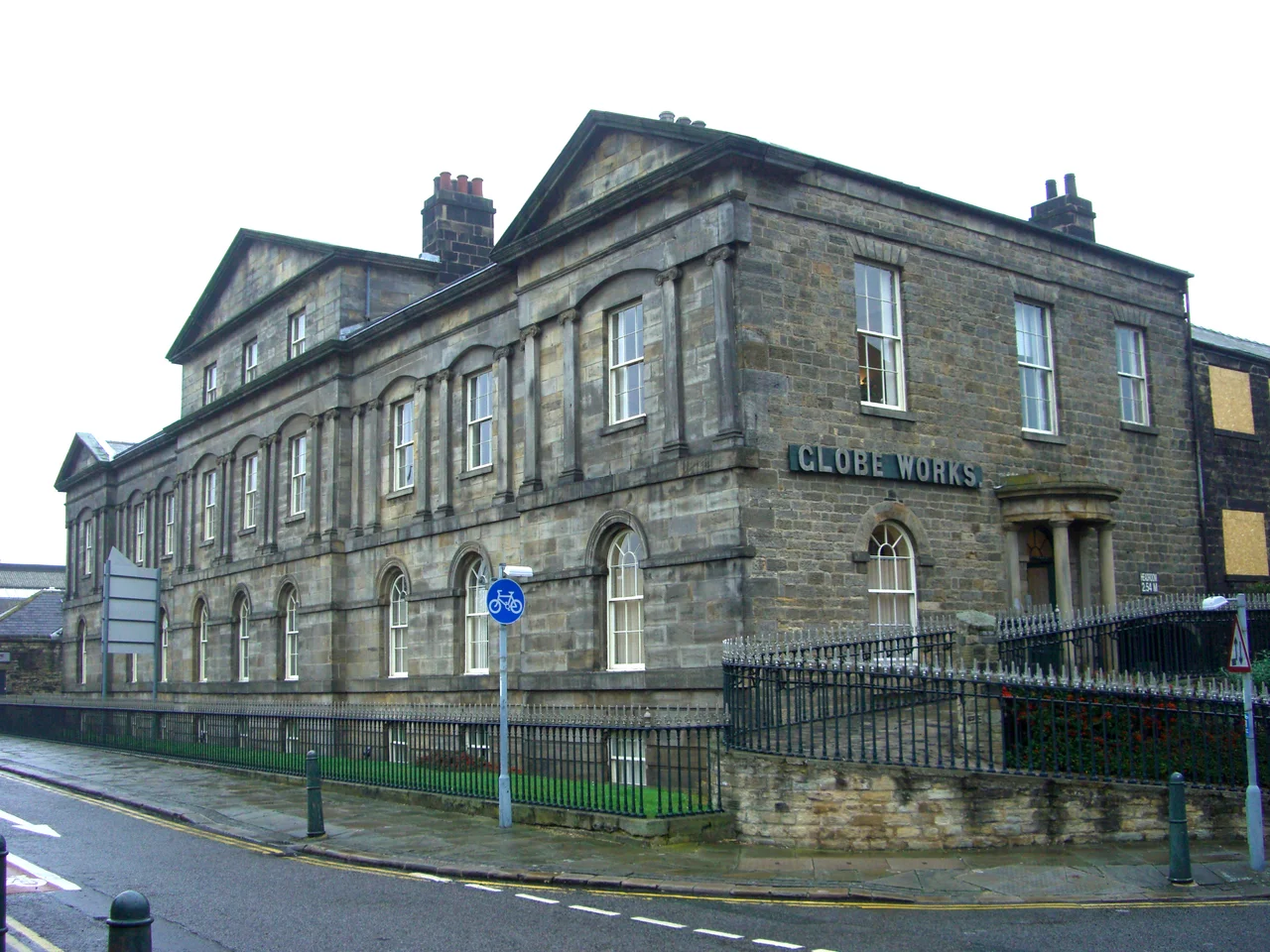
Look at the front of the Globe Works on Penistone Road and you can see the trick. Two storeys of coursed stone, nine windows wide, a pedimented centre rising half a storey higher than the wings - it looks like a townhouse pretending to be a public building. The architects Henry and William Ibbotson built it that way in 1825 because their patron, the edge-tool maker Ibbotson & Roebank, lived in one corner of his own factory. The grand classical façade was, in part, his front door. Behind it stretched a working courtyard, an octagonal chimney, and rows of workshops where the little mesters - Sheffield's freelance craftsmen - bent over grindstones and forges. The Globe was something new in 1825: arguably the world's first purpose-built cutlery factory, gathering steel-making, forging, grinding, hafting and finishing on a single site driven by steam.
The Men Who Walked Out
Two future titans of British industry came up through these courtyards as apprentices. Charles Cammell worked at the Globe for Ibbotson Brothers from 1830 to 1837 before leaving to co-found Johnson, Cammell and Company, a firm that would in time become part of the Cammell Laird shipbuilding empire, one of Britain's most significant naval shipbuilders. William Edgar Allen also served his apprenticeship here as a young man, then in 1867 set up Edgar Allen and Company, eventually one of Sheffield's great steel houses. The Globe Works was the kind of place where you could be sweeping the grinding shop one decade and giving your name to a steelworks the next.
Knives, Bowies, and a Saw Grinders' Bomb
The Globe's trade ran wide. In 1830 Thomas Bishop was granted his own assay mark there to produce Old Sheffield Plate - copper sheet fused with silver and worked into salvers, candlesticks, teapots. In 1852 John Walters moved his firm in, specialising in bowie knives for the American market; Sheffield's blade-makers shipped vast quantities of these dagger-bladed knives to the United States in the years before the Civil War. The works did not always run smoothly. In 1843, during the violent disputes that gave Sheffield's union history its dark name as the era of 'rattening' and outrage, two members of the Saw Grinders Union planted a bomb at the Globe. The damage was considerable. The unions were trying, in their own brutal way, to enforce membership and protect wages against employers who used unaffiliated labour. Between 1865 and 1910 the cutlery firm of Unwin & Rodgers held the works, and gradually the building shifted from a single integrated factory toward a warren of separate workshops, each with its own master.
Saved From the Bulldozer
By the 1970s the Globe was tired and unfashionable. In 1970 Sheffield's Town Planning Committee actually requested that the building be removed from the listed buildings register so it could be demolished to make way for an urban motorway. The request was rejected, but the works slipped into dereliction anyway, and a 1978 arson attack did extensive damage. Salvation came in 1987 when the Leadmill Association arts charity launched a £1.5 million restoration backed by Sheffield City Council, English Heritage, the European Regional Development Fund and the Arts Council. The renovation reopened the ground floor as a cutlery shop, visitor centre and a pub called The Rattener's Rest - a wry nod to the Victorian union enforcers.
What Lives Here Now
The Leadmill Association went insolvent in 1994 and Velocity Estates bought the site in the mid-1990s, completing an 18-month, multi-million-pound refurbishment. Today the building is the Globe Business Centre, home to around 22 small companies behind a façade that has not really changed since George IV was on the throne. The pillared porch that once led to the owner's house is now the main entrance and reception. Step through it and you can walk into the cobbled courtyard where horses once drew carts of finished blades to the railway, and where the little mesters' workshops still ring the central yard - empty of grindstones now, but kept intact by the conservation area rules and the stubborn refusal of Sheffield to forget what made it Sheffield.
From the Air
Coordinates 53.3899°N, 1.478°W. Best viewed from 1,500-2,500 feet AGL. Located on Penistone Road in Neepsend, part of the Kelham Island Conservation Area, about three quarters of a mile north of Sheffield city centre. Nearby airports: Sheffield/Doncaster (EGCN) 19 nm east, Manchester (EGCC) 33 nm west. Look for the long classical stone facade with a central pediment, set back from Penistone Road, with the River Don running just to the south. Best caught in afternoon light when the west-facing façade glows.
Nearby Stories
- Rochdale Pioneers Museum 3.4 km away
- Adlington Hall 4 km away
- National Coal Mining Museum for England 4.2 km away
- Sneyd Colliery Disaster 6.6 km away
- Southwell Minster 6.8 km away
- Belper North Mill 9 km away
- Selby Rail Crash 13 km away
- RAF Finningley 15 km away