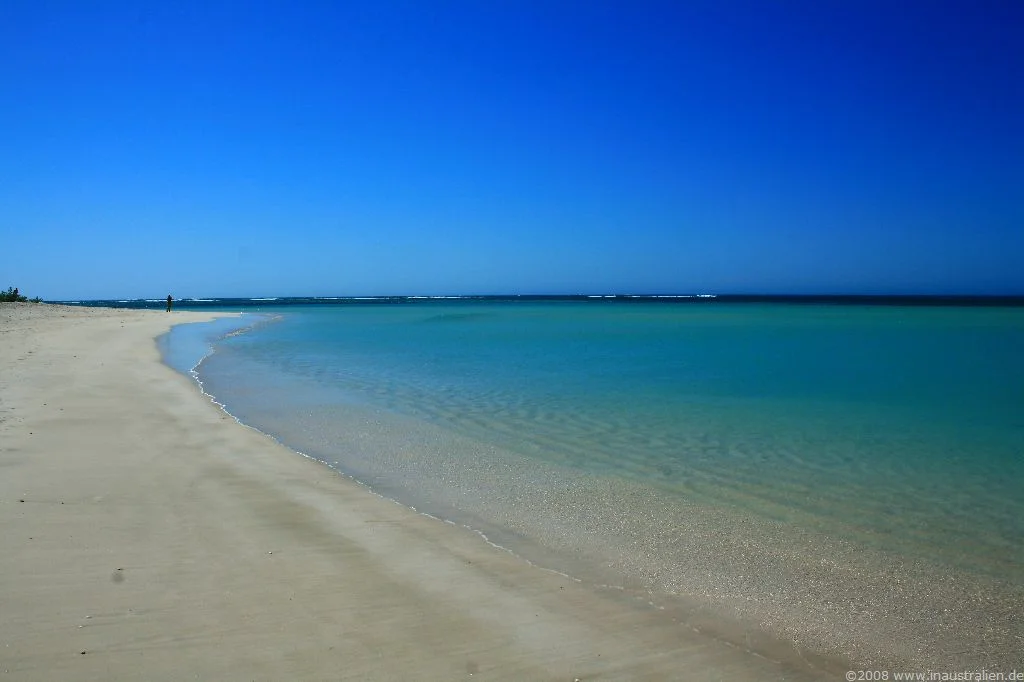

Gnaraloo
Surfers speak of it in lowered voices: Tombstones. The name belongs to a break at Gnaraloo, a heavy, barrelling left-hander that peels along a reef at the far southern tip of the Ningaloo coast, and it is named for what the place can do to people who misjudge it. This is not a resort town. Gnaraloo is a working sheep-country station turned wilderness camp, 150 kilometres north of Carnarvon at the end of a long dirt road, where the red dunes of the inland run straight into a turquoise lagoon. People come here for the wave, the wind, the fishing — and, increasingly, for the turtles.
Where the Desert Meets the Reef
Gnaraloo occupies a thin, dramatic margin of Western Australia. The homestead sits on rising ground about 500 metres back from the sea, with roughly 65 kilometres of coastline at its feet and the salt expanse of Lake MacLeod some 16 kilometres inland to the east. To the south lie Red Bluff and the Quobba homestead. This is dry country — barely 200 millimetres of rain in an average year, most of it arriving between May and July, against an annual evaporation rate around fourteen times that. When the rare deluges come, they come hard: in 1953 the station was drowned under 155 millimetres of rain in just two days. The reward for the harshness is the water itself, clear and warm, guarded by the long fringing line of Ningaloo Reef just offshore.
A Century of Wool and Names
The lease has changed hands many times, and each owner left a name in the ledgers. Donald Fleming pioneered the run with his partner Arthur Nicol and called it 'Flemington.' By 1908 it covered 90,000 acres; under Frank Mottram in 1910 it ran about 1,500 sheep, a flock that nearly tripled within a year. Mottram sold to Dansy Powell and Harry Cordes in 1921, by which point the station spanned 190,000 acres with twelve paddocks, nine wells, and a stone-kitchened homestead. The Fleming family eventually regained it outright and held on until 1975. Paul Richardson bought Gnaraloo in 2005, and in 2025 it was put up for sale, its famous surf break listed alongside the wool sheds — a reminder that out here, romance and real estate have always shared a fence line.
Guardians of the Loggerheads
Each summer, female loggerhead turtles haul themselves up Gnaraloo's beaches in the dark to dig nests above the tideline — and Gnaraloo Bay shelters one of the largest loggerhead rookeries on Earth. In 2008 the station launched the Gnaraloo Turtle Conservation Program, working under the state's Department of Environment and Conservation, with volunteers patrolling daily through the entire nesting season from November to February. A year later a feral-animal control program was added, because foxes and feral cats raid nests and devour hatchlings before they ever reach the water. The work has been recognised: in 2010 Gnaraloo took the Environment Protection category at Keep Australia Beautiful's Clean Beach Awards, honoured for protecting the critically endangered turtles that nest along its sand.
An Edge Still Being Negotiated
Gnaraloo sits hard against a UNESCO World Heritage area, and that proximity keeps it at the centre of arguments about what this coast is for. In 2015 the owners had to renegotiate their pastoral lease with the state, which carved out sections of land along the World Heritage–listed Ningaloo Coast for conservation and tourism. In 2021 came a new debate, as concerns were raised over a proposal to build wind turbines and solar panels on the ecologically sensitive site. The tension is the same one that has shadowed the whole Ningaloo coast for a generation: how to keep a place wild while letting people live, work, and visit there. At Gnaraloo, the question is still open.
From the Air
Gnaraloo lies at 23.82°S, 113.53°E on the exposed western edge of the North West Cape region, about 150 km north of Carnarvon and adjacent to the Ningaloo Marine Park. From the air the signature is the abrupt meeting of red dunes and the long, pale fringing reef offshore, with Red Bluff to the south and the vast pan of Lake MacLeod glinting 16 km inland to the east. Gnaraloo Station has a private airstrip just outside the leased area (no scheduled service; it was upgraded toward Royal Flying Doctor Service standard). The nearest airports with regular service are Carnarvon (ICAO YCAR) ~150 km south and Learmonth (ICAO YPLM), near Exmouth, well to the north-east. Strong, consistent southerly winds make this a famously breezy coast — ideal for wind sports but worth watching on approach. Recommended sightseeing altitude is 2,000–4,000 ft to read the reef line and the surf break at Tombstones.
Nearby Stories
- MV Korean Star 15 km away
- North West Coastal Highway 44 km away
- Warroora 56 km away
- Kennedy Range National Park 128 km away
- Qantas Flight 72 148 km away
- French Western Australia 192 km away
- The Silent Wave: Java's 1994 Tsunami Earthquake 1454 km away
- The Ghost Casino at the Edge of the World 1668 km away