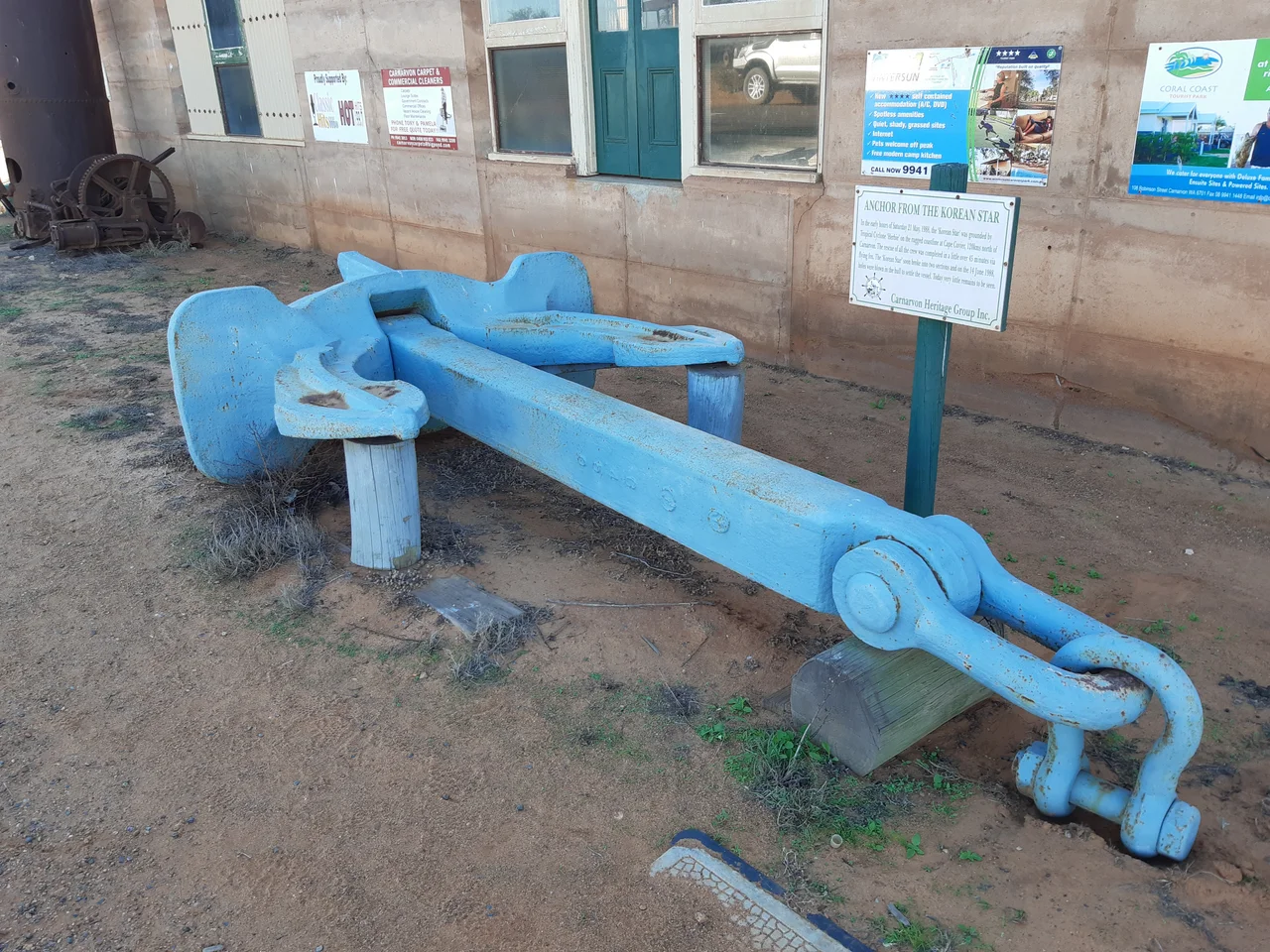

MV Korean Star
Fifty-six metres from shore, at the base of a cliff on the Quobba coast, a ship lies torn in half and slowly surrendering to the Indian Ocean. The MV Korean Star never sank in deep water and never carried a cargo to its destination. It came to grief while simply waiting, anchored off Cape Cuvier in May 1988, when a cyclone named Herbie reached down and threw it against the land. What makes the wreck remarkable is not how it died, but that everyone aboard lived.
A Routine Voyage
The Korean Star was a bulk carrier built in 1984, four years old and unremarkable when it left Hong Kong on 11 May 1988. It sailed in ballast, riding high and empty, the way ships do when they are travelling to collect a cargo rather than deliver one. Nineteen crew were aboard, and the task ahead was straightforward: reach the Western Australian coast and load salt from Lake MacLeod, the vast salt operation just inland. That salt is shipped out through the loading jetty at Cape Cuvier, a small working cove tucked beneath the cliffs, and so the vessel made its way there to wait its turn at anchor. None of this was unusual. Ships had been collecting Lake MacLeod salt from this coast for years, and an anchorage off Cape Cuvier was simply part of the routine.
Cyclone Herbie
Then the weather turned. Tropical Cyclone Herbie swept down the Gascoyne coast in May 1988, and a ship at anchor off an exposed cape is a ship in a vulnerable place. As the seas built, the Korean Star began to drag its anchors, the chains no longer able to hold against wind and swell. There was nowhere safe to run. On 20 May the vessel was driven ashore beneath the cliffs near Cape Cuvier and wrecked. Rough seas tore at the hull until it broke in two, and the ship was declared a constructive total loss, beyond any hope of salvage.
Nineteen Lives
Here the story diverges from so many shipwreck tales. All nineteen crew abandoned the breaking vessel, and not one of them was injured. They were rescued within a day of the grounding and flown to Carnarvon, shaken but whole. Cyclone Herbie caused real damage along this coast, yet the men of the Korean Star walked away from a wreck that should, by every grim precedent of the sea, have cost lives. In the long, sombre ledger of ships lost off Western Australia, this entry carries no death toll, and that is worth pausing on.
A Coast That Eats Ships
The Korean Star joined a grim local tradition. The Gascoyne coast is exposed and cyclone-prone, its waters poorly sheltered when the big storms track down from the tropics between November and April. Just south, within the same Quobba Station boundaries, lies the country that received the survivors of the HMAS Sydney disaster in 1941, the worst loss in Australia's naval history. This is a shoreline that has claimed vessels across the centuries, from sailing ships to modern steel carriers. What sets the Korean Star apart is not that it wrecked, but that it did so without taking anyone down with it, a rare mercy on a coast that has so often shown none.
The Wreck Today
What remains is a landmark. The hull sits scattered just fifty-six metres offshore at the foot of the cliff, close enough that divers reach it from the beach as a shore dive, following a track that someone, with characteristic outback dryness, named Korean Star Road. The salt jetty at Cape Cuvier still operates and remains off limits to the public, but the wreck endures as one of the markers of this coast, a rust-streaked silhouette against the cliffs that ties the lonely shoreline to a single stormy week in 1988. For travellers who make the long drive up from Carnarvon, it is a place to stand and consider how thin the line can be between disaster and deliverance. Time and salt water are finishing the job the cyclone started, slowly, in full view of anyone who comes to look.
From the Air
The wreck of the MV Korean Star lies near Cape Cuvier on the Western Australian coast at approximately 24.21 degrees south, 113.42 degrees east, within Quobba Station and just north of Carnarvon. From the air the site is identifiable by the cliff line of Cape Cuvier, the adjacent salt loading jetty, and the broken hull close against the shore. The nearest airport is Carnarvon Airport (ICAO YCAR), roughly 70 to 80 km south, with Learmonth Airport (YPLM) near Exmouth to the north. Recommended viewing altitude is 2,000 to 4,000 feet to distinguish the wreck from surrounding reef and surf. Note that this is a cyclone-prone coast; visibility is excellent in settled weather but can deteriorate rapidly during the November-to-April cyclone season.
Nearby Stories
- Gnaraloo 18 km away
- North West Coastal Highway 51 km away
- Bernier Island 53 km away
- Kennedy Range National Park 117 km away
- French Western Australia 153 km away
- Gascoyne Junction 164 km away
- The Silent Wave: Java's 1994 Tsunami Earthquake 1493 km away
- The Ghost Casino at the Edge of the World 1702 km away