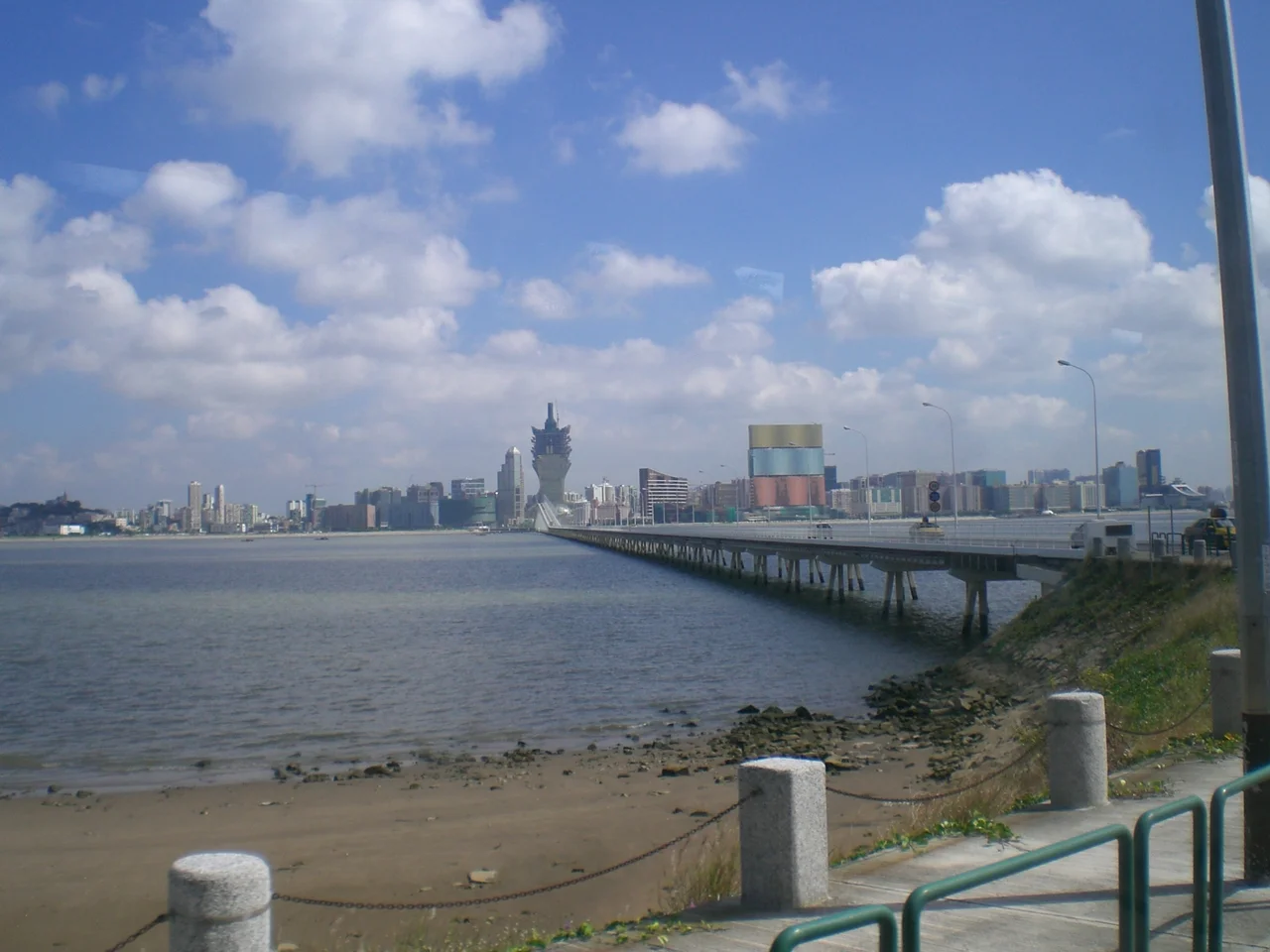

Governor Nobre de Carvalho Bridge
Before October 1974, getting from Macau's peninsula to the island of Taipa meant taking a boat. The crossing took about an hour. Governor José Manuel de Sousa e Faria Nobre de Carvalho had a different idea, and when his bridge opened — named for him, connecting Macau to Taipa across the former Baía da Praia Grande — the ferry became obsolete almost overnight. The bridge the locals would eventually just call "The Old Bridge" turned out to be a piece of urban symbolism as much as infrastructure: its designers shaped it to resemble a dragon, with Casino Lisboa at the dragon's head and a monument on Taipa Pequena as the tail.
The Governor With a Plan
José Manuel de Sousa e Faria Nobre de Carvalho served as Governor of Macau from 25 November 1966 to 19 November 1974. The bridge was his signature project, and his tenure ended within weeks of its completion — he left office having physically connected the colony's peninsula to its southern islands for the first time by road. The structure he commissioned is 2,436 metres long after a later rearrangement of the shoreline shortened it slightly from its original length. It was built as a toll bridge, but the toll was dropped in 1982 when traffic volume made collection impractical. The bridge does not belong to the governor's era anymore — it belongs to the city it helped create.
A Dragon Spanning the Harbor
The bridge's architectural concept is explicitly symbolic. Seen from above or from a distance, the span takes on the silhouette of a dragon — the Casino Lisboa tower at the Macau Peninsula end represents the creature's head, while the Taipa Monument on Taipa Pequena serves as the tail. Dragons carry weight in Cantonese cultural tradition: they bring fortune, they connect land and water, they are associated with the energy that animates a place. Building a bridge in dragon form across a harbor in a gambling city was not subtle, but it was intentional. The structural shape, which from certain angles resembles a flat triangle, reinforces the profile from a distance.
Fifty Years of Traffic and Change
The bridge carried everything Macau needed to move between the peninsula and Taipa for decades — vehicles, goods, people, and the casino economy that was already beginning its transformation of the islands. A second bridge, the Friendship Bridge, opened in 1994; a third, the Sai Van Bridge, followed in 2004. With three crossings available, traffic management changed: by 2006, the Governor Nobre de Carvalho Bridge had been restricted to buses, taxis, and emergency vehicles, preserving its function while reducing congestion. The bridge marked its fiftieth anniversary in October 2024. That same year, a Hong Kong-registered fishing vessel struck its protective rail — the boat sank, though the crew were rescued by the Macau Customs Service, and the bridge itself sustained only minor damage.
The Old Bridge in a New City
Macau today looks almost nothing like the Macau of 1974. The casino boom of the 2000s and 2010s transformed Taipa and the reclaimed land of Cotai into a landscape of resort towers, convention centers, and gaming floors that dwarf anything that existed when the bridge was built. The Governor Nobre de Carvalho Bridge now sits in the shadow of all that development, a modest 1970s span linking a crowded peninsula to an island that has become one of the world's most intense concentrations of gaming revenue. "The Old Bridge" earned its nickname honestly. It was the first, and for twenty years it was the only. The dragon's head still points toward Casino Lisboa; the tail still points toward Taipa. The creature has not moved.
From the Air
The Governor Nobre de Carvalho Bridge stretches at 22.1764°N, 113.5461°E, crossing the former Baía da Praia Grande between the southern Macau Peninsula and the northern slope of Taipa Pequena. From the air, all three of Macau's peninsula-to-Taipa bridges are visible in parallel — the Old Bridge is the westernmost and most slender of the three. Casino Lisboa (and the nearby Grand Lisboa tower at 261 m) provide a clear orientation anchor at the northern end of the bridge. Macau International Airport (VMMC) is approximately 4 km to the southeast. Approach from the south or west at 1,500–2,500 feet to see the full bridge span and its relationship to the peninsula and Taipa islands.
Nearby Stories
- 2024 Shenzhen Stabbing 0.8 km away
- Lantau Peak 1.5 km away
- Kweilin Incident 2.4 km away
- Taishan City 7 km away
- Wanshan Archipelago Campaign 38 km away
- Hong Kong 12 68 km away
- Battle of Nanpeng Island 82 km away
- Erhai Lake 1335 km away