
Grampian Transport Museum
On the floor of the Grampian Transport Museum, parked near a giant Mack snowplough painted bright municipal orange, sits a working steam waggon that has been hauling things since 1914. It is a Sentinel, built by the Sentinel Waggon Works in Shrewsbury, and as far as anyone knows it is the oldest example of its kind anywhere in the world. Around it, in a hangar-like building in the Aberdeenshire village of Alford, you can find a hydrogen bus that ran the streets of Aberdeen until 2020, a working model of Robert Davidson's 1837 electric locomotive (the first of its kind, also built in Aberdeen), and from 2025 onwards the actual props from the television series Top Gear. It is an oddly comprehensive history of how people have moved themselves around the north-east of Scotland, all in one place.
How A Museum Got Started in 1983
It started, as these things often do, with a small group of local enthusiasts in the early 1970s who wanted to put their growing collection somewhere the public could see it. In 1978 they held a public meeting after someone offered them the lease on the former goods yard north of the old Alford railway station, and the Grampian Transport Museum Association was born. They ran a pilot museum out of a local factory in 1981 and held the first Alford Cavalcade, a vintage vehicle rally, that July. The combination of public interest and grant funding from the local councils made the permanent museum possible. The current building was completed in September 1982 and the museum opened to the public in April 1983. It has grown steadily ever since, with an extension in 1998, a Collections Centre in the 2010s, and a new reception extension in 2016.
Robert Davidson and the First Electric Locomotive
Robert Davidson was an Aberdeen man, a chemist by training, who in 1837 built what is generally accepted as the world's first electric locomotive: a four-wheeled vehicle powered by zinc-acid batteries that ran on the Edinburgh and Glasgow Railway in 1842 at speeds approaching four miles per hour. The thing was wildly impractical at the time; the batteries were heavy and expensive, the railway company unimpressed, and steam dominated for another century. But Davidson had built the proof of concept. A working model of his locomotive is one of the centrepieces of the museum, an acknowledgement that Aberdeenshire's contribution to transport history runs deeper than most people realise. From the same county came Patrick Bell's reaper, John Loudon McAdam's road-surfacing technique, and a steady stream of engineers who exported their ideas to the wider world.
The Craigievar Express
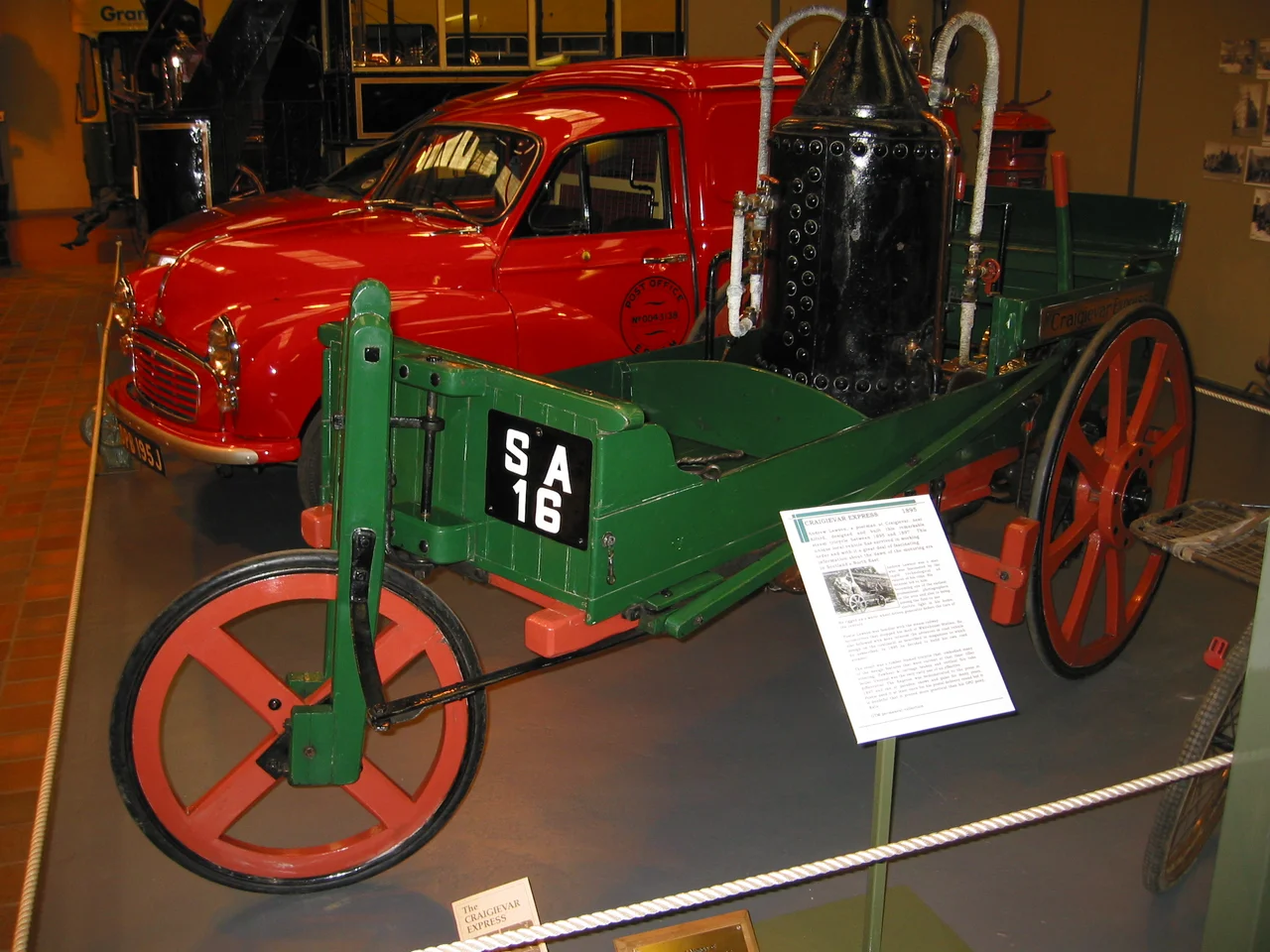
Tucked among the exhibits is the Craigievar Express, a steam tricycle built in 1895 by the local postman of Craigievar, just up the road, who needed a faster way to do his rounds. He named it after the local castle. It is a single-cylinder steam vehicle of his own design, hand-built, slightly Heath-Robinson in appearance, and it represents an entire forgotten chapter of British transport history when amateur inventors thought it was perfectly reasonable to construct their own steam vehicles in the back shed. The postman's name has not survived in the popular memory, but his machine has. It runs at the Alford Cavalcade most years, puffing slowly past spectators who tend to find it hard to believe what they are looking at.
From Hydrogen Buses to Top Gear
In 2020 Aberdeen ended its decade-long trial of hydrogen-fuel-cell buses, and one of those buses came to live at the museum. It is a strange, futuristic-looking thing parked among the antiques, a reminder that the museum's job is not just to preserve the past but to chronicle the present as it happens. In March 2025 the museum opened a new exhibition called And On That Bombshell, taking its name from Jeremy Clarkson's signature sign-off, and filled with vehicles created and used on the Top Gear television series, brought to Alford after the show wound up its long run. Cars made for ill-advised cross-Africa trips. A truck that was supposed to drive across the Bolivian salt flats. The hydrogen bus and the Top Gear oddities sit a few rooms apart, both equally part of how people thought about getting around in the early twenty-first century.
The Alford Cavalcade
Every July, the Alford Cavalcade vintage vehicle rally fills the museum grounds with steam cars, traction engines, vintage motorcycles, and the kind of brass-bound contraptions that draw their own crowds wherever they appear. The rally has been running since 1981, predating the museum itself, and it remains the museum's largest annual event. It is the day when the working exhibits actually move, when the Sentinel Steam Waggon hauls itself around the track, and when the Craigievar Express puffs along under its own steam. The museum runs other events through the season: rides in historic vehicles, special displays, themed weekends. The Grampian Transport Museum and the Alford Valley Railway are immediate neighbours, sharing access to the old railway yard.
From the Air
The Grampian Transport Museum sits at 57.23 degrees north, 2.70 degrees west in the village of Alford in the Howe of Alford, Aberdeenshire, about 23 nautical miles west of Aberdeen. The museum buildings and outdoor display area are on the former Alford railway goods yard, immediately adjacent to the Alford Valley Railway. Nearest major airport is Aberdeen (EGPD) approximately 25 nautical miles east. The upper River Don valley extends west toward the Cairngorms; Bennachie's distinctive Mither Tap summit lies a few miles to the northeast and is a useful navigation landmark.
Nearby Stories
- Glendronach Distillery 0.8 km away
- The Macallan Distillery 2.6 km away
- Aikey Brae Stone Circle 4.4 km away
- Brig o' Balgownie 4.4 km away
- Corgarff Castle 7.3 km away
- Fettercairn Distillery 12 km away
- Blairgowrie and Rattray 42 km away
- Eyemouth Disaster 117 km away