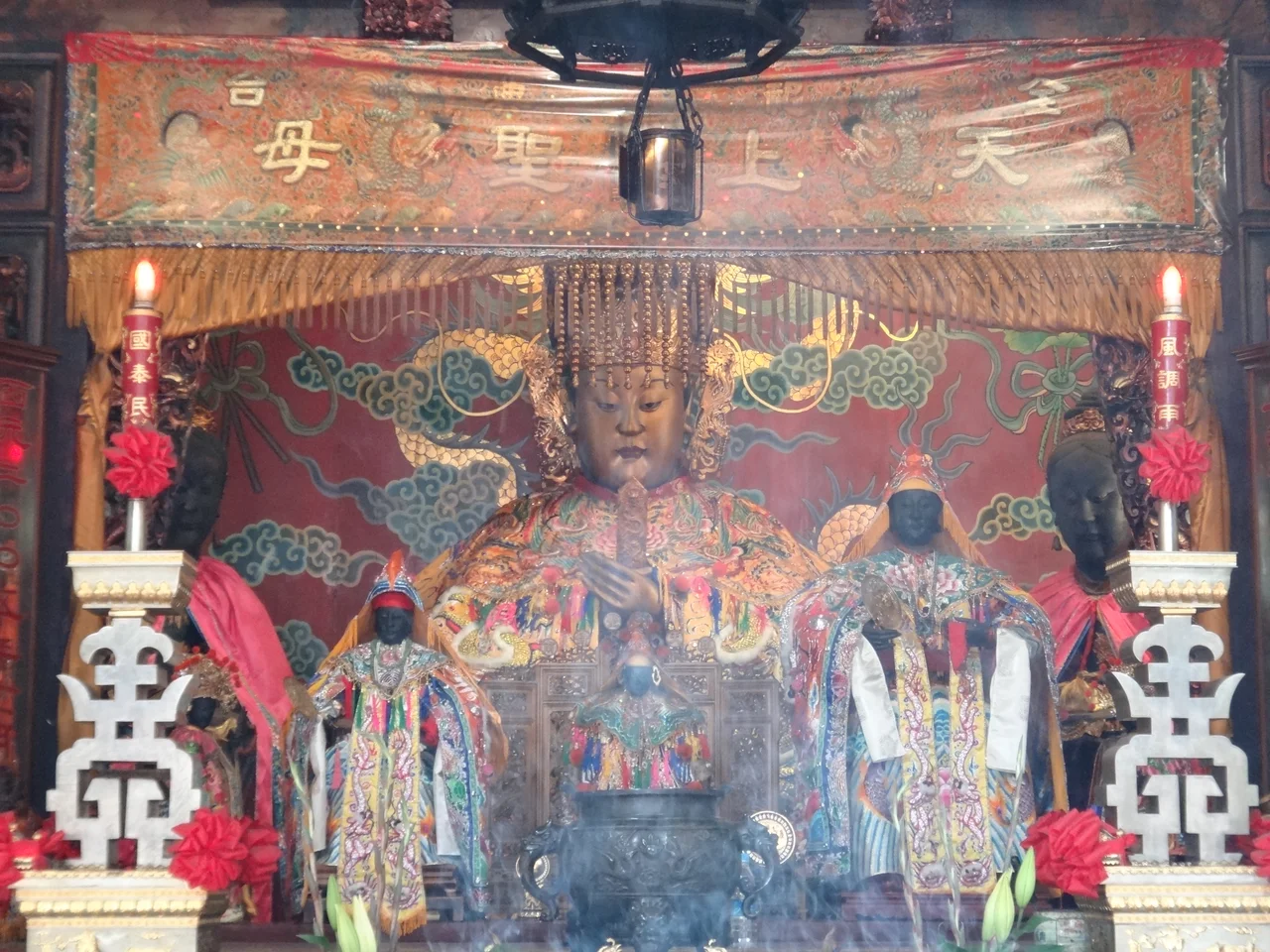

Grand Matsu Temple
Five women died in this building before it became a temple. They were the concubines of Prince Zhu Shugui — known as Prince Ningjing — a Southern Ming royal who had spent his final years in Taiwan watching the dynasty he served collapse around him. When Qing admiral Shi Lang's fleet defeated the Zheng dynasty at Penghu in 1683 and Taiwan's last resistance fell, the five women hanged themselves one by one from the beams of the palace bedroom. The prince followed the next morning. A year later, the palace became a temple to the sea goddess Mazu, the first in China or Taiwan to be granted the imperial title 'Empress of Heaven.' That title is still carved above the door.
A Palace Built for a Defeated Prince
The building that stands today in Tainan's West Central District began as something quite different: a royal residence constructed by Zheng Jing, son of the legendary Koxinga (Zheng Chenggong), for Prince Ningjing near Chikan Tower. The Southern Ming court had retreated to Taiwan after losing the Chinese mainland to the Qing dynasty, and Prince Ningjing — a member of the imperial family with no throne left to inherit — spent his final years in this compound. He helped clear farmland in the surrounding Chengtian Prefecture, living in a kind of gilded exile. When the Qing fleet finally extinguished the last embers of Ming resistance, there was no longer any place for him or his household in the new order. The tragedy that followed has never been forgotten in Tainan. A nearby temple, the Temple of the Five Concubines, still honors the women who died that day.
From Residence to Shrine
Shi Lang, the Qing admiral who had won Taiwan for the emperor, initially moved into the palace himself, making modifications to suit his tastes. Then he sent a memorial to the Kangxi Emperor proposing something more permanent: convert the residence into a temple dedicated to Mazu, the deified form of Lin Moniang, a medieval shamaness from Fujian believed to protect sailors and fishermen at sea. The Kangxi Emperor approved. In 1684, the palace became a temple, and Mazu was granted the new imperial title 'Tian Hou' — Empress of Heaven — a rank that superseded the 'Tian Fei' (Princess of Heaven) title her earlier temples had used. This made the Grand Matsu Temple the first Mazu shrine to bear that elevated name, giving it a particular precedence among the hundreds of Mazu temples that exist across Taiwan, China, and the Chinese diaspora.
The Goddess of Sea
Mazu remains one of the most widely venerated figures in Chinese folk religion, and her story is woven into the seafaring history of Fujian and Taiwan. She is understood as the deified spirit of a woman named Lin Moniang, born in Fujian in the tenth century, who was said to possess the power to calm storms and guide sailors safely home. As Fujianese emigrants crossed the Taiwan Strait in the seventeenth and eighteenth centuries — a dangerous passage in wooden junks — Mazu came with them. Temples dedicated to her appeared wherever fishing communities took root. The Grand Matsu Temple in Tainan, with its imperial pedigree and its extraordinary origin story, occupies a special place in that devotional geography. The main shrine hall, the incense burners, the Dragon Kings of the Four Seas and the Five Kings of the Water Immortals represented in the temple's iconography — all speak to an intimate relationship between a maritime people and a deity who answered them from the water.
Open and Free
The Grand Matsu Temple is open seven days a week with free admission, a detail that says something about how living religious sites function in Taiwan. This is not a preserved ruin or a managed heritage attraction. Worshippers come throughout the day to light incense, consult the divination blocks, and make offerings before the main shrine. The smell of sandalwood and incense fills the halls; the light shifts through the heavy wooden doors. The temple has survived more than three centuries of storms, political upheaval, Japanese colonial administration, and modern urban development. It remains what it has been since 1684: a place of active, continuous devotion at the center of one of Taiwan's oldest cities.
From the Air
The Grand Matsu Temple is located at approximately 22.9969°N, 120.2011°E in the West Central District of Tainan, near the landmark Chikan Tower (Fort Provintia). At 1,500–2,500 feet, the dense historic district of central Tainan is visible as a compact grid of red-roofed temple structures and older low-rise buildings. The nearest major airport is RCKH (Kaohsiung International), approximately 25 km to the southwest. Tainan Airport (RCNN) is the closer regional option, roughly 5 km to the west. The coastal plain around Tainan is flat and open, with the Taiwan Strait visible to the west in clear conditions.
Nearby Stories
- Chung Li-ho Museum 0.7 km away
- Jingzaijiao Tile-paved Salt Fields 8 km away
- Wanchin Basilica of the Immaculate Conception 9.3 km away
- Namasia District 16 km away
- Battle of Penghu 21 km away
- Shoushan (Kaohsiung) 21 km away
- Penghu Air Raids 62 km away
- Daya Bay 512 km away