.jpg)
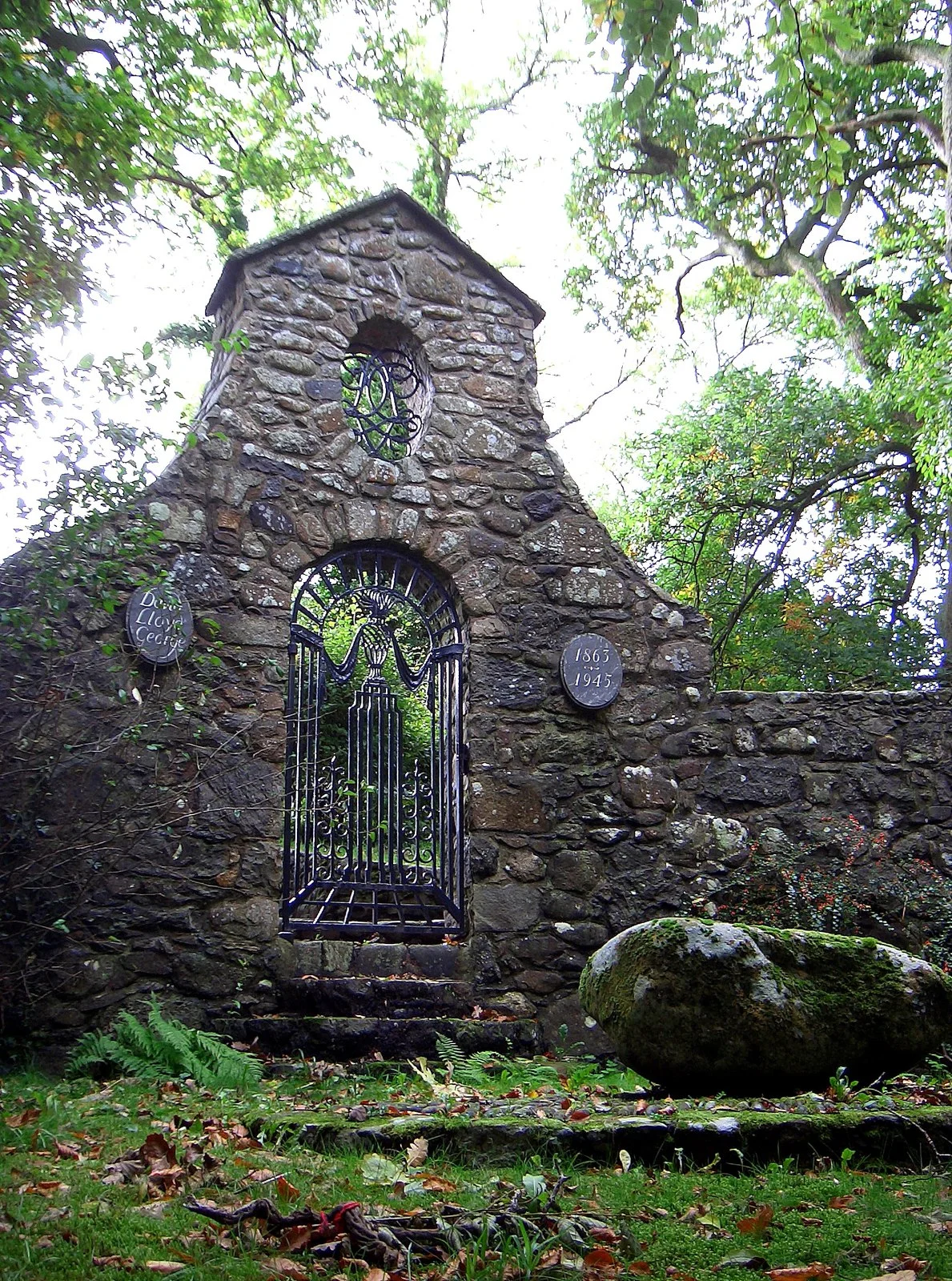
Grave of David Lloyd George
There is no headstone. The man who led Britain through the second half of the First World War, dismembered the Ottoman Empire, signed the Treaty of Versailles, gave women the vote, and was widely considered the most consequential British Prime Minister of the twentieth century before Churchill - the man buried in Llanystumdwy is buried not under a monument but under a boulder he used to sit on as a boy. The stone came out of the Afon Dwyfor, the river that runs through the village where he grew up. After his death, an oval enclosure was built around it. The design was by Clough Williams-Ellis, the same architect who built Portmeirion an hour up the coast. The whole thing was finished by March 1946, less than a year after Lloyd George died.
Born in Manchester, Raised in Llanystumdwy
David Lloyd George was born in Chorlton-on-Medlock, Manchester on 17 January 1863, where his father William George was a schoolteacher. Within months the family moved to Pembrokeshire. William died of pneumonia the following year, leaving the widow Elizabeth and her three children with little money. Elizabeth moved them again - this time to her brother Richard Lloyd's home in Llanystumdwy, the small Welsh-speaking village on the Llŷn where she had grown up. Lloyd George took his uncle's surname as the second half of his own, qualified as a solicitor in 1884, and was elected Liberal MP for Caernarfon Boroughs in 1890. He held the seat for fifty-five years, the longest continuous tenure of any constituency MP in twentieth-century Britain.
The Coalition Premier
Lloyd George became Prime Minister in December 1916 by displacing the Liberal premier H.H. Asquith in the middle of the war and leading a coalition with the Conservatives. He stayed at Number 10 until October 1922, when the Conservatives pulled out of the coalition and forced him out. He never returned to power, but he remained an MP until his death and a major figure in British politics throughout the inter-war years - sometimes as a constructive critic of orthodox Tory and Labour policy, sometimes as a frustrated outsider. By the 1940s his political relevance had faded. He died of cancer aged 82 on 26 March 1945, a week or so before VE Day, at his last home Tŷ Newydd in Llanystumdwy.
Frances Stevenson Commissions the Architect
Lloyd George's second wife, Frances Stevenson - who had been his personal secretary for thirty years before becoming his wife in 1943 - was suddenly a widow and, as the Dowager Countess Lloyd-George of Dwyfor, the person responsible for his memorial. She had already worked with Clough Williams-Ellis, the architect of the Italianate fantasy village at Portmeirion, who had renovated Tŷ Newydd for the Lloyd Georges. She commissioned him now to design the gravesite. Williams-Ellis built quickly despite the post-war restrictions on construction, and the memorial was complete by March 1946 - eleven months after the funeral.
Boulder, Pebbles, Englyn
The design is one of the most personal funerary monuments in Britain. The central feature is the river boulder under which Lloyd George is buried - a massive water-rounded stone he had favoured as a sitting place by the Dwyfor. The boulder rests on a plinth decorated with pebbles gathered from the beach at Criccieth, a few miles from Llanystumdwy where he had grown up. An oval enclosure of local stone rubble surrounds it. The entrance is through a wrought-iron gate set in a stone arch carrying a Welsh slate plaque, on which is carved an englyn - a strict-metre Welsh poem - composed by Lloyd George's nephew W.R.P. George. The lettering was cut by the sculptor Jonah Jones. Above the gate, a small oeil-de-boeuf window holds the wrought-iron initials DLG.
Dutch-Afrikaans by the River
The architectural historian Andrew Saint has noted, with some bemusement, that the style of the entrance arch reads more 'Dutch-Afrikaans' than Welsh vernacular - the curving lintel and the simple massing more reminiscent of Cape Dutch buildings than of Snowdonian cottages. Williams-Ellis was always idiosyncratic about borrowed styles, and the choice may have been deliberate. The materials are emphatically local: Welsh slate, Criccieth pebbles, Dwyfor stone, the boulder from the river itself. The whole monument is Grade II* listed. It sits in the village, beside the river, a few yards from the lanes Lloyd George walked as a boy - a Prime Minister returned to the streambank that produced him.
From the Air
52.92°N, 4.27°W on the bank of the Afon Dwyfor in Llanystumdwy, between Criccieth and Pwllheli. Best viewed at 1,000-2,000 ft to make out the small oval enclosure beside the river, set in trees a short distance south of the A497 through the village. EGCK (Caernarfon) is the nearest active airport, 13 nm north-west.
Nearby Stories
- GeoMôn 1.9 km away
- Battle of the Conwy 3.2 km away
- Irish Sea Bridge 5.2 km away
- Ysbyty Ifan 10 km away
- Machynlleth 16 km away
- Barmouth Lifeboat Station 23 km away
- Irish Sea 27 km away
- HMS Tyler 32 km away