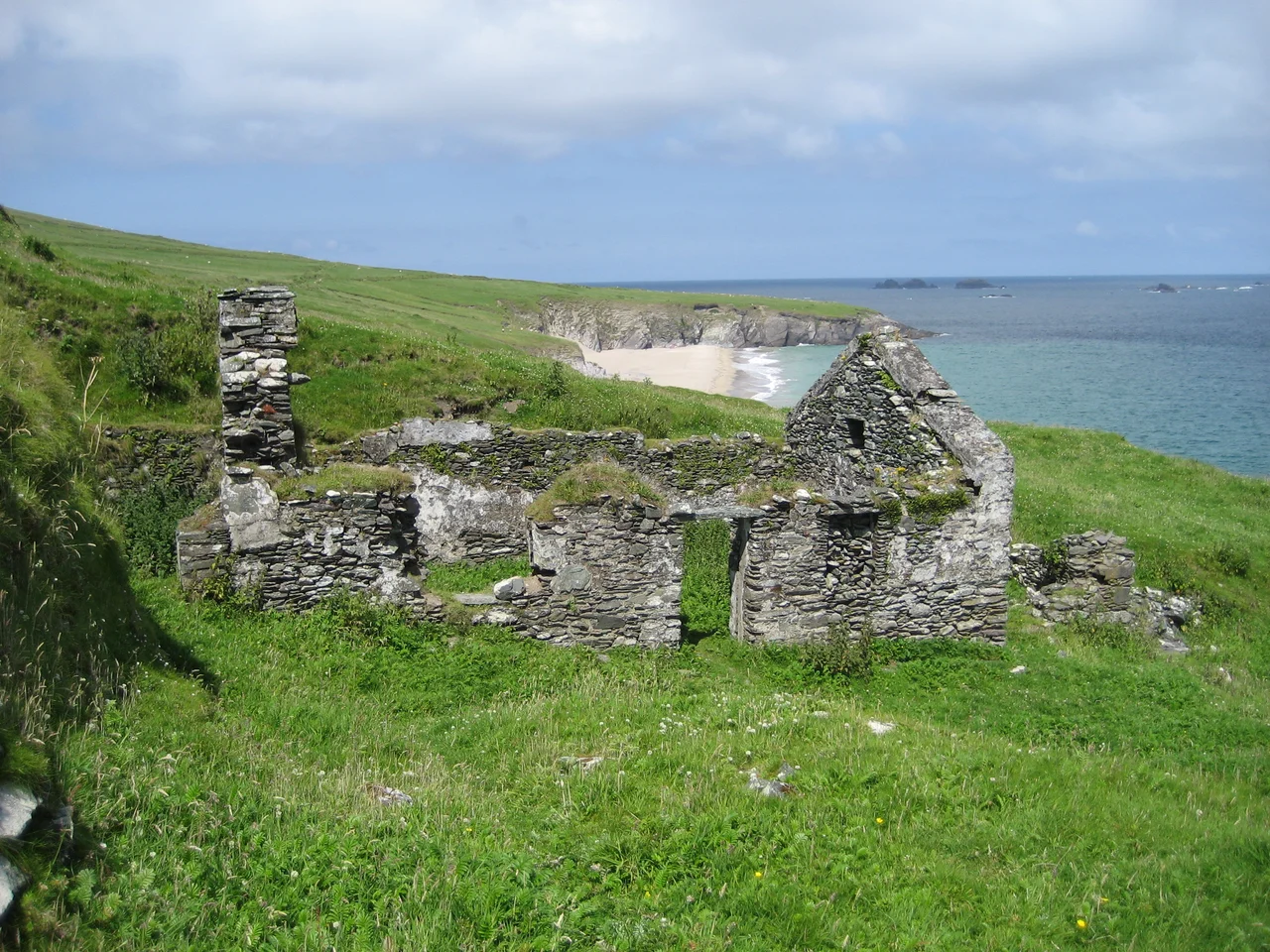

Great Blasket Island
Tomás Ó Criomhthain ended his memoir with a sentence that has haunted Irish letters for nearly a century: "the like of us will never be again." He wrote it from a stone cottage on Great Blasket Island, where roughly 150 of his neighbors lived without electricity, without a priest, without a doctor, and without anyone telling them what Irish they should speak. The island lies just two kilometres off Dunmore Head, the westernmost point of mainland Ireland, but in winter that gap could feel like an ocean. By 1953 it had become one, and the last twenty-two islanders were taken off for good.
A Cottage, a Notebook, Three Masterpieces
Considering how small the population was, the literary output is almost statistically unlikely. Tomás Ó Criomhthain, a fisherman with rough hands and an unsentimental eye, wrote An tOileánach (The Islandman) in 1929. Muiris Ó Súilleabháin followed in 1933 with Fiche Bliain ag Fás (Twenty Years A-Growing), the buoyant memoir of a young man's coming of age. Peig Sayers, who could neither read nor write Irish fluently, dictated stories that became Machnamh Seanmhná (An Old Woman's Reflections) in 1939. Together these books gave the modern Irish language something it badly needed: a literature written by people for whom Irish was simply the air. Scholars came from Norway, Germany, France and America to learn the dialect from islanders who treated their visitors with the same dry humor they reserved for everyone else.
The Death That Ended an Island
Living on Great Blasket meant accepting that the weather had veto power over your life. Birds nested in cliff hollows. Rabbits ran the slopes. Men launched naomhógs (tar-covered canvas boats) into the Blasket Sound to fish. In April 1947, the island was cut off for weeks, and the islanders sent a telegram to Taoiseach Éamon de Valera begging for supplies. A boat reached them two days later. But the breaking point came not from hunger; it came from a single death. When young Seánín Ó Cearnaigh fell ill, no doctor could cross the sound. No priest could either. His body lay on the island unable to be carried to the consecrated ground at Dunquin for days. The community understood, then, what they had been refusing to understand: they could no longer bury their own.
What Remains
Evacuation came in 1953 — the government brought the last residents to the mainland and gave them houses at Dunquin. The island grew quiet in the way only abandoned places do, with the wind moving freely through doors that no longer closed. Tomás Ó Criomhthain's restored cottage, opened by the Office of Public Works in 2018, is now free to visit. Peig Sayers' second island home has been restored too. Muiris Ó Súilleabháin's is in ruins. In summer a ferry runs from Dunquin, and two caretakers live each season in the old Congested Districts Board houses without electricity or hot water, replicating something of what the islanders endured. Tens of thousands of people apply every year for those two jobs. Whatever they think they're applying for — solitude, romance, escape — it is some echo of what the islanders were trying, finally, to leave behind.
The Island That Made Its Own Mind
What's remarkable about the Blasket books is how unsentimental they are. The islanders were not noble peasants performing for outsiders; they were people who saw exactly how hard their lives were and refused to pretend otherwise. Ó Criomhthain wrote about hunger, drownings, and back-breaking work with a directness that startled his urban readers. Sayers told her stories in the cadences of someone who had buried children and outlived her husband and watched her sons leave for America. Twenty Years A-Growing reads almost giddy by comparison, full of swimming and music, but its author too left the island and eventually took his own life on the mainland. The books are not laments. They are records — careful, honest, sometimes wry — of a way of being that the writers themselves could see was ending.
From the Air
Coordinates 52.0925°N, 10.5425°W. The island stretches six kilometres southwest from a high point of 346 m at An Cró Mór, and sits just west of Dunmore Head across the Blasket Sound. Best viewed from 2,000–4,000 ft AGL on a clear day, with the abandoned village clearly visible on the sheltered northeast shore. Nearest airport is Kerry Airport (EIKY) about 60 km east; Shannon (EINN) lies further north. Atlantic weather is unpredictable here — low cloud and strong winds are common even in summer.
Nearby Stories
- Ballyheigue Castle 1 km away
- Killemlagh Church 2.8 km away
- Pouldergaderry Sinkhole 6.8 km away
- Derreen Garden 11 km away
- Kilkee 59 km away
- The Laki Eruption: The Volcano That Changed World History 1366 km away
- The Northern Lights: The Sky Show That Vikings Thought Was Bridge to the Gods 1469 km away
- Sao Miguel 1935 km away