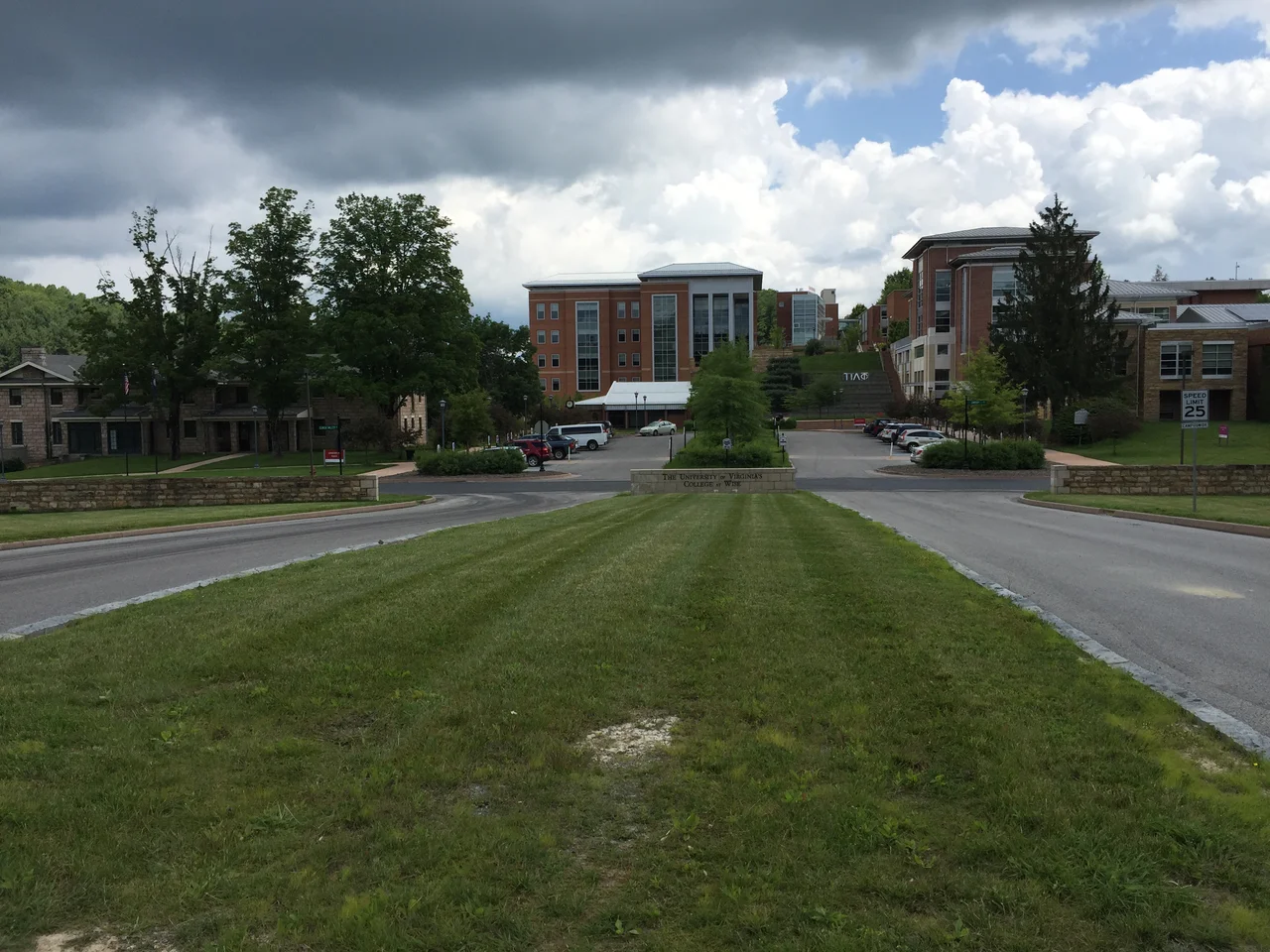
_at_the_University_of_Virginia%27s_College_at_Wise_in_Wise_County,_Virginia.jpg)
Grounds of the University of Virginia
On October 27, 1895, a professor named William Reddy Echols threw roughly a hundred pounds of dynamite into a burning building. The building was the Rotunda Annex at the University of Virginia, and Echols believed that if he could blow the Annex away from the Rotunda itself, he might save Thomas Jefferson's masterwork. He could not. The Rotunda burned to a brick shell that night, and a long fight began over what to put back in its place - a fight that took eighty-one years and the United States Bicentennial to finally settle.
The Academical Village
Jefferson did not call the place a campus. He called it an Academical Village, and the name still describes what he built: a community where students and professors lived together, where teaching happened in the same buildings as sleeping and eating, and where the architecture itself was supposed to teach. Ten Pavilions flank the Lawn, each rendered in a different classical style so that a student walking from end to end could read a survey of Western architecture. Behind the Pavilions sit walled gardens divided by serpentine brick walls - one brick thick, but strong because they wave back and forth in a sinusoidal curve. The Rotunda anchors the north end, half the height and width of the Pantheon in Rome. The south end Jefferson left open, looking out across cultivated land toward the mountains. The view to a Virginia of farms was the point.
The Fire and the Argument
After Echols's dynamite failed, the university hired Stanford White, the celebrity architect of the era, to rebuild. White did more than rebuild. He redesigned the Rotunda interior with two floors instead of three, added three new buildings to close off the south end of the Lawn, and erased Jefferson's open view of the countryside. For eight decades the Rotunda was White's Rotunda, not Jefferson's. Then in 1976, in concert with the Bicentennial, the university tore out White's changes and rebuilt the original three-story interior from Jefferson's sketches and historical photographs. The restored Rotunda opened on April 13, 1976 - Jefferson's birthday. Queen Elizabeth II walked the Lawn that year. The buildings White added at the south end still stand. The view to the mountains is still closed. The argument, in brick, continues.
A Library at the Center
Most universities of the period built around a chapel. Jefferson built around a library. The Rotunda's original purpose was to house the books, and Jefferson personally selected the founding collection and devised its catalog. The Rotunda served as the main library for over a century, until Alderman Library opened in 1937. In 2024 Alderman was renamed Shannon Library, after Edgar F. Shannon Jr., the university's fourth president. The system now holds more than five million volumes across roughly a dozen libraries. Shannon's stacks rise ten floors and shelter what is reportedly the most extensive Tibetan collection in the world. The Albert and Shirley Small Special Collections Library holds two copies of the Dunlap Broadside printing of the Declaration of Independence - the document Jefferson drafted, in the building he designed, on the grounds he laid out.
Living on the Lawn
Fifty-four fourth-year undergraduates live on the Lawn each year, in single rooms tucked between the Pavilions. Ten faculty members live permanently in the Pavilions themselves, teaching where they sleep. The rooms have fireplaces. They do not have plumbing - residents walk to bathhouses, even in winter. The honor of a Lawn room is one of the university's oldest and most coveted traditions. Far from the historic core, the architecture argument continues in modern brick and glass. Williams Tsien's postmodern Hereford College opened in 1992. The Darden School of Business opened in 1996, dressed in unapologetic Jeffersonian red brick and white columns. The university kept building both ways. In 2001 billionaire John Kluge gave the school 7,379 acres south of town, including the 2,913-acre Morven Farm. Five Kluge farms were sold to the musician Dave Matthews for an organic project supporting his nearby Blenheim Vineyards.
From Above
Seen from the air, the Lawn is a long green rectangle running roughly north to south, with the white drum of the Rotunda at its head. The ten Pavilions step down the sides like punctuation. Beyond them, the serpentine walls curl through the gardens in shallow waves. The university now sprawls well past Jefferson's original lines - dormitories, hospitals, research parks, a stadium - but the Academical Village remains legible from above, distinct from the modern campus around it. UNESCO recognized it as a World Heritage Site in 1987, paired with Monticello a few miles to the southeast. It was the first World Heritage Site dedicated to collegiate architecture anywhere in the world.
From the Air
The University of Virginia Grounds sit at 38.0298 N, 78.5177 W, straddling the City of Charlottesville and Albemarle County. Recommended viewing altitude is 2,500 to 4,000 feet AGL to read the Lawn's long green axis and the white drum of the Rotunda at its northern end. The nearest airport is Charlottesville-Albemarle (KCHO), about 4 nautical miles to the north. Monticello lies roughly 3 nm to the southeast - the two World Heritage sites can be flown in a single pass. The Blue Ridge crest rises about 20 nm to the west; afternoon convection there can produce turbulence and shifting visibility in summer. Best light for photographing the Lawn is mid-morning, when the Rotunda's dome catches the sun and the Pavilion shadows step crisply across the grass.
Nearby Stories
- Augusta County Training School 10 km away
- A. P. Hill Boyhood Home 18 km away
- Reddish Knob 20 km away
- Amherst County, Virginia 21 km away
- Appalachian Trail 21 km away
- Fork Union Military Academy 28 km away
- Huguenot Memorial Chapel and Monument 39 km away
Sources
- Grounds of the University of Virginia - Wikipedia
- The Rotunda (University of Virginia) - Wikipedia
- Board of Visitors votes to name renovated library The Edgar Shannon Library | UVA Library
- Monticello and the University of Virginia in Charlottesville - UNESCO World Heritage Centre
- University of Virginia - Wikipedia