
Hämeenkyrö
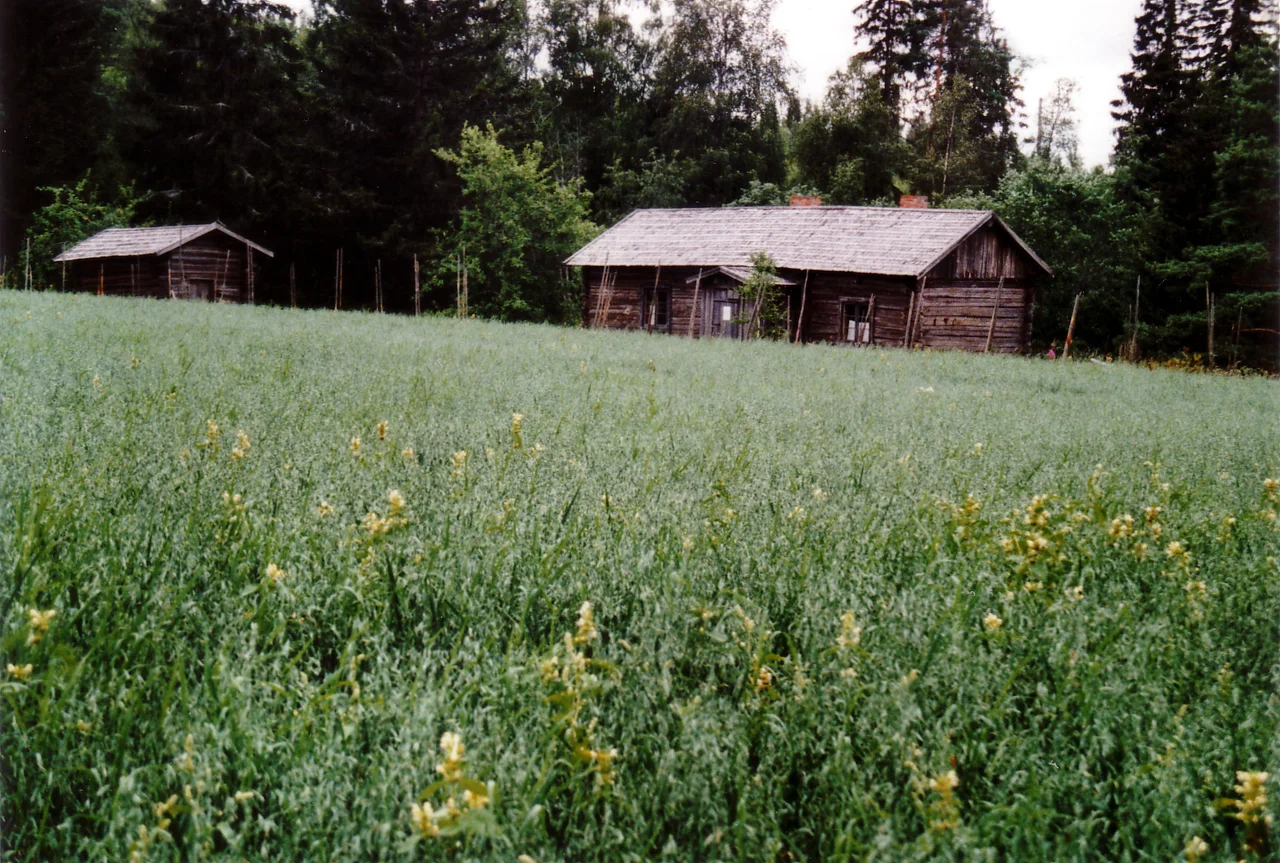
Two children had been born in the cottage at Myllykolu before this one, and both had died small. The third arrived on 16 September 1888 and was given the name Frans Emil. His father was a cottager from Kauvatsa, his mother had been a servant girl in the parish, and the two had married six years earlier owning almost nothing at all. Fifty-one years later that child became the only Finn ever awarded the Nobel Prize in Literature, honoured for his deep understanding of his country's rural people and the art with which he portrayed their lives. Hämeenkyrö is where the understanding came from. It was not a literary pose. He was one of them.
A Rented Hut in Kierikkala
Frans Henrik Koskinen and Loviisa Vilhelmina Mäkelä held their rented hut in the village of Kierikkala, and later bought a former shoemaker's cottage at Töllinmäki. Their surviving son did well enough at the village schools that they gambled on the lyceum in Tampere, a gamble the family could afford only because his father had opened a small general store and the household had crept a little way up. In 1908 the boy entered the University of Helsinki to read medicine. Five years later he abandoned it, went home, and started writing instead.
The Civil War of 1918 caught him squarely in the middle. He was arrested in turn by both sides and condemned the killing done by both. Out of that summer came Hurskas kurjuus — published in English as Meek Heritage — which follows a crofter named Juha Toivola from the famine years of the 1860s to the spring of 1918, when he is shot for a murder he did not commit. It appeared in 1919. It flattered nobody, and it was meant not to.
Twenty-Two Metres of Falling Water
The rapids at Kyröskoski drop about twenty-two metres, which makes them one of the steepest falls in Finland and, by long tradition, one of the three great cataracts named in the Kalevala — Hämeen Hälläpyörä, the whirlpool of Tavastia. Painters came for it. Werner Holmberg put it in oils in 1854, Magnus von Wright drew it, and a travelling Swede had sketched it as early as 1799.
Farmers came for entirely different reasons. Three times in the nineteenth century the households around the lake dredged the outlet to lower Kyrösjärvi and win farmland from the shallows; the third attempt, in 1865 and 1866, consumed something like twenty thousand working days. Industry followed almost immediately. A Tampere partnership set up wood processing at the falls in 1870 and was making paper by 1878, and a mill has run there under a succession of owners and names ever since. Four times each summer the sluice gates are opened and the rapids are permitted, briefly, to be rapids again.
Number Thirteen on the List
In 1994 Finland's Ministry of the Environment named twenty-seven landscapes to stand for the country as a whole, a considered echo of the seventy-fifth anniversary of independence two years before. Hämeenkyrö's cultural landscape is thirteenth on that list. What earned it the place is a chain of water — Kyrösjärvi, the Pappilanjoki, Kirkkojärvi, Mahnalanselkä — that splits the municipality down the middle from north to south, with the fields and farmhouses gathered tight along its banks and forested upland stretching away behind. Seinävuori, in the southeastern corner near the Nokia boundary, tops out at 188.7 metres.
The parish church, raised between 1780 and 1782 to drawings from the intendant's office in Stockholm, stands where an older wooden one had stood since the 1640s. This is a working landscape rather than a wild one, and that is precisely the point of it. Most of the municipality's ten thousand residents live at Kyröskoski, in the shadow of the mill.
A Parish That Arrived With Nothing
When the wars ended, Finland had to find homes for the people of the territory it had ceded. Among them were the inhabitants of Pyhäjärvi, a parish on the Karelian Isthmus that is now the Russian town of Otradnoye. Most of them were resettled here.
They did not come as scattered individuals. Finland's resettlement laws moved communities more or less whole, compulsorily buying land from existing farms and cutting new smallholdings out of it, so that a Hämeenkyrö farmer might find his fields halved while a Karelian family cleared stumps at the edge of them. Neither party had chosen what it lost. Across Finland the evacuated parishes kept their societies, their dialects and their names alive for decades after the ground itself was gone, holding an idea of a place that no longer existed in any atlas. Hämeenkyrö's share of that long story belongs to Pyhäjärvi.
What Sillanpää Built
Success let the writer build a house. Saavutus — "Achievement" — went up in the village of Vanaja and was ready to move into by December 1920, a neoclassical villa designed by a schoolfriend from his Tampere lyceum days, an architect from the next parish over. It was never quite finished. Sillanpää's money troubles began with it and never really ended; the Nobel Prize in 1939 arrived in a year that had already taken his wife.
The town has not been shy about the connection since. The upper school and the high school carry his name, and the cottage at Myllykolu is preserved as the museum of his birthplace. Hämeenkyrö remains what it was when he wrote about it: a farming parish that happens to have produced a Nobel laureate, and has never entirely got over it.
From the Air
Hämeenkyrö sits at 61.63°N, 23.20°E in Pirkanmaa, some 40 km northwest of Tampere along Finnish national road 3 (E12). Best viewed from 3,000–5,000 ft AGL: the defining feature from the air is the north–south water chain of Kyrösjärvi, the Pappilanjoki, Kirkkojärvi and Mahnalanselkä, with cultivated fields hugging the shorelines and unbroken forest on the uplands either side. The paper mill and the settlement at Kyröskoski mark the drop where the lake empties southward. Nearest controlled field is Tampere-Pirkkala (EFTP), 40 km southeast; Pori (EFPO) lies 95 km west and Jämijärvi airfield (EFJM) about 40 km northwest. Summer brings long twilight and generally good visibility; winter days are short, and lake ice and low sun can wash out the water features entirely.
Nearby Stories
- Sastamala 6.4 km away
- St. Henry's Chapel 12 km away
- Näsijärvi 12 km away
- Finnish War 14 km away
- Helvetinjärvi National Park 23 km away
- Akaa 26 km away
- Villa Mairea 33 km away
- Kauhajoki School Shooting 64 km away