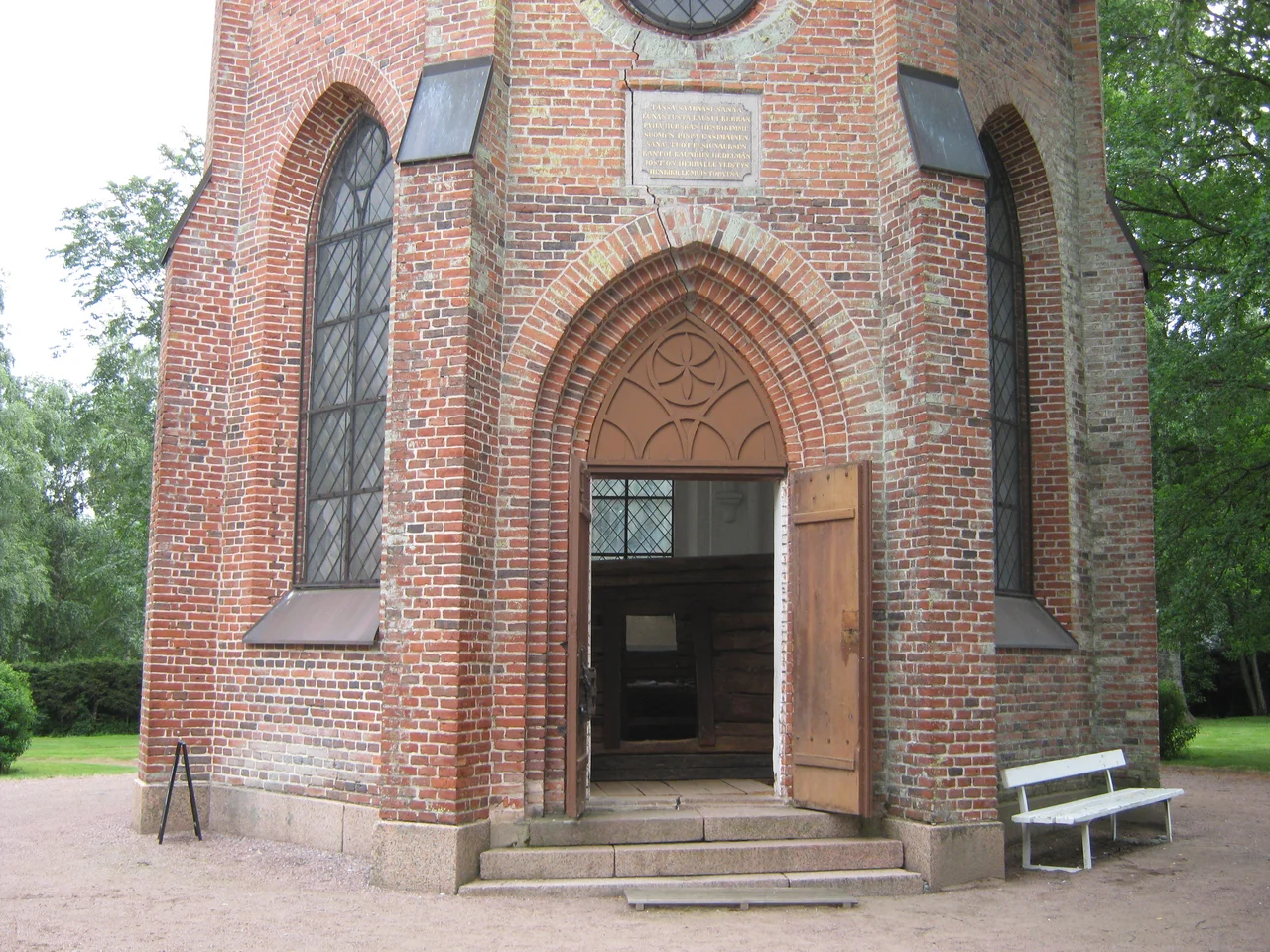

St. Henry's Chapel
Step inside the octagonal brick chapel at Kokemäki and you find another building. A log shed, roughly 3.7 by 4.4 metres, stands in the middle of the floor like an exhibit — which is precisely what it is. The neo-Gothic shell was raised in the 1850s for no other reason than to keep the weather off the thing inside it. Tradition holds that this shed is where Bishop Henry preached, and where he slept his last night before a farmer named Lalli killed him on the ice of Lake Köyliö. The tradition is why the chapel exists. It is also the part that tree rings later complicated.
The Shed
Finns call it the saarnahuone, the preaching house, though it began life as an aitta — a log granary, the standard storehouse of the Finnish farmyard. It stood in the village of Ylistaro, a kilometre east of what is now the centre of Kokemäki, on the bank of the Kokemäenjoki. Its corner joinery is a rare type in Finland and may show early medieval Hanseatic influence. Inside, the walls are dense with carved names and marks left by visitors across centuries, once treated as damage and now read as record — a guest book cut into wood. Whatever its origins, the building is widely considered the oldest surviving wooden structure in Finland, which counts for a great deal in a country that built almost everything out of timber.
What the Tree Rings Said
Logs can be dated. Samples were taken in 1990 and again in 2003 and analysed at the University of Joensuu, and the answer came back awkward: the oldest timbers were felled in 1472 and 1473, with others running down to the 1780s. Three centuries too late for Henry. The case is not entirely closed, because not every log could be dated and rotting timbers in a building this old get swapped out over the generations, so an earlier core cannot be ruled out. The honest summary, though, is that the shed is late medieval and the twelfth-century bishop is a tradition attached to it rather than a fact embedded in it. Even so, a building from the 1470s is still Finland's oldest wooden one.
Preserved by Decree
In October 1839 the Senate of Finland decided the shed should be protected as a national monument, which is a strikingly early date for that kind of thinking anywhere in Europe. Money took longer. A fire in 1852 disrupted the brick supply, and building began only afterwards. Pehr Johan Gylich drew the shelter: an octagon 8.4 metres across, seven pointed-arch windows, a spire clad in copper that was eventually replaced in 1989. Georg Theodor von Chiewitz laid out an English-style park around it. The chapel was consecrated on 18 June 1857 — Saint Henry's summer feast, and the date Finland was then marking as the 700th anniversary of its Christianisation. Roughly five thousand people came. It has a fair claim to being the country's first museum of cultural history.
Leaning Toward the River
The ground here was never good. The chapel has been tilting toward the Kokemäenjoki for over a century — 21.5 centimetres out of plumb when it was measured in 1975, 25.1 by 2006 — pulled by weak soil and by bank erosion associated with the Kolsi hydroelectric station upstream, running since the 1940s. Repairs came in 1976 and in the decades after. The surroundings carry their own losses. This stretch of river is the presumed site of the Iron Age settlement of Teljä, and the medieval village of Ylistaro that once stood here burned in the 1830s. In 2002 a bronze bust of Henry by the sculptor Emil Cedercreutz, who died in 1949, was unveiled in the park — a portrait that waited a long time for its plinth.
The End of the Road
Saint Henry's Way finishes here. The 140-kilometre pilgrimage route from Turku Cathedral runs north through Nousiainen and past Lake Köyliö before ending at this chapel, and an ecumenical pilgrimage walks it every third year. The door is normally locked; keys live at the city hall and the pastor's office, and there are staffed hours in summer. It is worth the arranging. Inside the brick octagon, in the half-light, you can put a hand on logs that were standing trees in the 1470s and read the names of people who came to see them centuries later. The bishop may be a legend. The wood is not.
From the Air
St. Henry's Chapel sits at 61.2575°N, 22.3717°E, on the bank of the Kokemäenjoki about a kilometre east of the centre of Kokemäki in Satakunta. The chapel itself is small — an 8.4-metre octagon with a copper spire — so navigate by the river, which is broad and obvious here, and by the town. Piikajärvi Airfield (EFPI), a glider field at 45 metres elevation with two runways of roughly 1,000 and 1,080 metres, lies about eight kilometres southwest of town; Eura Airfield (EFEU) is to the south, and Pori (EFPO) and Tampere-Pirkkala (EFTP) are the nearest served airports. Fly the river corridor at 1,500 to 2,500 feet AGL — it also passes the Kolsi hydroelectric station upstream and, further southeast, Lake Köyliö with Kirkkokari in it, which puts the whole legend in a single leg. Long summer daylight; expect low cloud and short days from November through February.
Nearby Stories
- Kokemäenjoki 5.9 km away
- Sastamala 9.6 km away
- Liinmaa Castle 11 km away
- Church of Loimaa Proper 15 km away
- Vaskijärvi Strict Nature Reserve 17 km away
- Hämeenkyrö 22 km away
- Pyhämaa 24 km away
- Villa Mairea 25 km away