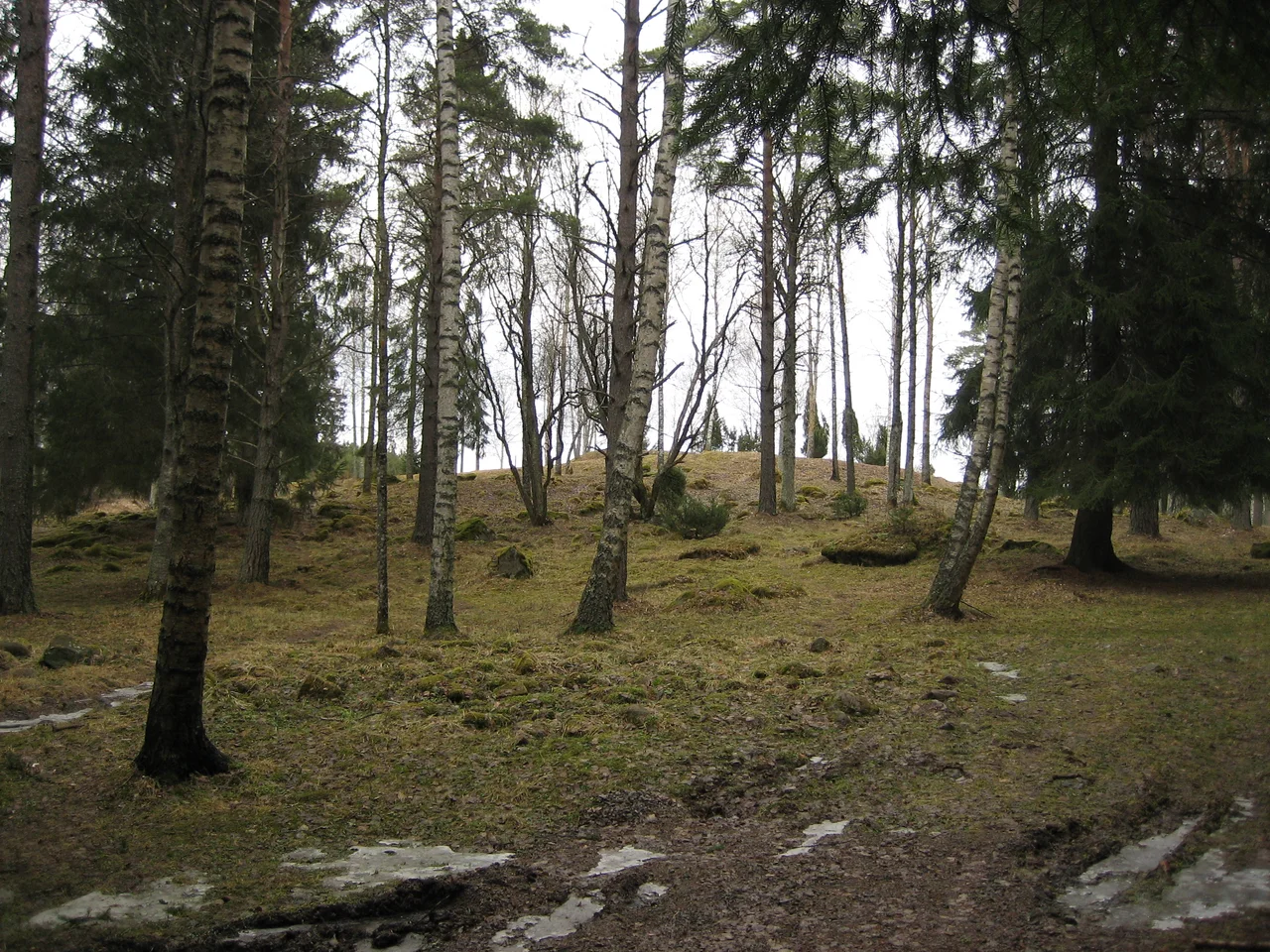

Liinmaa Castle
A rhyme outlived the castle it remembered. Ei silloin hyvin eletty, cuin oli Linna Lijnamaisa, it begins — we did not live well then, when the castle stood at Liinmaa — and then it prices the misery out. Bread cost a cow. A crumb cost a yearling calf. Whatever the fortress at Eurajoki was built to protect, the people who paid for it filed it under hard bargains, and they were still saying so generations after the last garrison walked out. The verse survives. So do the earth ramparts, running low and green through a field a few hundred metres from a sea that has since retreated.
A Castle Ordered to Move
Liinmaa exists because another castle came down. In 1367, King Albrekt of Mecklenburg issued a letter — preserved in the Black Book of Turku Cathedral, with a later hand adding the heading super castro in Kwmo demoliendo — concerning the demolition of the stronghold at Kokemäki and its transfer downriver to Eurajoki. The reason was probably arithmetic. Supplying a castle had become too heavy a burden on Kokemäki's peasants, and moving the garrison moved the cost. It also filled a gap: the 1360s brought a push to thicken the realm's network of castles and administrative centres, and Eurajoki completed a chain along a coast that mattered. The name that stuck, Vreghdenborg in Swedish and Vreghdenborch in German, is thought to come from Didrik Vieregge, the German nobleman who had the place built.
Timber, Brick, and a Wall Beneath the Water
Finland's medieval castles are mostly grey stone. Liinmaa was not. Excavators turned up brick fragments in quantity but never one intact brick, which led the archaeologist Jukka Luoto to argue for Fachwerk construction: a timber frame with the panels between the beams filled in with brickwork, a technique at home in the medieval towns of southern Scandinavia. The plan was a rectangular bailey holding three or four building foundations, wrapped by an inner and an outer rampart with a ditch between them. On the seaward side, under the waterline, ran a low stone wall believed to have carried stakes — an obstacle meant to keep warships from coming straight in. This was a fortress designed for the warfare of its own century: arrows, scaling ladders, and engines that threw stones.
Pirates, Copper Serpents, Iron Nails
Local tradition insisted the place had been a nest of sea robbers, and tradition may have had a point. Between 1369 and 1399 the Vitalian Brothers, privateers backed by towns loyal to Mecklenburg, worked the Gulf of Bothnia from a base at Korsholm Castle and harried Swedish and Hanseatic shipping along exactly this coast. Around that plausible core, folklore built freely. A great hoard was said to lie buried in the castle earth. People were still digging for it in the 1600s, and in the late 1800s a crofter worked the mound and came away with a handful of iron nails. One version hands the treasure to Mikko Simonpoika, a man accused of witchcraft in the early 1700s. Another has Ostrobothnians talking their way into the cellar and leaving a great copper serpent coiled over whatever remained.
The Lord Who Sank His Own Son
The bleakest of the Liinmaa stories was still being printed in newspapers in 1898. The lord of the castle, it goes, was expecting a ship out of Sweden carrying a cargo of brick, with his son aboard. As a joke, the boy ran an enemy flag up the mast. The lord sank the ship. When he understood what he had done, he shut himself in the cellar with his treasure and burned himself, the gold and the castle together to ash. Whether any of it happened matters less than what it preserved — a memory of Liinmaa as a place where power ended badly, handed down by people who had no documents and no need of them. The castle did fall out of use in the course of the 1400s.
The Sea Walked Away
In its working years the castle stood on an island between the mouths of two rivers, the Eurajoki and the Lapinjoki, well placed to watch and tax anything moving into either. That geography no longer exists. Post-glacial land uplift has been lifting this coast clear of the water for ten thousand years, and the sea now lies a few hundred metres off, with meadow and scrub where the anchorage used to be. What survives is earth — the ramparts, the ditch, the rectangle of a bailey legible in the grass. Archaeologists came in the 1970s and returned in 2004 and 2005, and a great deal is still down there. The site stays open all year, tended by the Liinmaa heritage association, with a fire pit, an outdoor privy, and guided tours bookable through Eurajoki for anyone who wants the shape of it explained.
From the Air
61.2180N, 21.6088E, in Eurajoki on the Satakunta coast, roughly 11 kilometres northeast of Rauma. The castle itself is a low grassy mound with earth ramparts and no standing masonry, so it is hard to pick out from altitude; navigate instead by the Olkiluoto nuclear power station about 9 kilometres west-northwest, whose reactor buildings and shoreline are unmistakable, then work inland along the Eurajoki river. Pori Airport (EFPO) lies about 30 kilometres north-northeast and Turku (EFTU) roughly 86 kilometres southeast. Best viewed from 1,000 to 2,000 feet in low sun, when the rampart shadows pick out the rectangular bailey. Note the Olkiluoto restricted airspace when planning any close approach from the west.
Nearby Stories
- Kokemäenjoki 5.1 km away
- Kokemäki Castle 8.4 km away
- Pyhämaa 14 km away
- Vaskijärvi Strict Nature Reserve 18 km away
- Ikaalinen 56 km away
- Archipelago Sea 78 km away
- Battle of Bomarsund 125 km away
- Härnösand Cathedral 205 km away