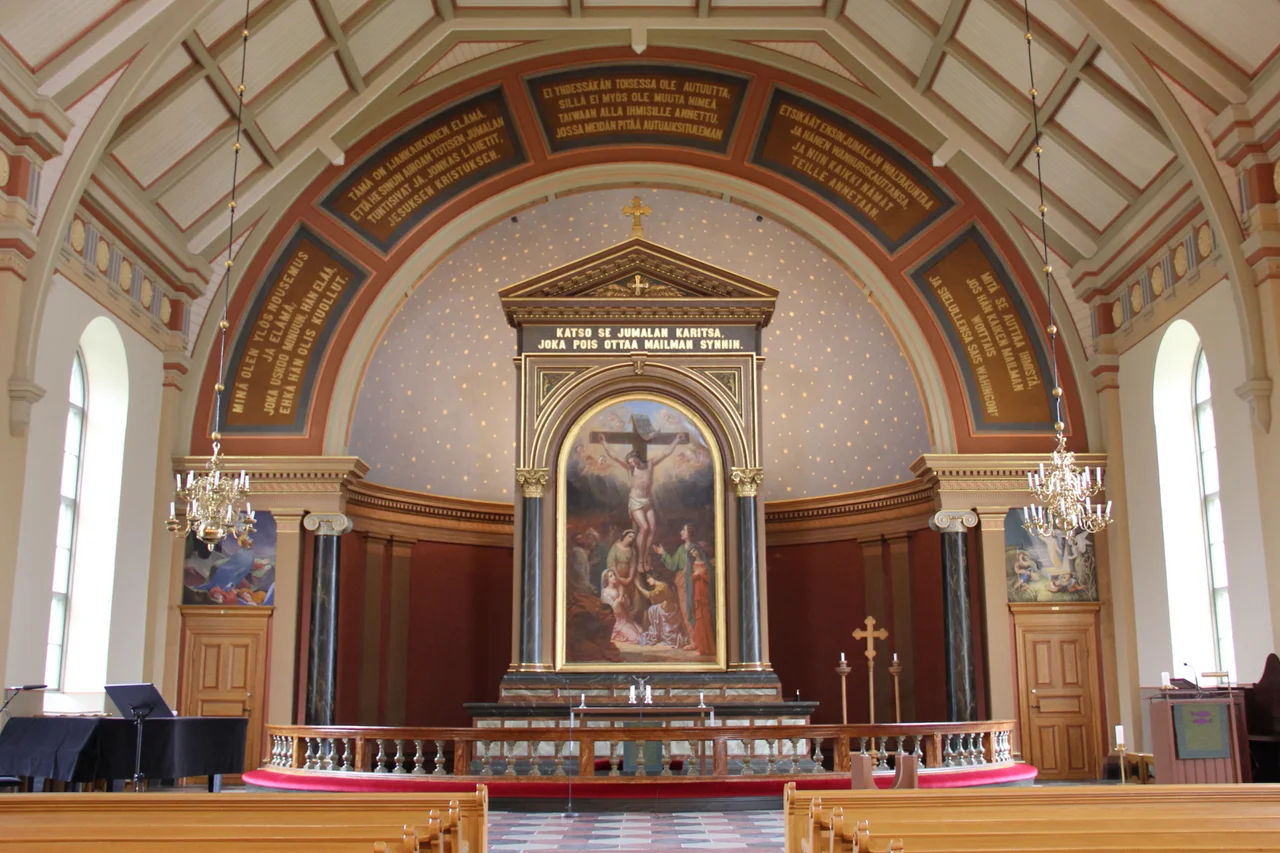

Church of Loimaa Proper
Long before there was anything here to burn, a woman is supposed to have said the church would burn. Prättäkitti — the name is a nickname, and nobody can now say with certainty who wore it — lived at the Manninen farm in Loimaa, in the part that is today Ypäjä. Legend places her in the 1600s, though some accounts attach the name instead to a nineteenth-century housewife of the same house. She is said to have foretold an iron belt laid across the land and an iron carriage that no horse would pull; the railway reached Loimaa in 1876. She is also said to have foretold that the church would burn. In August 1888, lightning struck the top of the tower.
The Third Church
Loimaa has had a parish since the 1420s, and this is its third church. The first two were wooden and stood nearer Oripää, at the old centre of a parish whose boundaries have been redrawn many times since. The wooden church of 1751 was eventually taken down and moved to Alastaro, which is the sort of thing that happened to Finnish country churches: too useful to abandon, too small to keep. Its replacement went up at Hirvikoski in 1837, on the flat farmland where the population had drifted, and it seats a thousand. In a landscape with no hills to speak of, the tower does the work that geography refuses to do. You see it long before you see the village, from any road in.
Two Architects, One Set of Drawings
The drawings are Charles Bassi's, made in 1824. Born Carlo Francesco Bassi in Turin in 1772 and brought to Sweden as a child, he trained at the Royal Swedish Academy of Arts and became the first professionally trained architect to settle permanently in what is now Finland. From 1810 to 1824 he ran the government office responsible for church designs, which is why so many parishes of that generation share his restrained Neoclassicism — closer to Gustavian sobriety than to the grander manner his successor Carl Ludvig Engel would make into a national style. Loimaa's church was drawn for grey stone. When the material was changed to brick, it fell to Engel to adjust the plans. Construction dragged on. The building was finished in July 1837 and consecrated that August by Archbishop Erik Gabriel Melartin. Bassi died three years later, in Turku.
What They Carried Out
Then August 1888. Lightning hit the top of the tower, the fire caught in the wooden roof structure, and it came down into the body of the church. Whatever people could carry out into the field, they saved — most of the movable furnishings, the altarpiece painting among them. The brick walls stood. That mattered more than anything else, because it meant the parish was rebuilding rather than beginning again; the new church could rise on the surviving structure and the old foundation. The work went to Josef Stenbäck, then in his thirties, who would go on to design thirty-five churches across Finland and become far better known for Gothic Revival and National Romantic work such as Mikkeli Cathedral and the Juselius Mausoleum. Here he did something harder and much less visible. He followed Bassi's drawings, by then well over half a century old, as closely as he could manage. The church was back in use in 1892.
The Painting That Stands Free
The altarpiece rewards the walk up the aisle. Its central painting is not set into a frame built against the wall; it stands free, and the sacristy sits directly behind it, reachable from either side of the altar. The picture is Kristus ristillä — Christ on the Cross — painted in 1850 by R. W. Ekman. Ekman (1808-1873) is foundational in Finnish art. He founded the Turku School of Drawing in 1846 and led it until his death, frescoed Turku Cathedral, and did more than anyone of his generation to put the Kalevala and ordinary Finnish life onto canvas. He painted more than thirty altarpieces for churches around the country. This is the one that survived a fire because somebody picked it up and walked out with it.
Prättäkitti Still Gets a Day
The pulpit is rarely used now. The carved box stands as furniture with a job it no longer does, and the church itself, together with the parsonage beside it, is protected by the Finnish Heritage Agency. As for Prättäkitti, Loimaa has not let her go: a day in her name falls in late February or early March, with witch costumes in the shop windows. Her legend has collected the usual apparatus over the centuries — that she came from Nousiainen, that a farmer named Teppo spotted her rowing a boat in Turku and married her, that her powers came from a midwife who was herself a witch. Accounts disagree about exactly what she said and how long beforehand. She is also supposed to have said that the church would one day kill its congregation. That one has not happened.
From the Air
60.8756°N, 22.9750°E, at Hirvikoski in Loimaa, roughly 60 m above sea level. The tower is the single best visual reference for miles in an almost perfectly flat agricultural plain; the Loimijoki and the Turku-Toijala railway line run nearby and make useful ground tracks. Turku (EFTU) is about 55 km southwest, Forssa (EFFO) about 35 km east, and Helsinki-Vantaa (EFHK) about 110 km southeast. Recommended viewing altitude 1,500-3,000 ft AGL, which keeps the tower and the surrounding field pattern in the same frame. Visibility is generally excellent in summer; autumn and winter bring persistent low stratus over the plain, and the same convective weather that produced the 1888 strike still delivers summer thunderstorms.
Nearby Stories
- Koijärvi 6.9 km away
- Hiidenlinna 11 km away
- St. Henry's Chapel 12 km away
- Vaskijärvi Strict Nature Reserve 15 km away
- Huittinen 18 km away
- Old Castle of Lieto 19 km away
- Paimio Sanatorium 26 km away
- Tursiannotko 31 km away