
Koijärvi
The excavator came for the dam in April 1979, and the young people chained themselves to it. Koijärvi is a shallow lake in the flat farm country north of Forssa — reeds, open shallows, the smell of warm mud in June — the kind of water a driver passes without turning his head. By the 1970s it was also the most important bird lake in southwest Häme, and the landowners around it had begun draining it while the water court case was still pending. What followed turned a local dispute over ditches into the founding story of Finnish environmental politics.
Forty-Six Years on the Map
Koijärvi was a municipality for less than half a century. It was carved out of Tammela and Urjala in 1923 — the same year Forssa was separated from Tammela — and it covered 174.5 square kilometres of field, forest and bog. At the end of 1968 it had 2,262 inhabitants. A year later it was gone: 2,103 people went south to Forssa, 159 north to Urjala, and the name survived on lake charts, road signs and letterheads nobody hurried to replace.
It never got around to a coat of arms. Through the 1960s, Koijärvi was one of only two Finnish municipalities without one, sharing that distinction with Uudenkaupungin maalaiskunta. For a place about to hand the country a political movement, it was a modest send-off.
At Kojo
The main village, Kojo, is older than the municipality by centuries. It surfaces in the records in 1600 as Quoiuull, a scribe's attempt at the Finnish adessive — "at Kojo" — which modern orthography writes Kojolla and which Tavastian dialect speakers clip to Kojol. Names here wear down like stones in a ploughed field.
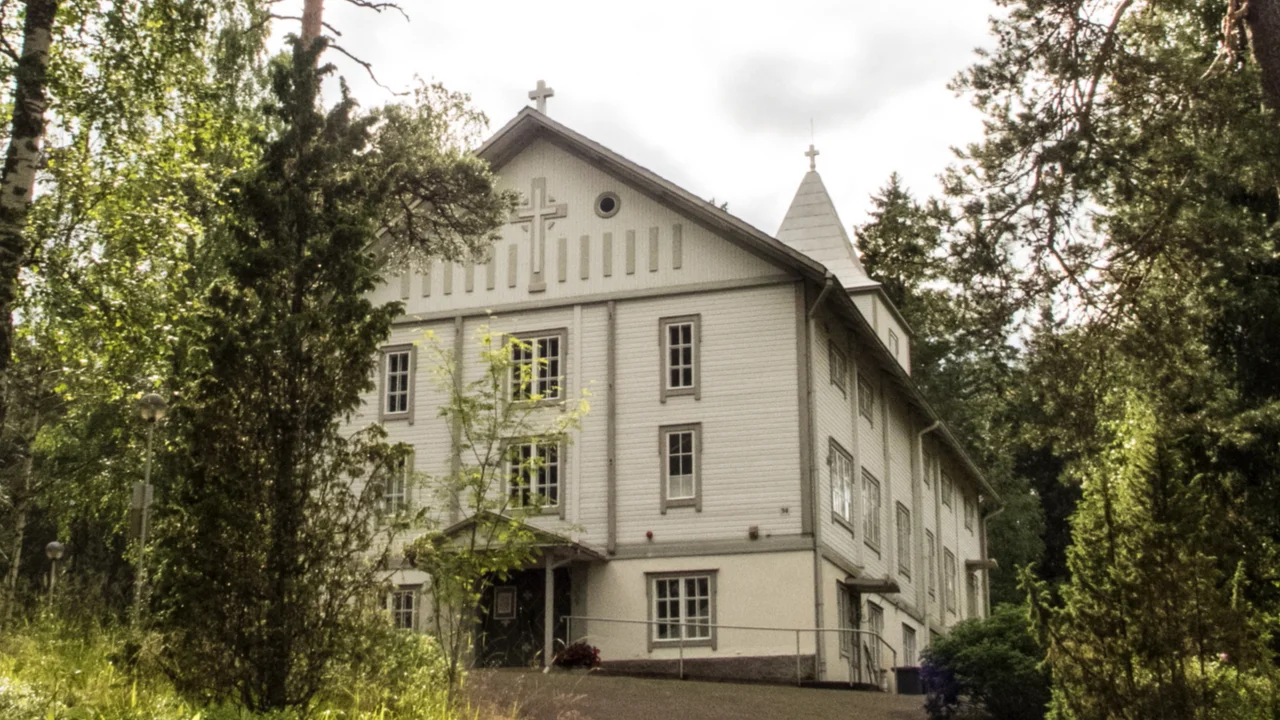
Kojo's church began life as a community hall, built between 1920 and 1922 to plans by the forester Mauno Kallio. A bell tower was added, and on 16 December 1923 Bishop Jaakko Gummerus of Tampere consecrated the building as a church. Its altarpiece, showing Christ in Gethsemane, was painted by Elias Muukka and given to the congregation in 1924; the organ came from the Kangasala works in 1968. The two iron bells travelled furthest of all. Cast in Yaroslavl, they had once hung in a chapel built for Russian soldiers at Tammisaari before ending up calling a Häme farming village to worship.
Three Months in Exile
In 1906 Kojo manor took in an unlikely guest. Maxim Gorky — by then Russia's most famous living writer and a man who had to leave the empire for political reasons — spent three months here, in a house surrounded by rye fields and spruce. Finland was still a Grand Duchy under the Russian crown, close enough to reach easily and separate enough to offer cover. Whether the quiet suited him is not recorded. A plaque marking the stay was unveiled on the manor's main wall in 1968, one year before the municipality that contained it ceased to exist.
Chains, Camps and Court Dates
In April 1979 landowners around the lake started drainage work without authorisation, the water court case still unresolved. On 21 April, conservationists built a dam to hold the level up. When machines arrived to tear it out, protesters chained themselves to them. Police hauled them off, the dam came down, and the activists built it again — and again. By 1980 the argument had travelled to Helsinki, where hunger strikers took up position in Senate Square.
The reckoning came at the Tammela district court in May 1982. A hundred and twelve people were charged, some of them minors. That December, 101 were convicted of obstruction and causing harm, with fines reaching 2,000 markka. On appeal, the Supreme Court declined to accept civil disobedience as a defence.
They lost in court and won nearly everything else. The lake was never drained. Finland established a national environmental administration in 1983, the same year Ville Komsi entered parliament; Osmo Soininvaara followed in 1987, and Pekka Haavisto became the country's first Green environment minister in 1995.
The Water Now
Koijärvi has been protected since 1992 and sits inside a Natura 2000 site of roughly 242 hectares, which is not quite the same thing as being saved. Shallow lakes silt and grow in; reed and sedge advance a little further each year. Black-headed gulls and coots have disappeared from the breeding population entirely. Cranes have held their ground, swans and marsh harriers still nest along the shore, but the open water that made this the region's finest bird lake keeps shrinking.
Kojo carries on quietly. There is a primary school for grades one to six with a daycare in the same building, and a small grocery. Twenty kilometres down the road, Forssa handles everything else.
From the Air
Koijärvi lies at 60.95°N, 23.65°E in Kanta-Häme, about 20 km north of Forssa and 75 km south of Tampere. The terrain is emphatically flat — a mosaic of rectangular fields, drainage ditches and dark spruce stands, with the lake reading as a pale reed-fringed smudge rather than open blue. Best viewed at 2,000–4,000 ft AGL, where the geometry of the ditch network and the ragged natural edge of the wetland contrast sharply. The Koijoki river runs south from the lake toward the Loimijoki. Nearest airports: Tampere-Pirkkala (EFTP) roughly 75 km north, Turku (EFTU) about 95 km west, Helsinki-Vantaa (EFHK) about 130 km southeast, and the Räyskälä gliding centre (EFRY) to the east. Spring and autumn bring migration traffic and low haze over the wetlands; winter flattens the whole scene to white and grey.
Nearby Stories
- Hiidenlinna 2 km away
- Church of Loimaa Proper 13 km away
- Battle of Hämeenlinna 15 km away
- Battle of Pälkäne 19 km away
- St. Olaf's Church, Tyrvää 25 km away
- Halikko Church 28 km away
- Hervanta 31 km away
- National Museum of Finland 64 km away