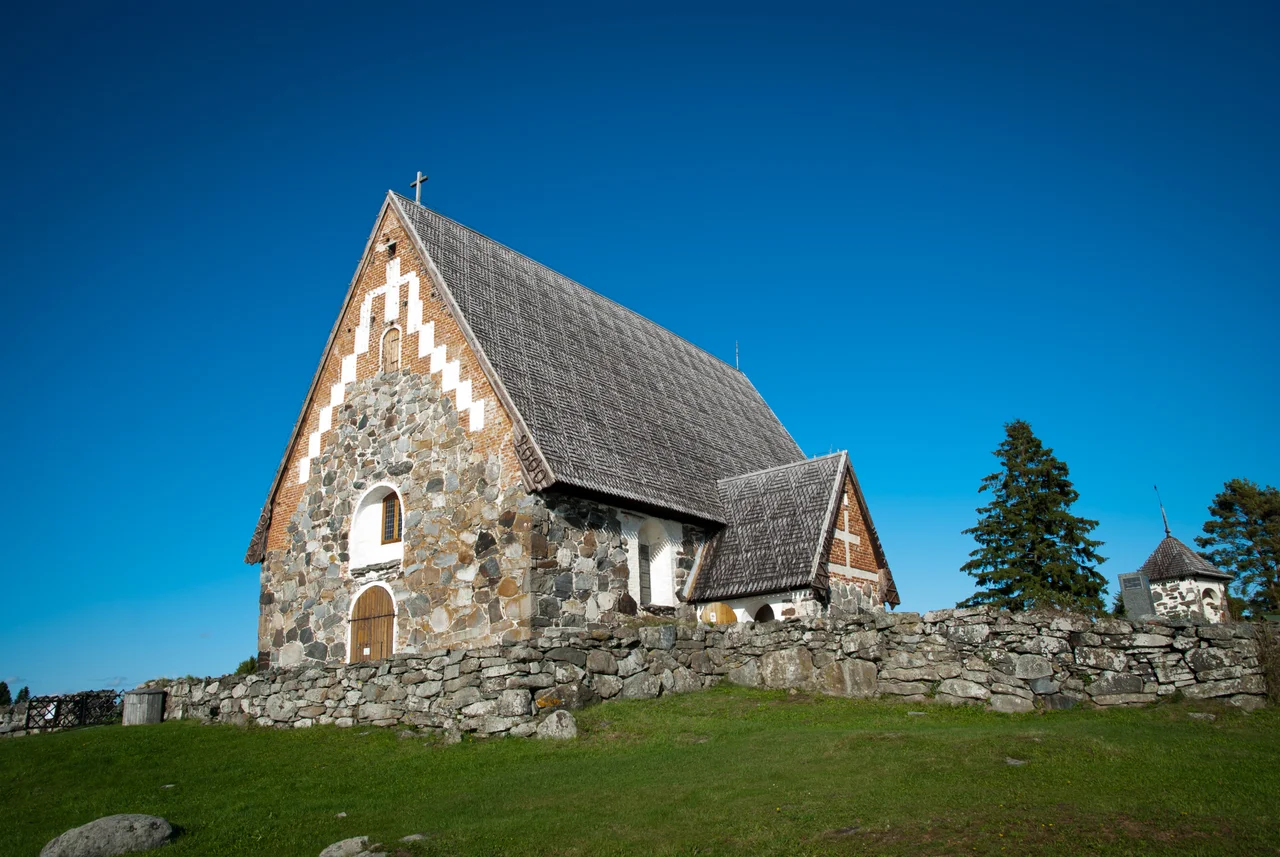

St. Olaf's Church, Tyrvää
The church on the shore of Rautavesi is five hundred years old, and it is not. Its walls are the fieldstone that Tyrvää farmers hauled and set in the first years of the 1500s. Everything inside them was made after September 1997, when a man broke in looking for communion wine, failed to find any, and came back to set candles burning under the pews so his fingerprints would go with the building. They did. So did an interior nobody could replace, which left the rebuilders to decide what a five-hundred-year-old church should look like when you start from bare stone.
Stone Hauled by Obligation
The church went up between roughly 1506 and 1516 in a late Gothic idiom on the water at Kalliala, and its designer is known only as the Master of Huittinen. It was built the way medieval parish churches generally were: not by hired crews but by landowners discharging a compulsory labour duty, quarrying stone from their own fields and burning their own lime. Bishop Arvid Kurki is thought to have consecrated it in 1518.
The dedication is to Saint Olaf, the Norwegian king turned saint whose cult ran unusually strong through Satakunta. Swedish merchants and settlers had carried it here in the late thirteenth century, and by the time the masons were setting these walls, Olaf was a familiar name in a district that had never seen Norway.
Left Empty on Purpose
The Reformation reached Sweden's church in 1527 and, at first, barely touched Tyrvää — sculptures shifted, a statue of the Virgin taken away. The deeper change came after a fire in the early 1600s destroyed the wooden fittings, and the interior was rebuilt along Lutheran lines. A wooden barrel vault was in place by 1748.
Then the parish outgrew it. A new Tyrvää church opened in 1855 and the old one became an autiokirkko — a deserted church, kept but no longer used. Its medieval treasures went to the National Museum in 1875. Serious repair waited until the 1960s, when the National Board of Antiquities reinforced the foundations and replaced windows. In the 1990s the building was documented in unusual detail ahead of a roof renovation using hand-carved wooden shingles. That documentation would shortly become the most valuable thing anyone had done for it.
Three Weeks After the New Roof
The parish celebrated the finished shingle roof, and three weeks later, on 21 September 1997, the church burned. The fire took the whole eighteenth-century interior: the Baroque pulpit, the crucifixes, the carved pews, and the 1780 paintings by Andreas Löfmark of Christ's Passion and the Last Judgment. Stone walls and nothing else remained.
The investigation ran five years. In October 2002 police arrested a thirty-year-old local man who said he had gone in looking for communion wine and, finding none, returned and lit candles beneath the pews to destroy the traces he had left. He acknowledged a long history of substance abuse and rejected any religious motive. A court sentenced him in January 2003 to five years for aggravated destruction; the Supreme Court later reduced it to three years and three months. No sentence was going to give the paintings back.
Rebuilt by Hand
The decision to rebuild came at once. Henrik Lilius, director of the National Board of Antiquities, pledged support; Archbishop John Vikström pressed for a recovery of the church's own character rather than a modern interior inside old walls. A working group formed in December 1997 to settle the historical and theological questions. Architect Ulla Rahola took the commission in summer 1999, assisted by Maija Kairamo and Juha Leiviskä.
Roughly 1,200 volunteers and donors did the rest. The stone department of the Tyrvää craft and art school repaired the walls through 1998 and 1999. New shingles were carved over the winter of 1999–2000 and the roof closed that autumn; by December the barrel vault, whitewashed walls, doors and floor were finished. Money came from an entire country: the illustrator Mauri Kunnas wrote a children's book, Koiramäen joulukirkko, that raised over a million markka by itself, and the citizens' campaign gathered 1.8 million markka against a build cost of about 1.14 million euros — with donated professional work worth nearly as much. Some 100,000 people came to watch. Bishop Ilkka Kantola reconsecrated the church on 3 August 2003.
One Hundred and One Paintings
In the summer of 2005 the painters Kuutti Lavonen and Osmo Rauhala began filling the bare walls, and lost roughly a year to technique alone, hunting historic pigments and consulting the Valamo Monastery and Russian icon museums on how paint behaves on wood.
Rauhala took the altar end and the pulpit, working in clean outline: the Creation told day by day rather than compressed into one image, and Paradise. He gave God a sextant as a tool, and staged the Fall with a large elephant, a flourish borrowed from the eighteenth-century church painter Mikael Toppelius. Lavonen worked the opposite register — dense, textured, expressionist — painting the apostles into the rail panels along with a Way of the Cross and a Last Judgment to stand where Löfmark's had been. They finished on 28 July 2009, 101 works in all, and the church opened to the public again on 15 August. Lavonen and Rauhala later told the story in a book with Pirjo Silveri.
It is still technically a deserted church. Sastamala parish holds summer services here, couples marry, children are baptised, tours run from May to September, and the Sastamala Gregoriana festival brings concerts in July.
From the Air
St Olaf's Church stands at 61.35°N, 22.94°E on the shore of Lake Rautavesi in the Tyrvää district of Sastamala, southwest Pirkanmaa. It is a small grey fieldstone building with a steep shingled roof, low and unspired, so it reads at low level rather than from cruise — best at 1,000–2,500 ft AGL, picked out against the dark water and surrounding spruce. Rautavesi itself is the reliable navigation feature: a broad basin of the Kokemäenjoki system, with Vammala roughly 3 km southwest and the Ellivuori slope on the ridge above the lake. Nearest airports: Tampere-Pirkkala (EFTP) about 50 km east, Pori (EFPO) about 80 km northwest. Summer evenings give long low light across the water and the best view of the roof shingles; in winter the church sits on a white plain of lake ice, and its outline against the snow is unmistakable.
Nearby Stories
- Tursiannotko 1.9 km away
- Ikaalinen 8.1 km away
- Kirkkokari 9.8 km away
- Akaa 17 km away
- Kokemäki Castle 21 km away
- Urjala 30 km away
- Helvetinjärvi National Park 40 km away
- Oura Archipelago 63 km away