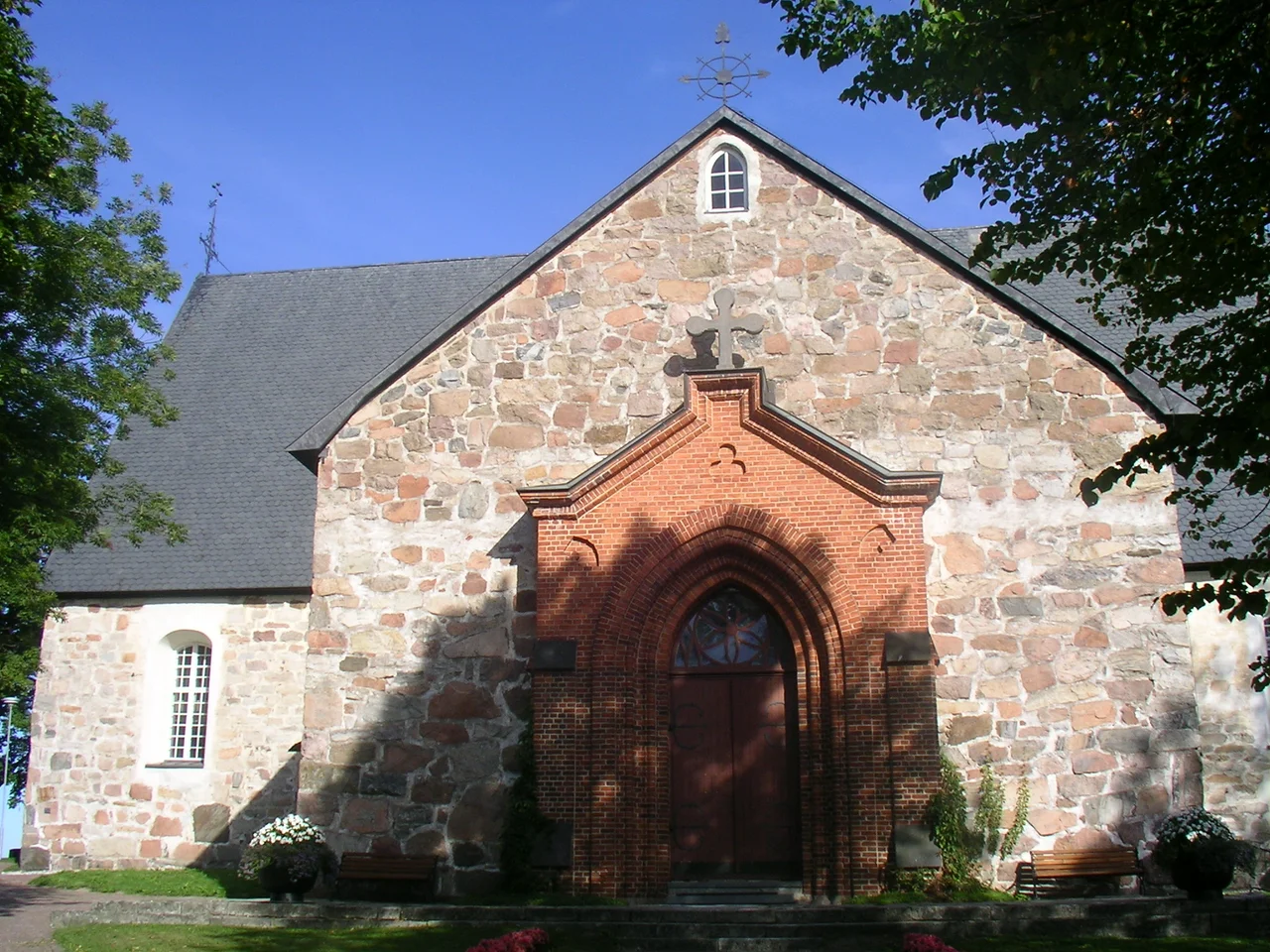

Halikko Church
The story Halikko tells about its own church begins with a killing. In the local legend, Henrik Olafsson, lord of Åminne manor, paid for three churches — Halikko, Pertteli and the chapel at Salo — to settle a debt of sin that was not his own. His father-in-law had murdered his wife. Then, the legend says, Christ appeared to the old man and told him the account had to be paid. The woman's name has not survived the telling, which says something about which parts of a story a village keeps. What stands on the ridge today is grey granite, and it is very much older than the version of events the guidebooks repeat.
What the Stones Say
Halikko Church is one of roughly eighty medieval stone churches still standing in Finland, out of some hundred and four ever built. Finnish scholarship dates the fabric to between 1460 and 1475 and attributes it to the workshop known as the Master of Karjaa, one of the anonymous building crews who moved along this coast raising parish churches for a province that was, at the time, a distant Swedish periphery. The parish's own count runs a little earlier: Halikko celebrated the church's 550th anniversary in 1990, which puts the founding around 1440. It began as a two-aisled long church of the standard medieval Finnish type, Roman Catholic, and dedicated to Saint Birgitta of Sweden, who had died in 1373 and whose visions were still comparatively fresh news in the north.
The Armfelts Rebuild
By the late 1700s the parish had outgrown the medieval shell, and the fixing of it was a family project. Maria Katariina Armfelt paid for a first enlargement in 1799, carried out by the architect John Sundsten. Between 1813 and 1815 the counts Gustaf Mauritz and August Armfelt funded a far more radical operation: the whole church was reconfigured into a cross plan to designs by Charles Bassi, the Turin-born neoclassicist who was the first professionally trained architect to settle permanently in Finland and who held official responsibility for planning the country's new churches. Making room for the new arms meant demolition. The medieval sacristy came down, the weapon-house with it, and so did the Horn family's grave — the Horns having been the manor owners who most likely paid for the church in the first place, and who held the right to name Halikko's priests through Åminne. The interior was renewed throughout. There are seats now for about 850.
Bells, Organ, Crucifix
The belfry stands separate from the church, as Finnish belfries usually do. The present one is the third on the site, put up in 1773, and it received a new bell in 1990. A neo-Gothic brick portal was added at the southern entrance in 1877 — an odd, ornate note against all that plain granite. Anders Thulén built the organ in 1851; J. A. Zachariassen substantially reworked it in 1879; it was rebuilt again with thirty-three stops in 1971 and serviced in 2002. The oldest things inside are quieter. A wooden crucifix from the 1400s survives, along with some of the earliest altar furnishings, and during the restoration of 1959 workers uncovered fragments of medieval painting, including a consecration cross — one of the marks a bishop anointed on the walls when a church was first dedicated, painted over and forgotten for centuries.
Manor Country
Halikko was not a poor parish, which is why its church is stone. Åminne, Vuorentaka and Wiurila were medieval manors with real reach, and Vuorentaka produced the district's most consequential export: Count Arvid Bernhard Horn (1664–1742), a Swedish general and diplomat who twice presided over the privy council chancellery and stood among the leading figures of Sweden's Age of Liberty. The land had been settled far longer. Down where the Halikonjoki river opens toward the bay lies Rikala, an Iron Age village and trading place where Baltic traffic came inland to do business with the Finns, and the parish also produced the Iron Age hoard known as the Halikko treasure. Halikko governed itself as a municipality from 1865 until the end of 2008, when it was merged into Salo. The church has been repaired three times in the modern era — 1921, 1959 and 1989–90 — and it was Archbishop John Vikström who led the 550th anniversary service in 1990. Each autumn now, a field down the road fills with several thousand carved pumpkins, and the medieval walls look on.
From the Air
Halikko Church stands at 60.4000°N, 23.0722°E, on a rise above the Halikonjoki river a few kilometres west of central Salo in Southwest Finland. From 2,000–3,000 ft it is a small pale cross set in open clay farmland, with the separate belfry beside it and the river winding south toward the head of Halikonlahti bay; the E18 motorway and the Halikko bridge crossing the valley are the strongest navigational features nearby. Kiikala Airfield (EFIK) lies roughly 30 km east, Turku Airport (EFTU) about 45 km west and Helsinki-Vantaa (EFHK) some 110 km east. The surrounding country is flat and cultivated, so the church is visible from a long way out in clear air; expect valley fog on calm autumn mornings, low cloud through the winter, and the best light in the long slanting evenings of June and July.
Nearby Stories
- Battle of Lemo 10 km away
- Kurjenrahka National Park 11 km away
- Torronsuo National Park 11 km away
- Paikkari Croft 14 km away
- Raseborg Castle 15 km away
- Sarka (museum) 21 km away
- Ekenäs Church 28 km away
- Archipelago National Park 41 km away