
Paikkari Croft
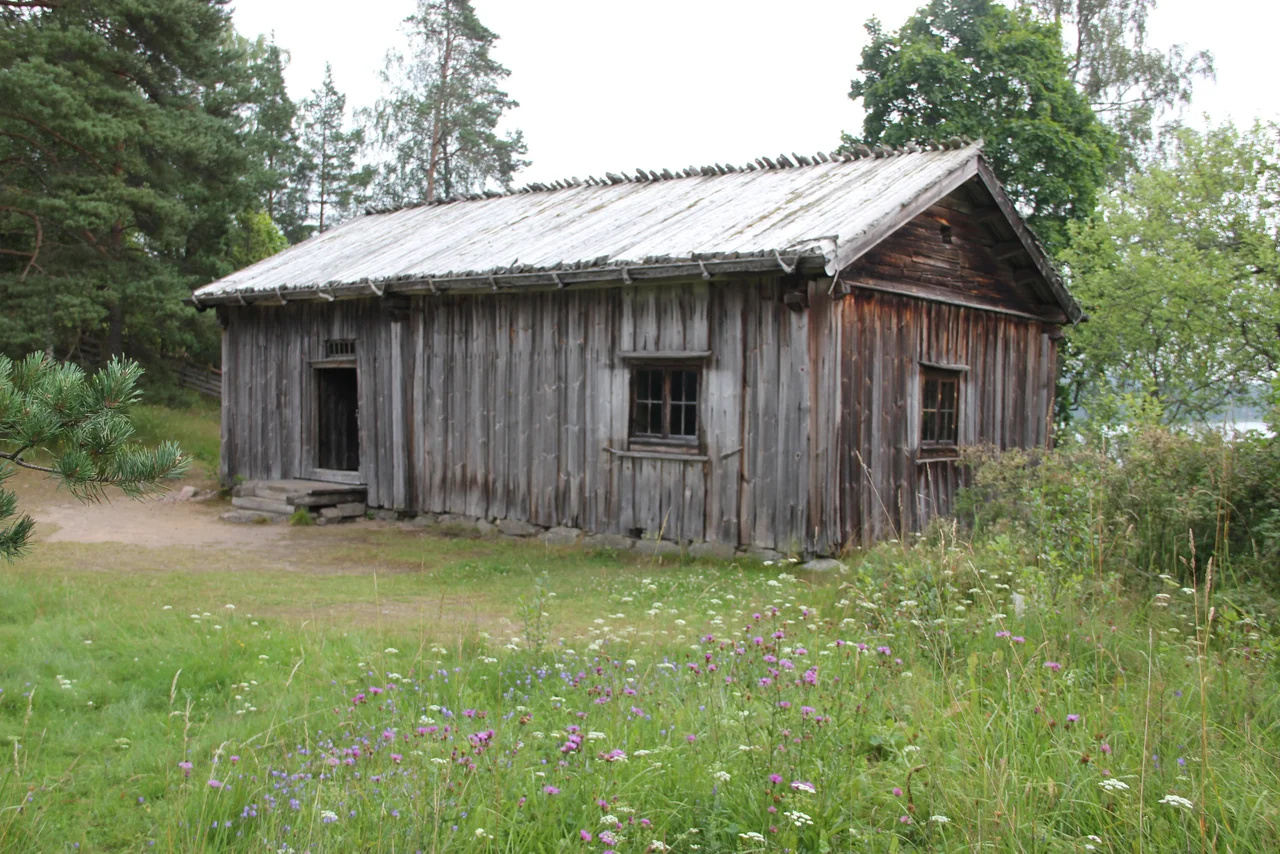
A black kantele hangs on the wall of the front room. Beneath it stands a wooden cradle. The building around them is a log cottage of three parts on the shore of Valkjärvi in Sammatti — a living room, a porch, a chamber — put up around the year 1800 on the grounds of a soldier's holding by a tailor named Fredrik Johan Lönnrot. In 1802 his fourth child was born here. That child grew up to walk east eleven times into the forests of Karelia, write down the songs of people whose names history had not bothered to record, and assemble from them the Kalevala.
A Torppa, Not a Farm
The Finnish word is torppa, and the distinction matters. A croft was a tenancy — you worked land you did not own, paying in labour or in kind, and you could be moved off it. Fredrik Johan Lönnrot built his cottage on the grounds of the Paikkari military residence in the village of Haarjärvi, which is to say he built it on someone else's ground. Elias, born on 9 April 1802, lived in these rooms until 1814, when at twelve he left for school in Ekenäs. What followed was not a straight line. He got to Turku Cathedral School by 1816 and abandoned it two years later, worked as a tailor alongside his father and sang for his keep, reached the Porvoo gymnasium in 1820, spent two years apprenticed to an apothecary at Hämeenlinna, and only in October 1822 enrolled at the Academy of Turku to study medicine. He graduated in 1832, by which time the Great Fire of Turku had driven the university to Helsinki. The man who would give Finland its founding text spent his youth being interrupted.
Eleven Journeys
Lönnrot's day job was medicine. He served as district doctor in Kajaani, in eastern Finland, through years of famine and epidemic — grim, unromantic work in a poor and remote district. The collecting happened on leave. Between 1828 and 1844 he made eleven field trips, mostly into Karelia, the region straddling eastern Finland and what is now northwestern Russia, where the old sung poetry was still a living practice rather than a memory. Some of the travel was funded by the Finnish Literary Society, which he had helped found. He walked, he listened, and he wrote down thousands of verses from rune-singers, the most celebrated of them Arhippa Perttunen, a master of the ancient trochaic metre. It is worth saying plainly that these singers were the authors. Lönnrot did not compose the Kalevala; he gathered it, arranged it, and stitched the fragments into a continuous narrative, and the poetry he was given had been carried in memory across generations of people who could mostly neither read nor write and who received no royalties from any of it.
Thirty-Two Poems, Then Fifty
The first edition appeared in 1835 — thirty-two poems, 12,078 verses, published across two volumes. Lönnrot dated the preface February of that year, and 28 February is now Kalevala Day, marked in Finland as Finnish Culture Day. He kept collecting. The 1849 edition, distinguished ever since as the New Kalevala against the Old, ran to fifty poems and 22,795 verses, and it is the version the world reads. Its effect on a country that was then an autonomous Grand Duchy under Russian rule, with Swedish as the language of law and learning, is difficult to overstate: here was proof that Finnish carried an epic literature of its own. Lönnrot went further than the epic. He published the lyric collection Kanteletar in 1840, produced Flora Fennica in 1860 — the first work of botanical science written in Finnish rather than Latin — and coined over two hundred thousand dictionary entries, including scientific and medical terms Finns still use without knowing where they came from.
The Cottage Becomes a Monument
Lönnrot died in Sammatti on 19 March 1884, having returned to the parish of his birth. Three years later, in 1887, the croft opened as a museum — remarkably fast, and a measure of how completely he had been absorbed into the national story while still alive. The state of the Grand Duchy of Finland bought the building outright in 1889. It passed through the care of the national antiquities authority, and in 2014 ownership transferred to Senate Properties, the government's property management arm; Lohja Museum runs it as a home museum today, Sammatti having long since become part of Lohja. It opens for the summer months, and the Finnish Museum Card gets you in. Inside, the living room holds the cradle and the black kantele. The chamber holds his inkstand, his manuscript shelf, his bookshelf. Standing in a room that small, with a lake outside the window and a national epic on the other end of the story, the arithmetic feels wrong in the best possible way.
From the Air
Paikkari Croft sits at 60.35°N, 23.80°E on the shore of Valkjärvi in Sammatti, in the Lohja municipality of western Uusimaa. The building is tiny and dark-timbered — do not expect to spot it from altitude. Best viewed from 1,500–2,500 ft AGL, using the lake as the target: Valkjärvi is one of a dense scatter of small clear lakes in this district, and the croft stands on its shore among trees. The reliable navigation landmarks are larger: Lake Lohjanjärvi some 15 km northeast, and the long Karjaanjoki water system draining south toward Pohja Bay. Nearby airports: Nummela (EFNU) 30 km northeast, Helsinki-Vantaa (EFHK) 65 km east, Kiikala (EFIK) 30 km west, Turku (EFTU) 90 km northwest, Hanko (EFHN) 65 km southwest. This is inland lake country, generally good VFR in summer with long light; autumn and spring bring low stratus, and the lakes generate morning mist that can sit in the hollows well past sunrise. Freeze-up from roughly December to April turns the lake surfaces into flat white plates and makes the shoreline geometry much easier to read from the air.
Nearby Stories
- Salo 3.9 km away
- Liesjärvi National Park 8 km away
- Raseborg Castle 15 km away
- Sarka (museum) 24 km away
- Hakoinen Castle 32 km away
- Hanko Peninsula 32 km away
- National Museum of Finland 44 km away
- Peter the Great's Naval Fortress 74 km away