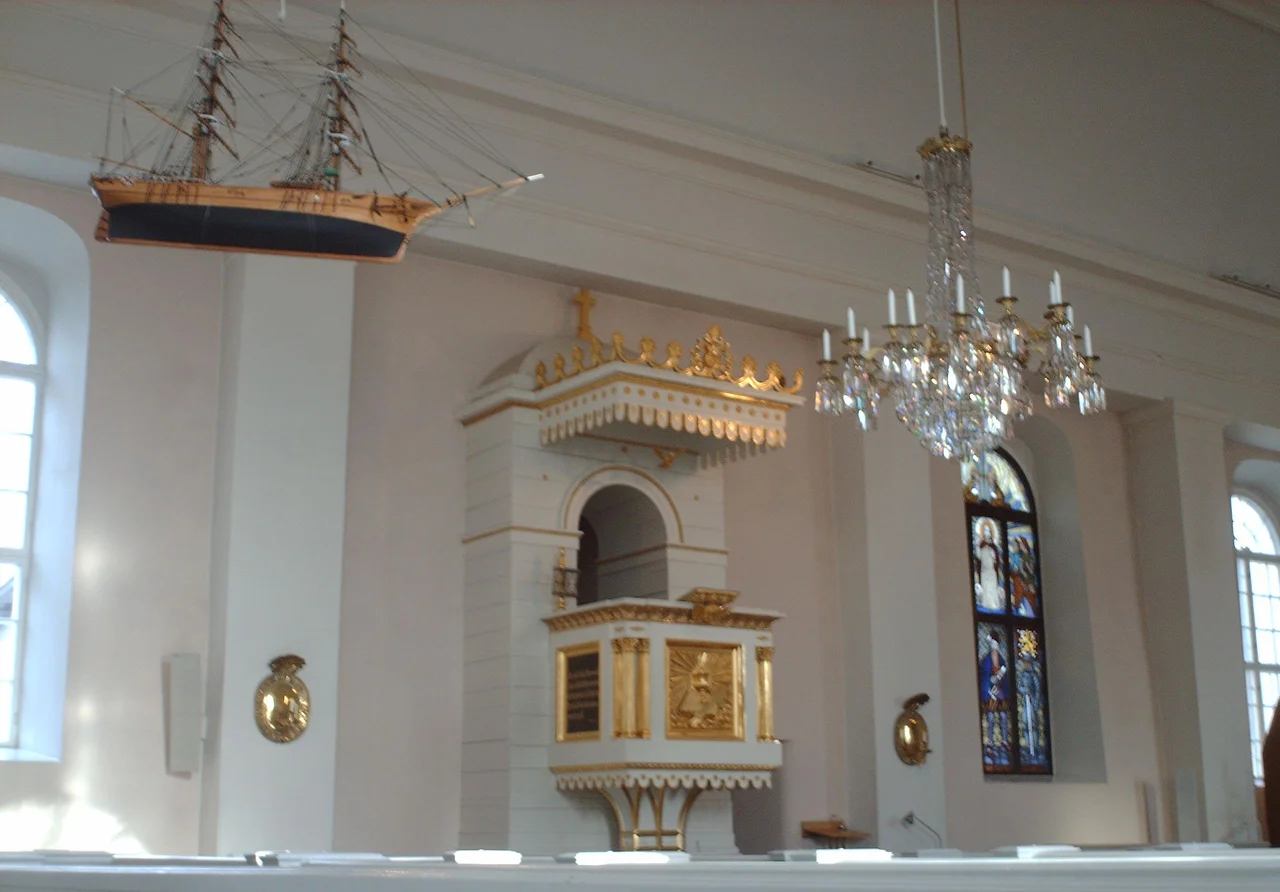

Ekenäs Church
Count Gustaf Adolf Lewenhaupt never saw a stone of it laid straight. He gave the order in 1651 that Ekenäs should finally have a church of granite instead of timber, and five years later, in 1656, he died of wounds taken in the Thirty Years' War — the long European bloodletting that had pulled Swedish noblemen south for a generation. His instruction survived him. Twenty-nine years later his son Gustav Mauritz Lewenhaupt completed the building according to his father's will, and on the outer wall a memorial plate still shows the count alongside his wife, Christina Catharina de la Gardie. Ekenäs Church is the product of exactly this pattern: people who started things, and other people who had to finish them.
A Will Carried Out in Granite
Ekenäs had been building toward this for generations. In 1589 Count Axel Leijonhufvud began a small wooden church in Ekenäs; his younger brother Moritz finished it in 1600. Through the 17th century the town's appetite for something more permanent grew, and the stone church begun in 1651 answered it on a scale that still looks improbable for a place this size. Built of granite, it ran thirty-six metres long and seventeen wide, with walls two metres thick and a bell tower rising thirty-one metres. Nobody knows who designed it; the architect of the original Baroque church has simply been lost. When it was completed in 1680 the old wooden church stood alongside it for another decade before being pulled down in 1690, the two buildings briefly overlapping like a before-and-after photograph.
Four in the Morning, 14 June 1821
Fire took it at around four in the morning on 14 June 1821. It climbed into the wooden roof, and from there the interior was finished. Almost nothing came out of the building: the altarpiece and a handful of objects, carried into the summer dawn by whoever was awake and fast enough. What remained afterwards were the granite walls, two metres thick and largely indifferent to what had burned inside them. The parish had lost the church its ancestors spent three decades building, but it had not lost the shell, and that fact shaped everything about what came next.
Bassi's Drawings, Granstedt's Hands
The rebuilding fell to Charles Bassi, born in Turin in 1772 and by then the most consequential architect in the Grand Duchy of Finland. From 1810 he had run the government office responsible for church designs, a post he held until 1824, when Carl Ludvig Engel succeeded him. Bassi drew Ekenäs a new interior in the neoclassical language of his era: the roof ten metres lower than the burned original, the interior pillars taken out, larger windows cut to flood the space with the pale northern light that neoclassicism loved. He died in Turku in 1840 with the work unfinished, and Anders Fredrik Granstedt carried it through to completion in 1842. Granstedt also designed the pulpit. What stands today is therefore a 17th-century Baroque church wearing a 19th-century neoclassical interior — a building that changed its mind between architects. There is seating for 560, and the tower now reaches 35.8 metres above the ground, 41.5 above the sea.
The Astronomer Who Was Vicar Here
One of the objects rescued from the fire was a Bible, and it belonged to the strangest man ever to hold this pulpit. Sigfridus Aronus Forsius, born around 1560, was a priest, astronomer, astrologer and naturalist who published the first almanacs printed in Sweden between 1608 and 1623 and produced some fifty works in all. He was jailed twice at Örebro Castle — once when Charles IX suspected him of sympathy for a rival claimant to the throne, once when the church decided his astrological research was superstition. He finished his life as vicar of Ekenäs, dying here in 1624. His Bible survived 1821 and now sits in the Ekenäs Museum, a memorial plate to him hangs on the church wall, the town raised a monument on the three-hundredth anniversary of his death in 1924, and the asteroid 3223 Forsius carries his name into the sky he spent his life reading.
Silver, Paint and Pipes
The church's oldest fittings predate the granite that houses them. Communion vessels here date to 1613, from the wooden-church years. The altarpiece was made in Stockholm around 1660, but the paintings set into it are much younger: commissioned in Stockholm in 1797 and executed by Professor Lorens Pasch the Younger, they show the Holy Trinity and the sorrow of Christ. The organ arrived in the rebuilt church in 1842, built by Anders Thulé and given by the knight Berndt Erik Inberg; it has been renovated repeatedly since, most recently in 1992. The stained glass by Karin Mazeitti-Slotte was painted in 1924 and has been moved twice — to the northern side between 1957 and 1959, and again during the restoration of 1987 to 1990, when the altar wall was rebuilt and marbled. The parish that uses all of this, Ekenäsnejdens svenska församling, worships in Swedish and belongs to the Diocese of Borgå.
From the Air
Ekenäs Church stands at 59.974 N, 23.434 E in the old town of Ekenäs (Tammisaari), Raseborg, on Finland's south coast about 80 km west of Helsinki. The bell tower, 35.8 m above ground and 41.5 m above sea level, is the tallest thing in the old town and the obvious visual anchor from the air — a pale tower rising out of a dense grid of low wooden houses right at the water's edge, with the archipelago fanning out to the south. Nearest airports: Hanko-Täktom (EFHN) 30 km southwest, Nummela (EFNU) 45 km northeast, Helsinki-Vantaa (EFHK) 80 km northeast, Turku (EFTU) 100 km northwest. Recommended viewing altitude 1,500-2,500 ft for the old-town street pattern. Best light is low summer sun from the southwest, which throws the tower's shadow across the wooden quarter.
Nearby Stories
- Sauvo Church 10 km away
- Kimitoön 17 km away
- Salo 17 km away
- Russian cruiser Pallada (1906) 18 km away
- Finnish minelayer Louhi 20 km away
- Peter the Great's Naval Fortress 44 km away
- National Museum of Finland 59 km away
- Hakoinen Castle 75 km away