
Sauvo Church
Around 1650, somebody in Sauvo climbed a scaffold with a bucket of lime and painted out the apostles. The images on the brick vaults had been there since the 1470s, and to the hard Lutheran orthodoxy of the seventeenth century they smelled of Rome and its cult of saints. Under they went. They stayed under for roughly 250 years, emerging only in the early 1900s and not fully recovered until a conservation campaign finished in 1971. What you see when you tip your head back in Sauvo now is a medieval ceiling that survived by being hidden.
Building in Stages
There has been a church here far longer than there has been this church. The first written mention comes from the registers of Turku Cathedral in 1346, and wooden churches stood on the site before that - the earliest perhaps at the start of the thirteenth century. Planning and fundraising for a stone building began in the 1460s. The sacristy went up first and remains the oldest fabric; a painted inscription around the chancel window bears the date 1472, which probably marks the completion of the work. The result is a three-aisled hall church, its naves separated by brick piers, and it is startlingly unaltered - the only significant later additions are the buttresses propping the southeast and northeast corners, added in the 1690s. The star vaults have been called the high point of medieval church building in Finland. They resemble those at Kemiö and Tenhola closely enough that the fifteenth-century master builder Pietari Kemiöläinen - Peter of Kemiö - is often credited with them, though nobody can prove it.
The Paintings and the Whitewash
The lime paintings of the 1470s run to plant ornament and to figures: apostles, prophets, and one very worldly donor. Lars Skalm, a nobleman who served as mayor of Turku in the early 1500s, gave money toward the church and was rewarded with a portrait of himself on the wall of it. Then came the covering-over, and then the long dark. When restorers began uncovering the work in the early twentieth century they were reading a hand that had been invisible for eight or nine generations. The final campaign, led by the conservator Veikko Kiljunen, was completed in 1971. Catholic Sauvo had dedicated its church to Saint Clement; the parish that whitewashed him out and the parish that scraped him back are the same institution, two and a half centuries apart, changing its mind.
Objects With Longer Memories Than the Walls
Some of what stands inside is older than the building. The heavy baptismal font was cut from Gotland limestone in the 1200s, shipped in, and carried over from the wooden church it originally served. The altar itself is topped by a gravestone dated 1391. The triumphal crucifix hanging in the nave dates from the second half of the 1400s; the altarpiece is a mid-seventeenth-century gift from Gertrud Wessel, the widow of a local landowner, and its painter is unknown. An extravagant baroque pulpit arrived in 1651, also as a donation, and statues of Christ, of Saint Lawrence and a Saint George group came in during the first half of the 1500s. Sauvo also holds an unusually rich collection of wooden funerary coats of arms - the painted escutcheons carried before an aristocratic coffin and then hung up as a memorial. The one great loss is the organ of 1671, among the oldest in Finland Proper, which was moved to the museum at Turku Castle in the 1890s and destroyed there in the castle fire of 1941. Its replacement dates from 1896. The bell, cast in 1791, carries a Finnish verse in thumping alliteration that calls the parish to come and hear.
Who Sat Where, and Who Stayed Awake
Parish records make this church feel inhabited. In the 1600s services began at eight in summer and nine the rest of the year and ran until midday. On feast days there were two, one in Finnish and one in Swedish - and for a while the parish simply used both its churches at once, wooden and stone, a language in each. Once pews were installed with private money in the 1500s, the question of who sat where became explosive. An official seating order was drawn up in 1642: the first five rows for the nobility, everything behind them carefully apportioned among farming households. People argued about it anyway, and sometimes fought about it out on the church hill. The first vicar known by name is Ascerus, recorded in 1335. In the 1640s the sexton Lars Märtensson doubled as unilukkari - literally the sleep-clerk, the man who went round waking anyone who had nodded off during the sermon. The job was later hived off to a specialist; the first named waker is a man called Jussi in the 1670s.
The Graves Outside
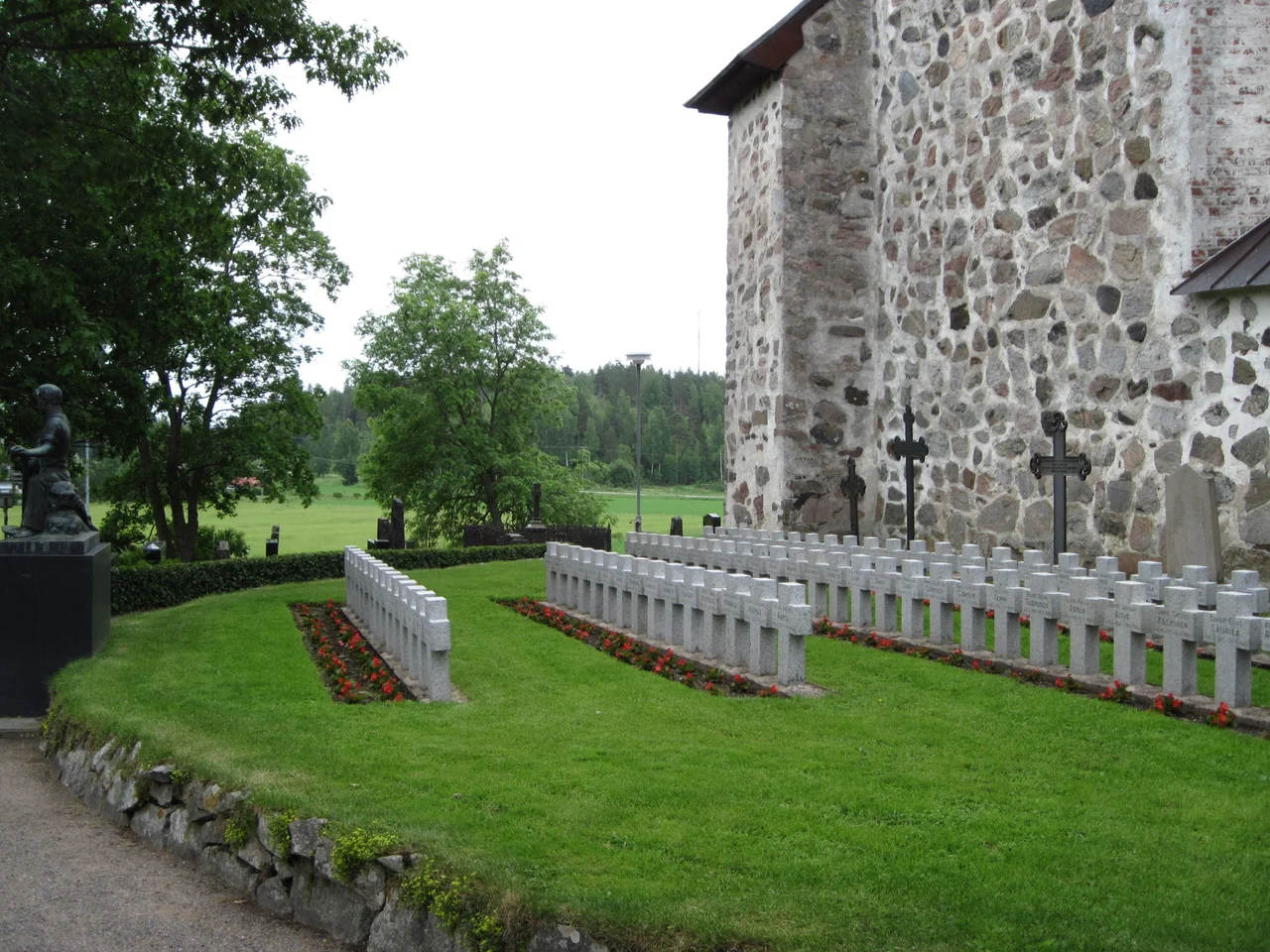
In the churchyard is Sauvo's military cemetery, where the parish's dead from Finland's twentieth-century wars were brought home and buried among the neighbours who had known them since childhood - a small municipality's losses, laid out in rows you can walk in a minute. The memorial standing over them was carved in 1946 by Aarre Aaltonen, a Southwest Finnish sculptor born in Pöytyä who made a number of such monuments in the years after the war. On 1 January 2019 the Sauvo-Karuna congregation was merged into the parish of Paimio, ending a separate parish life that ran back before the first written record. The building keeps going regardless. Services are held on Sundays, in one church or the other.
From the Air
60.3425°N, 22.6989°E, on a low rise in the Sauvo church village, in the middle of the peninsula between Paimionlahti and Halikonlahti bays and about 6 km from open water. Suggested viewing altitude 1,500-2,500 ft AGL. The church is a long grey stone mass with a separate wooden belfry beside it, the most prominent structure for several kilometres in a landscape of fields and forest; road 181 runs past it from Paimio south toward the Rungonsalmi bridge to Kemiönsaari. Nearest airport is Turku (EFTU), about 34 km northwest; Kiikala gliding field (EFIK) roughly 38 km northeast in Salo, and Helsinki-Vantaa (EFHK) about 125 km east. Visibility is generally good inland even when the archipelago to the south is under low cloud.
Nearby Stories
- Nådendal Abbey 13 km away
- Dalsbruk 14 km away
- Kurjenrahka National Park 18 km away
- Ekenäs, Finland 20 km away
- Jokioinen 24 km away
- Archipelago National Park 27 km away
- Paikkari Croft 33 km away
- Valmet Automotive 42 km away