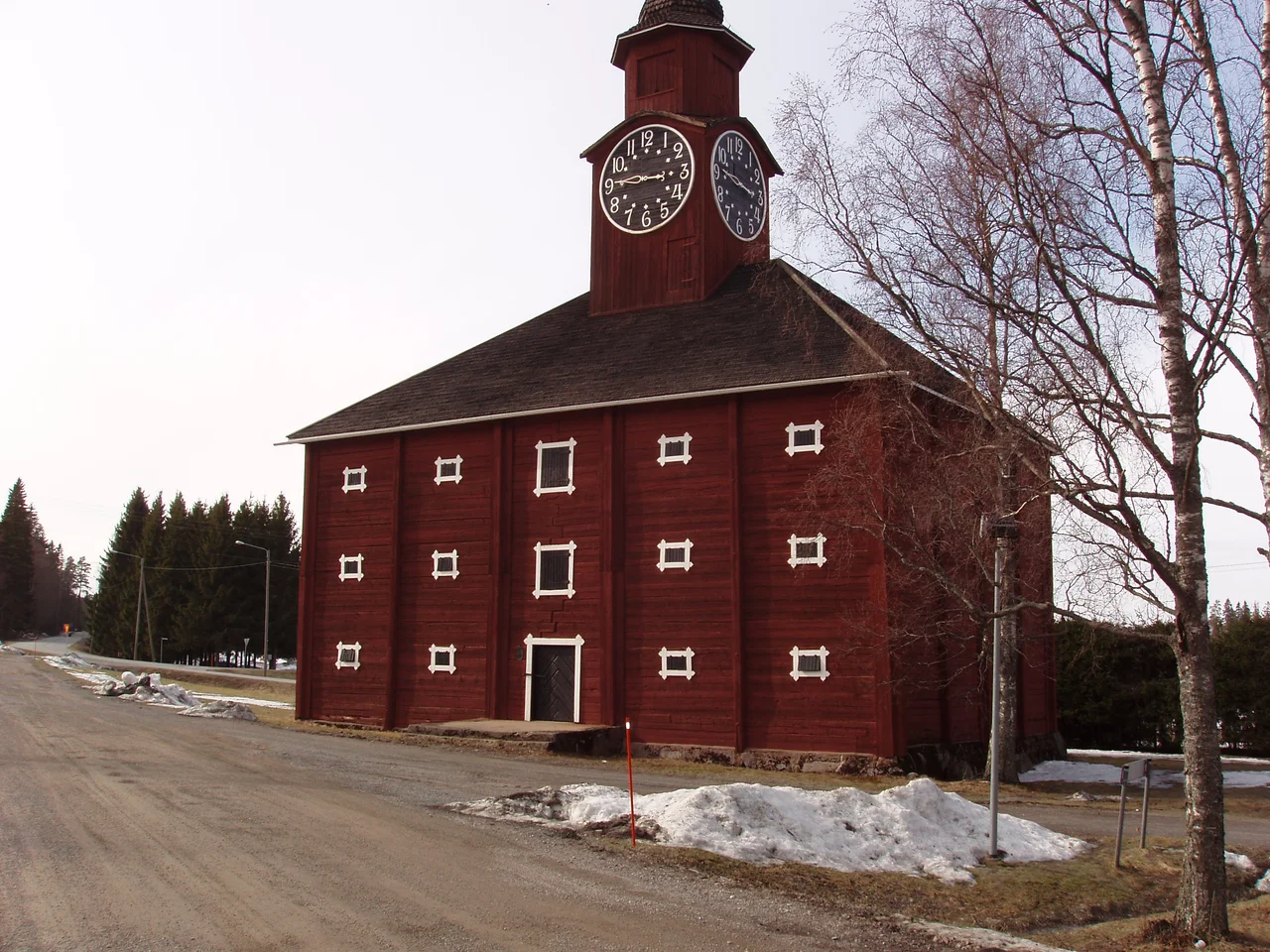

Jokioinen
When Finland wants to know what its weather actually does, one of the places it asks is a field in Jokioinen. The observatory moved here from Pasila in 1957 and has been keeping the record ever since; the station's all-time extremes run from 32.3°C in July down to -39.3°C in February. That is a spread of more than seventy degrees, logged in a municipality of fewer than five thousand people. Jokioinen also has quiet influence over what Finland eats. The national plant breeding department was moved here in 1928, and the work has never left.
One Estate, Fifteen Hundred Farms
Almost everything about Jokioinen runs back to a single property. The estate was established in 1562, and in 1565 Erik XIV granted the Jokioinen quarter and its taxes to Klaus Horn. From there it accumulated. Under Ernst Gustaf von Willebrand, provincial governor at the end of the 1700s, it grew into the largest estate in Finland and began manufacturing: a textile factory in 1796, an ironworks in 1804. By the early twentieth century — Alfred Kordelin owned it by 1907 — the estate ran a corn mill, a saw mill, a brick factory, a steel plant, and a sugar and syrup mill. It was less a farm than a small economy with a manor house on top of it.
Then it was taken apart. The remainder passed to the Finnish state in 1918, the same year as the crofters' law that let tenant farmers buy the land they had been working, and the land reform of 1945 finished the job. More than fifteen hundred homes and small farms came out of it. The municipal coat of arms, designed by Gustaf von Numers and approved by the council on 30 July 1951, holds both halves of that history in one shield: an ear of wheat for the manor's part in Finnish agriculture, an anvil for the ironworks. The Ministry of the Interior confirmed it that September.
The Station That Keeps the Record
What the state did with its inheritance was turn Jokioinen into an instrument. The Department of Finnish Plant Breeding transferred here from Tikkurila in 1928; the Finnish Meteorological Institute's observatory arrived from Pasila in 1957. The crops and the climate they have to survive are now measured in the same parish, which is a tidier arrangement than it sounds. The Natural Resources Institute Finland, Luke, is the municipality's largest employer with several hundred staff on site, and Boreal Plant Breeding — which develops cereal, grass and potato varieties grown across the country — works from here too. It is a strange sort of importance, because nothing here looks like national infrastructure. It looks like farmland. But if you eat Finnish barley, or read a Finnish temperature normal, part of it was settled in these fields.
Seven Hundred and Fifty Millimetres
Finland once had a scattering of narrow-gauge railways. One survives. The line from Humppila to Forssa opened in 1898 at a gauge of 750 millimetres, narrow even by the standards of narrow gauge, chosen because it was cheap to lay across soft ground. Passenger service ended in 1954 and freight in 1974, and that should have been the end of it. Volunteers began running museum trains between Minkiö and Jokioinen in 1978, rebuilt the Humppila-Minkiö section between 1992 and 1994, and today operate fourteen kilometres of track at a top speed of fifty kilometres an hour. Steam hauls the weekend trains from June through August. A narrow-gauge museum at Minkiö station holds rolling stock rescued from lines that did not survive. By early 2021 the railway had carried more than 556,000 passengers.
Born Here, Died Here
Miina Sillanpää was born in Jokioinen in 1866, as Vilhelmiina Riktig, and went into factory work at twelve before entering domestic service. Those two facts explain most of what followed. She led the Servants' Association for roughly fifty years, arguing for women whose labour happened inside other people's houses and was therefore easy to ignore. In 1907 she was among the first nineteen women elected to any parliament in the world. From 1926 to 1927 she served as Deputy Minister of Social Affairs, making her Finland's first female minister, and through the 1930s she established shelters for unmarried mothers, at a time when the shame directed at them was meant to be ruinous. Since 2016 the first of October has been an official Finnish flag day in her name.
Karl Fazer, born the same year in Helsinki, has the opposite connection to the place. He opened the confectionery that still carries his name on 17 September 1891, shot trap for Finland at the 1912 Olympics, and died in Jokioinen in 1932 of a heart attack while out hunting. The singer Anneli Saaristo was born here in 1949.
Mantras in a Machine Hall
The least expected thing in Jokioinen is a former machine hall. A Tibetan Buddhist community moved into it in 2016, and in 2022 the site formally became Danakosha Ling, a monastery led by Tulku Dakpa Rinpoche — the first Tibetan Buddhist to take Finnish citizenship — with around a hundred and fifty lay practitioners. Yle has described it as the largest Tibetan Buddhist monastery in the Nordic countries. Beside it stands a stupa packed with more than a hundred thousand mantras, relics and consecrated objects, the largest Buddhist shrine in Finland. Roughly thirty-five kilometres west, in Alastaro, sits Finland's only Tibetan art centre. For whatever combination of reasons, this stretch of southern Finnish grain country has turned unexpectedly Himalayan.
From the Air
60.8042°N, 23.4861°E in Kanta-Häme, at roughly 100 m elevation across 181.94 km² of gently rolling farmland. Forssa (EFFO) is close by to the east, only about 8 km from the village centre, which makes this straightforward general-aviation country. Tampere-Pirkkala (EFTP) lies roughly 70 km north, Hämeenlinna (EFHH) about 55 km northeast, and Helsinki-Vantaa (EFHK) about 95 km southeast. Navigate by the Loimijoki, the 750 mm museum railway running Humppila-Minkiö-Jokioinen, and the research station buildings; the stupa is a distinctive white landmark. Recommended viewing altitude 1,500-3,000 ft AGL. Winters are severe here by southern Finnish standards, with a station record of -39.3°C, and annual precipitation averages 621 mm.
Nearby Stories
- Paimio Sanatorium 6.4 km away
- Urjala 13 km away
- Salo 17 km away
- Tibet Art Center 19 km away
- Huittinen 22 km away
- The Artillery Museum of Finland 30 km away
- Hakoinen Castle 40 km away
- National Museum of Finland 65 km away