
Hervanta
Hervanta existed as a drawing before it existed as a place. In 1967 Tampere ran an architectural competition for an empty stretch of forest ten kilometres south of the city; the professor Aarno Ruusuvuori won it the following year with a plan for a self-sufficient satellite town where housing, a university and industry would sit side by side. Finland was emptying its countryside into its cities, and the city manager Pekka Paavola needed somewhere to put people. Groundworks began in 1969. The first residents moved in during July 1973, into apartment blocks standing in what had recently been pine woods, with the roads not yet finished. Fifty years on, more than 25,000 people live there.
The Shape of the Plan
The district covers 13.8 square kilometres and holds around 11,000 apartments, most of them in the prefabricated concrete blocks that Finland threw up at speed in the 1970s. On paper it is a textbook of its era: a linear spine of services with residential slabs arranged along it, everything walkable, everything zoned. In practice it works better than that description suggests, because the forest was never fully cleared. Blocks stop abruptly at the tree line. Paths run from stairwell doors straight into the woods. The population was 25,231 at the end of 2022, but on a working weekday more than thirty thousand people are in Hervanta once students and commuters are counted, which was more or less the point of building it.
Pietilä's Red Brick Spine
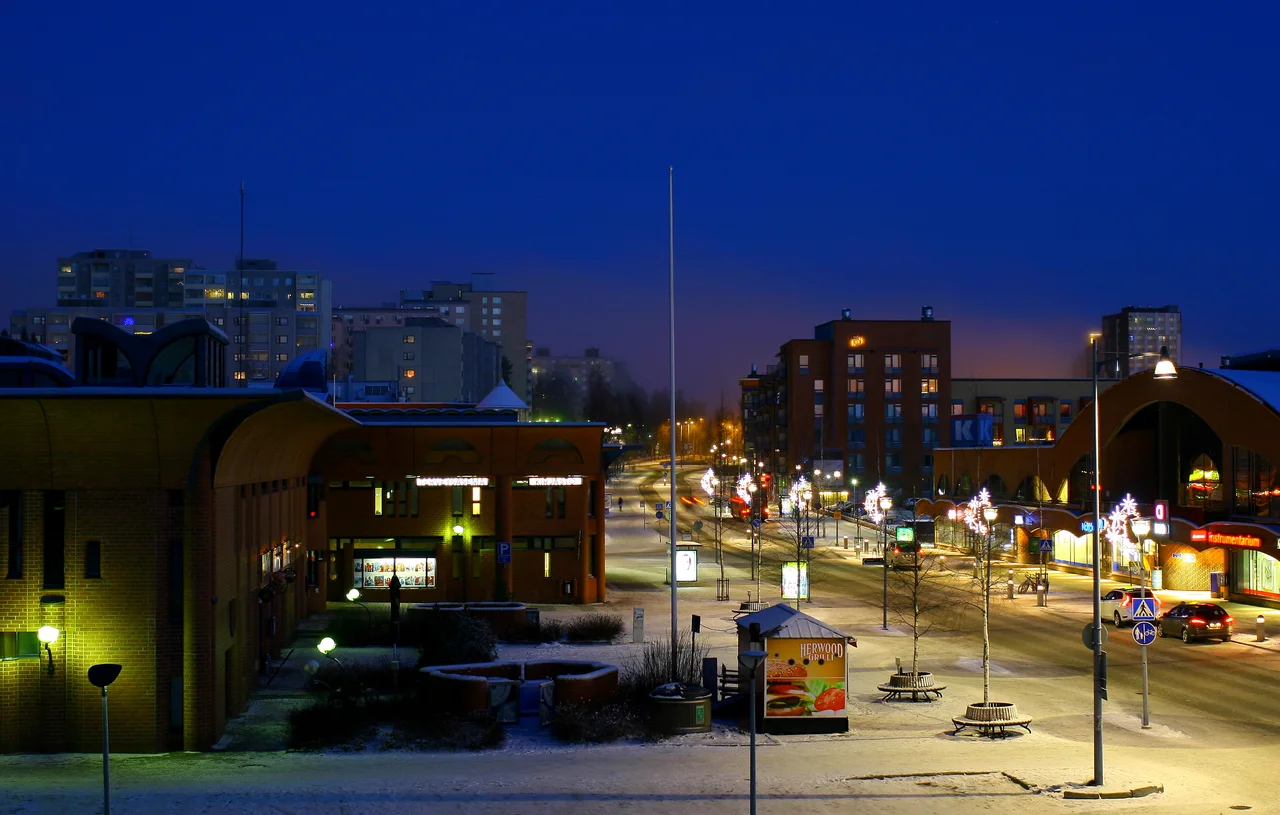
The architects Raili and Reima Pietilä were given the central axis, and what they produced is the reason architects still come here. Their congregation and leisure centre and their shopping centre both opened in 1979, followed by the activity centre in 1989 - a run of red-brick buildings with folding, restless geometry that refuses to line up with the concrete rectangles around it. The contrast is the whole experience of central Hervanta: slab housing built for efficiency on one side, and on the other a sequence of buildings that are considered among the Pietiläs' most successful work anywhere. Few Finnish suburbs of this generation got that kind of attention at their centre. Fewer still kept it.
The Reputation and the Reality
For decades "Hervanta" functioned in Finnish as shorthand for the wrong sort of neighbourhood - the standard prejudice attached to any large, quickly built, working-class housing estate anywhere in Europe. About a tenth of residents are foreign-born, from some seventy-five nationalities, and roughly a fifth are students; the Mikontalo tower alone houses 767 of them, close to three percent of the district's population. That mix is exactly what earned the district its reputation, and exactly what has dismantled it. On 17 August 2003, Helsingin Sanomat published a survey that named Hervanta the best suburb in Finland. In 2026 the Finnish Local Heritage Federation chose it as district of the year. Apartments here now sell briskly.
Ten Kilometres of Engineers
Construction of the Tampere University of Technology campus started in 1973, and the technology sector grew around it exactly as the 1968 plan intended. TUT merged with the University of Tampere in 2019 to form Tampere University, and the Hervanta campus remains its engineering heart; the Police College of Finland trains here too. The Hermia science park sits alongside, with VTT, the state technical research centre, and offices belonging to Nokia, Huawei, Intel and Microsoft. Finns sometimes call the district the Silicon Valley of Finland, which is generous about the weather and fair about the concentration - it is genuinely unusual to find that much engineering research, that many corporate laboratories and that much student housing inside one suburban district.
Where the Blocks End
Come in from the north along Hervannan valtaväylä and the first thing you see is a small ski jump tower at Lukonmäki, where a modest downhill centre runs two slopes off a single lift. Lake Suolijärvi lies on the western edge with a small swimming beach and two loop trails, the outer one joining the network that runs all the way around Tampere; in winter the same routes are groomed for skiing. Ahvenispuisto wraps around Lake Ahvenisjärvi in the middle of the district, and Näyttelijänpuisto in the south has a disc golf course and a hill that fills with sledges in January. Sports fields are flooded and frozen for skating. Since 9 August 2021, tram line 3 has run from Hervantajärvi into the city centre, and after a hard day the queue at Hervannan Grilli for kebab is its own small institution.
From the Air
Hervanta sits at 61.4481°N, 23.8521°E, about 10 km south of central Tampere between lakes Suolijärvi to the west and Hervantajärvi to the south. From the air the district is unmistakable: a tight cluster of tall, pale, rectangular apartment blocks isolated in continuous forest, with a distinct linear spine of lower buildings through the middle and the Hervannan valtaväylä expressway running north to the city. Tampere-Pirkkala Airport (EFTP) lies roughly 10 km west-northwest, making Hervanta a useful visual fix on easterly approaches; Helsinki-Vantaa (EFHK) is about 155 km south. Recommended viewing altitude 1,500-3,000 ft AGL. In winter the snow-covered forest flattens contrast and the block cluster becomes the only reliable landmark for several kilometres in any direction.
Nearby Stories
- Akaa 7.4 km away
- Ikaalinen 11 km away
- Battle of Pälkäne 11 km away
- St. Olaf's Church, Tyrvää 17 km away
- The Artillery Museum of Finland 21 km away
- Church of Loimaa Proper 35 km away
- Helvetinjärvi National Park 38 km away
- Petajavesi Old Church 78 km away