.jpg)
Villa Mairea
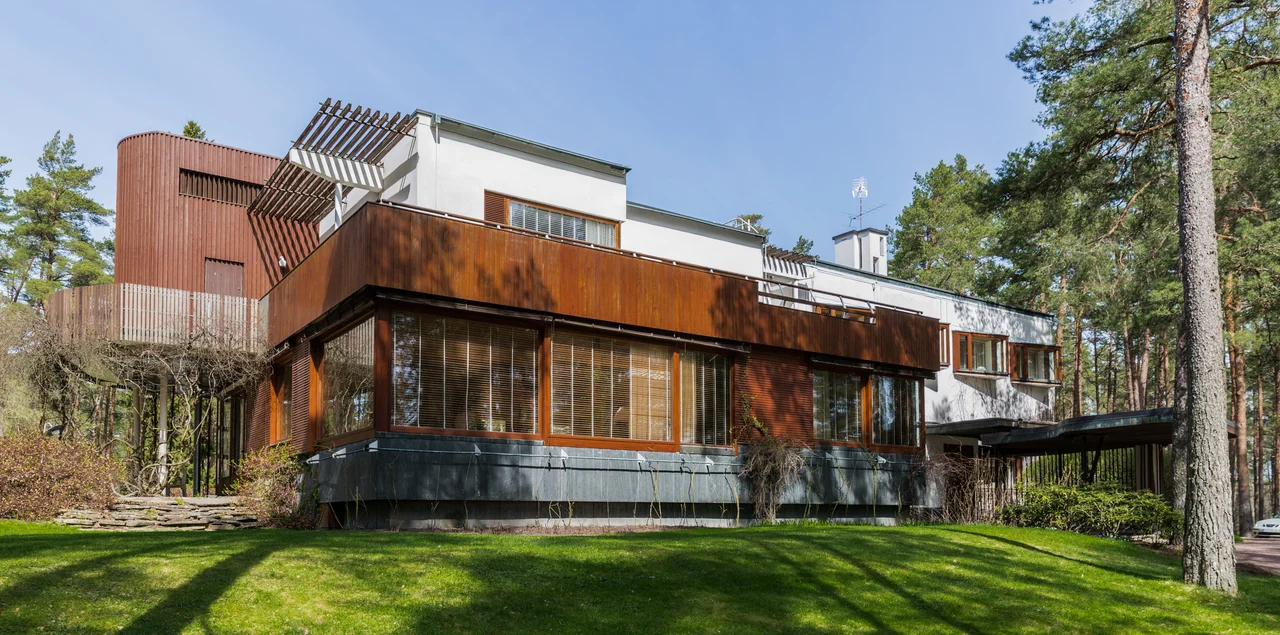
Harry and Maire Gullichsen saw their finished house for the first time in a photograph, an ocean away from its front door. The villa at Noormarkku was completed in 1939 while the couple were travelling in the United States, and the pictures caught up with them at the New York World's Fair — where the Finnish Pavilion, also by Alvar Aalto, was drawing crowds of its own. They had asked Aalto for an experimental house and then largely left him to it. What he and Aino Aalto delivered is now regularly named among the finest private houses of the twentieth century.
The Third House on the Estate
Maire Gullichsen was born in Noormarkku in 1907, daughter of Walter Ahlström and granddaughter of Antti Ahlström, whose timber and paper fortune had built the works village around her. She studied painting in Paris in the early 1920s. In 1928 she married Harry Gullichsen, who four years later became managing director of A. Ahlström; in 1935 the couple met the Aaltos, and Maire went on to co-found Artek with Aino and Alvar Aalto and Nils-Gustav Hahl — the firm that still manufactures Aalto's furniture.
Villa Mairea was the third major house the family raised on the same estate. Antti Ahlström built an imposing timber residence there in 1877; Walter added an Art Nouveau house at the turn of the century. Each announced the values of its generation. The Gullichsens wanted theirs to announce something else entirely — a conviction that industry and technology would eventually put a good life within reach of ordinary people. So they told Aalto to treat the commission as an experiment, and meant it.
Scolding the Model
Aalto started work late in 1937. His first proposal was a rustic hut modelled on vernacular farmhouses. Then, early in 1938, Frank Lloyd Wright's Fallingwater burst into the international press, and Aalto's enthusiasm ran so high that — according to Göran Schildt, who later wrote his biography — he tried to talk the Gullichsens into building over a stream on Ahlström land some miles away instead.
The scheme that followed, which Schildt called the Proto-Mairea, was approved in spring 1938 and the foundations were dug. Aalto hated it. He had programmed a gentlemen's room, a ladies' room, a music room, a table tennis room and a separate art gallery: a schedule closer to a Victorian country house than to any social-democratic vision of the future. A young Swiss student working in his office recalled him scolding the model like a naughty dog and complaining that those people did not need so many rooms. He then persuaded his clients to accept a wholesale redesign that kept the footprint and the servants' wing and discarded most of the rest.
A Forest Brought Indoors
The redesigned house never stops quoting the woods outside it. Slender wooden poles screen the main staircase at irregular intervals, so that climbing to the bedrooms feels like pushing through saplings. Steel columns are wrapped in black rattan or clad in strips of birch, doubled and tripled without visible logic — Aalto worked hard to disguise the fact that the whole plan is governed by a series of squares. The entrance canopy rests on unstripped saplings. Ventilation in the living room ceiling passes through tens of thousands of hand-bored holes.
Outside, in the crook of the L-shaped plan, a curved swimming pool answers the line of the treeline, and the small timber sauna carries a roof of turf and grass. The undulating wall that recurs throughout the house was already Aalto's signature, and it carries a private joke: *aalto* is the Finnish word for wave.
The Life It Was Built For
It worked as a home. Maire kept a painting studio upstairs, reached by its own stair from the winter garden where she arranged flowers. Her collection — Picasso, Braque, Léger, Modigliani — hung in the living rooms rather than in the gallery Aalto had deleted. Harry died in 1954, at fifty-two. Maire outlived him by thirty-six years and spent them building institutions: the Free Art School, the Contemporary Art Society, and eventually the Pori Art Museum, which opened in 1979 around the collection she gave it.
In 1980 she founded the foundation that still cares for the villa and opens it to visitors by guided tour, in Finnish and English, through the year. In July 2026 Villa Mairea was inscribed on the UNESCO World Heritage List as one of thirteen sites in the Aalto Works series — the first Finnish modern architecture to receive the designation, and the eighth World Heritage property in the country.
From the Air
Villa Mairea sits at 61.5975°N, 21.8745°E, inland from the Gulf of Bothnia in the Noormarkku district of Pori. The house is low, timber-and-stone, and largely screened by pine, so it reads from the air as part of the Ahlström works estate rather than as a standalone landmark — look for the cluster of historic estate buildings and the clearing around them. Best appreciated at 1,500–2,500 ft AGL in clear air. Pori Airport (EFPO) lies roughly 15 km southwest, with the city grid of Pori and the broad Kokemäenjoki delta beyond it; Turku Airport (EFTU) is the nearest larger field to the southeast. Low cloud and Baltic sea fog are common on this coast in spring and autumn, and winter light this far north is short and slanting.
Nearby Stories
- Olkiluoto Nuclear Power Plant 12 km away
- Säppi 16 km away
- Kokemäki Castle 19 km away
- Sastamala 22 km away
- Finnish War 28 km away
- Ikaalinen 35 km away
- Kauhajoki School Shooting 63 km away
- Kvarken Archipelago 155 km away