
Olkiluoto Nuclear Power Plant
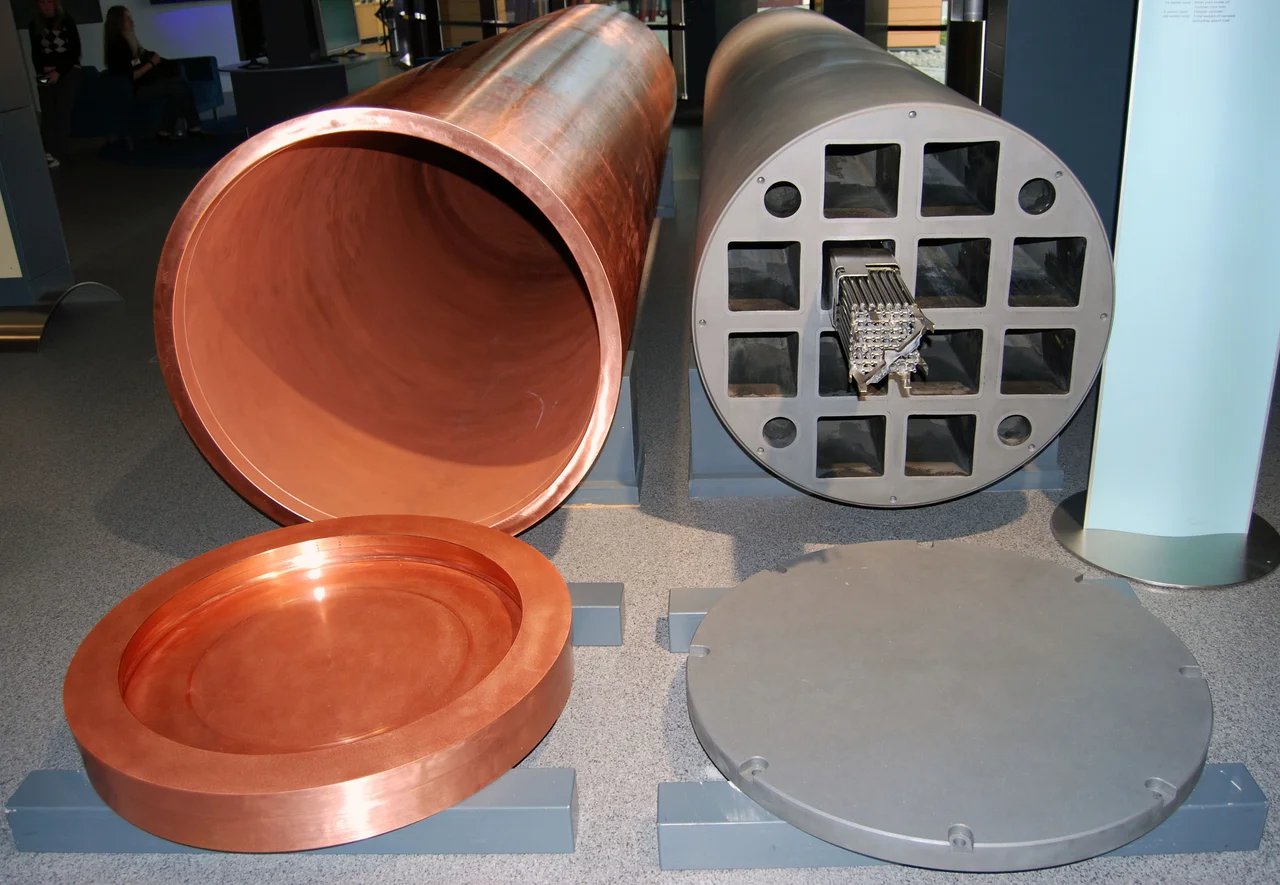
In August 2024, on a low island off Finland's west coast, engineers lowered empty canisters into holes drilled in the floor of a tunnel more than four hundred metres underground and then pulled them back out again. It was a rehearsal. The canisters were copper over a boron-steel insert, each built to hold twelve spent fuel assemblies, and the tunnel was Onkalo, which will be the world's first permanent burial site for high-level nuclear waste. Everything else on Olkiluoto Island operates on a timescale of decades: reactors, licences, outage schedules, electricity prices. The hole in the granite is designed for a hundred thousand years. The two things sit within a few kilometres of one another, which is the whole point.
The Island's First Business
Teollisuuden Voima, TVO, has been generating power on this shore since Olkiluoto 1 came on line in October 1979, with Olkiluoto 2 following in July 1982. Both are boiling water reactors from ASEA-Atom, the Swedish designer now folded into Westinghouse, with turbines by Stal-Laval, pressure vessels by Uddcomb and electrical gear by Strömberg. They were built to produce 660 megawatts apiece and have been steadily coaxed upward ever since: to 710 megawatts in 1983 and 1984, 840 by the late 1990s, 860 in the mid-2000s, and a rating around 890 today. Between 2013 and 2017 the pair delivered between 13,385 and 14,740 gigawatt-hours a year at capacity factors running from 87.2 to 96 per cent, figures that make them among the hardest-working reactors anywhere. Their licences run to 2038, and TVO has been studying extensions of ten or twenty years beyond that.
Fourteen Years Late
Then there is unit 3, which became a cautionary tale told across the industry. Finland approved it in February 2005, the first Western European country in fifteen years to order a reactor, and Areva contracted to build the first EPR for a fixed price of three billion euros. Almost nothing went to plan. The detailed design was incomplete when construction began. Areva had supplied reactors before but had never managed the building of one, its experienced subcontractors had left the business, and Finland's regulator STUK insisted on approving manufacturing plans and inspecting at hold points before major components could be made at all. Pressurizer forgings and reactor internals were remanufactured once or twice over to reach the required quality. A schedule of four years from groundbreaking to grid stretched into a decade and a half, and the final bill is estimated at around eleven billion euros - TVO's five and a half billion in investment, and an equivalent pile of accumulated losses at Areva. In 2009 the economist Stephen Thomas wrote that Olkiluoto had become an example of all that can go wrong in economic terms with new reactors, and for years nobody in the industry could argue with him.
First Criticality to Full Power
The endgame was its own drama. First criticality came on 21 December 2021; an unplanned scram on 14 January 2022 pushed grid connection back; electricity finally began flowing at one minute past noon on 12 March 2022. Debris from the steam guide plates turned up in the turbine reheater that May and shut the plant for three months. In October cracks a few centimetres long were found in all four feedwater pump impellers, which are larger here than in any other reactor, and new ones had to be designed and fitted. Regular production started on 16 April 2023 and commercial operation on 1 May. Its 526-tonne reactor pressure vessel, forged by Japan Steel Works and Mitsubishi Heavy Industries, and its 241 fuel assemblies now drive 1,600 megawatts of electricity from 4,300 megawatts of heat - the most powerful single unit in Europe. In a fittingly Nordic epilogue, OL3 had to throttle back within weeks of starting, in May 2023, because spring meltwater had flooded the grid with hydropower and prices had gone negative.
The Hundred-Thousand-Year Room
Onkalo belongs to Posiva, a company owned by TVO and Fortum, and excavation began in 2004 after Eurajoki granted a building permit the previous year. The Finnish government issued the construction licence on 12 November 2015. The engineering rests on redundancy rather than cleverness: fuel in a boron-steel insert, the insert sealed inside copper, the copper packed in bentonite clay that swells shut on contact with water, all of it set into billion-year-old granite far below the reach of anything living. Construction has cost something near a billion euros and the century of operation and closure ahead of it is projected at four billion more. Other countries have buried military waste or low-level material. No one has ever done this with civilian spent fuel, which is why delegations keep arriving on this island to watch.
A Working Plant, Not a Monument
For all the significance layered onto it, Olkiluoto runs like any large industrial site, with the ordinary faults that implies. On 3 June 2024 a turbine tripped unit 3 offline for a night, traced to a pressure measurement failure in the generator's sealing oil and hydrogen cooling. On 7 March 2025, during a maintenance outage, a hatch in the refuelling pool was not properly closed and a hundred cubic metres of radioactive coolant drained into containment rooms. TVO classed it a significant operating event and said its radiation safety consequence was low. Neither released anything to the environment. Around all of this, Eurajoki carries on being Eurajoki: flat shoreline, pine and granite, the Gulf of Bothnia twenty kilometres from the wooden lanes of old Rauma and fifty from Pori.
From the Air
61.2367 N, 21.4422 E, on Olkiluoto Island in the municipality of Eurajoki, on the Gulf of Bothnia coast of Satakunta. Unmistakable from the air: three reactor buildings and their turbine halls on an otherwise low, wooded, granite-and-pine shoreline, with the cooling water intake and discharge channels cutting clean geometric lines into the coast. The Onkalo surface works sit inland of the reactor blocks. Pori Airport (EFPO) lies roughly 50 km north-northeast and is the practical base; Turku Airport (EFTU) is about 110 km south-southeast. Note that nuclear sites commonly carry airspace restrictions - check current Finnish AIP and NOTAMs before planning any approach, and treat 3,000 to 5,000 feet and an offshore standoff as the sensible default framing. Coastal haze and sea fog are frequent in spring; late summer evenings give the cleanest light along this shore.
Nearby Stories
- Pyhämaa 7.3 km away
- Noormarkku 8.5 km away
- Kallo Lighthouse 13 km away
- Villilä Manor 16 km away
- Vaskijärvi Strict Nature Reserve 30 km away
- Battle of Bomarsund 91 km away
- Kastelholm Castle 120 km away
- Härnösand Cathedral 191 km away