
Noormarkku
Noormarkku stopped existing on 1 January 2010. Six thousand one hundred and fifty-eight people went to bed in a municipality of their own and woke up in the city of Pori, and 332 square kilometres of forest, river and farmland lost the name it had answered to since 1868. Sixteen years later, in July 2026, UNESCO put one of Noormarkku's houses — Villa Mairea — on the World Heritage list. The place had lost its name and gained a listing, which is a strange fate for a district originally noted for having a lot of squirrels.
Named for Squirrels
The name is first recorded in 1400. The area was known for an unusual abundance of squirrels — a serious asset in a fur economy — and when the municipality eventually needed a coat of arms, a squirrel is what went on it. Noormarkku separated from Ulvila to become a municipality of its own in 1868, though people had been worshipping here long before that. A small preaching house was completed in 1726, in the exhausted years after the Great Northern War. C. L. Engel designed a stone church in 1835; it burned during the Civil War of 1918, in a year when Finns did a great deal of damage to each other across Satakunta. The present church, drawn by Armas Lindgren and paid for by the Ahlström company, was consecrated in 1933. A wooden village church at Lassila, dating from 1852, still stands.
Iron on the Makkarakoski
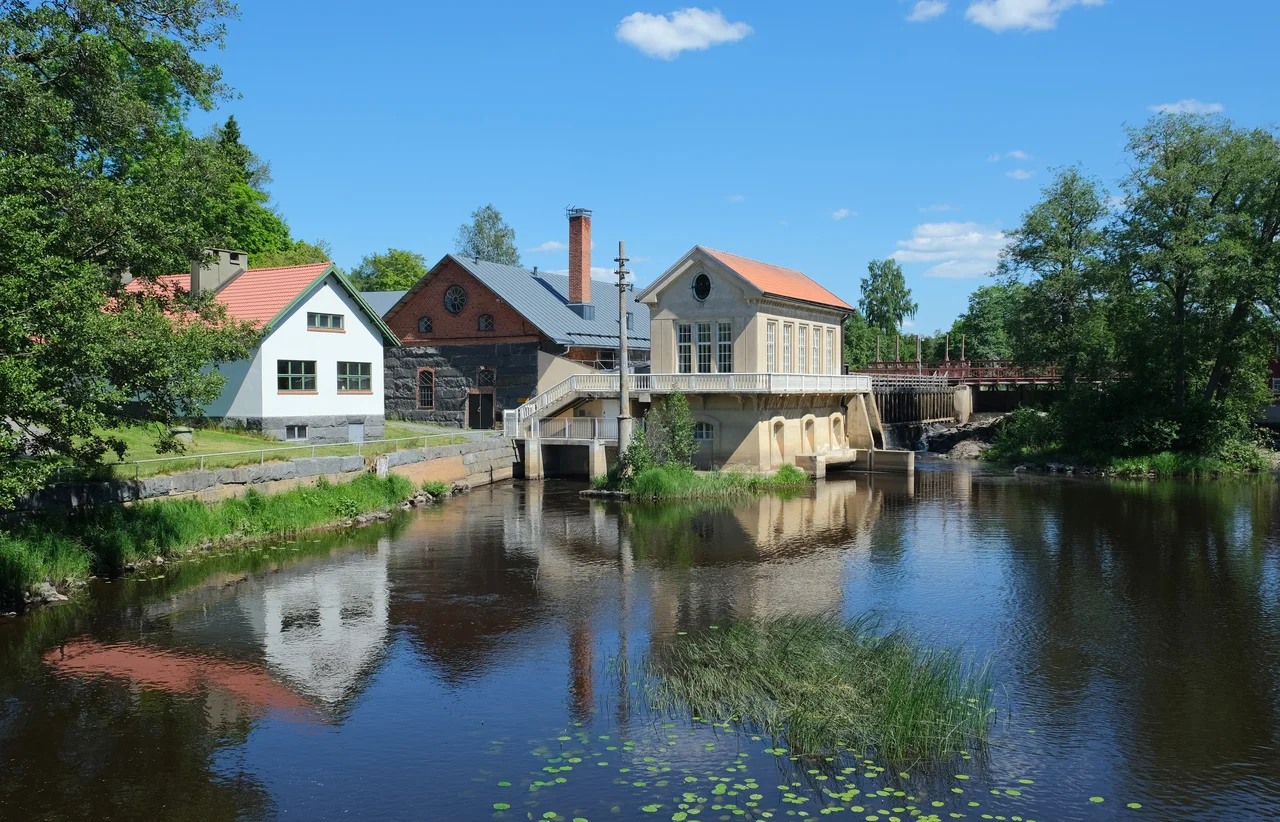
Industry came to the Noormarkunjoki in 1753, when Noormarkku manor was licensed to put a sawmill on the Makkarakoski rapids. The general-adjutant Carl Constantin de Carnall bought the manor in 1795 and, in 1806, obtained the right to build a bar hammer and forge — the last ironworks founded in Finland under Swedish rule, established at the very end of an era that would close for good three years later. Iron was worked here for over a century, until 1920. In the 1860s the then owner, Karl Johan Lönegren, dammed the rapids properly, and the river's power was fixed in place for whoever came next.
Antti Ahlström's Purchase
Whoever came next was Antti Ahlström. Born in 1827 in Merikarvia up the coast, he had made his first fortune in shipping and was the largest shipowner in Pori by 1871. In 1870 he bought the Noormarkku ironworks, the sawmill and the manor together, and began immediately to expand all three. The sawmill burned in 1875 and he rebuilt it the following year to a design by Henry Gibson, reusing structures from an older mill on the Sahakoski. In 1896 a power station on the rapids brought electric light to the works. By the time he died that same year he was worth roughly 11.4 million marks — reckoned the largest fortune in Finland — and owned 60,000 hectares of forest. He also put his money into the district itself: one of Finland's first Finnish-language schools, and a road network where there had been tracks. The firm was incorporated as A. Ahlström Osakeyhtiö in 1907, and its head office, built in 1916 to designs by Valter Jung and Emil Fabritius, is still on the site and still in use. In the summer of 2008 the works staged an opera about his life, Vierivä kivi, composed by Kimmo Hakola to a libretto by the novelist Antti Tuuri.
The Village the Company Built
What grew up around the rapids is one of the best-preserved industrial landscapes in the country, and it is worth reading building by building. The workers' houses stand in a group near the hammer works, put up around the turn of the twentieth century; the officials' housing, a step up the hill and a step up the hierarchy, was designed by the brothers Valter and Ivar Thomé in 1915. The head office of 1916 survives almost entirely as built. Sahala, raised in 1866 as the sawmill's office, was refurbished in 2010 into twelve guest rooms. Noormarkun Klubi began life in 1907 as a fire station, was bought by the company in 1919 and turned into a club in 1924, and still takes bookings for parties. The garden architect Bengt Schalin laid out the parkland in the 1910s. The 1876 sawmill is internationally significant for its unusual construction and its surviving machinery — of Finland's large old industrial sawmills, only the one at Strömfors compares. Between mill and hammer works sits the Makkarakoski power station of 1914, rebuilt in 2004–05, and in the old hammer shop the Voyage exhibition tells the works' own story.
Isotalo, Havulinna, and the House After
Three houses on one estate track three generations of a family. Isotalo, completed in 1882 to Evert Lagerspetz's design, was Antti Ahlström's own home, with the company office occupying one end — patriarchy and bookkeeping under a single roof. It remains in private family use. Havulinna followed in 1901, a Jugend villa by G. A. Lindberg built for Antti's son Walter and his wife Lilli; their daughter Maire was born in it, and the house now serves for training and representation. The third, Villa Mairea, went up in 1938–39 for Maire and her husband Harry Gullichsen, and it is the reason people who have never heard of Satakunta know the name Noormarkku. And then, on 1 January 2010, the municipality that had contained all of this since 1868 ceased to exist. Its 6,158 residents and 332 square kilometres — fifteen of them water, at a density of roughly nineteen people to the square kilometre — became part of Pori. Noormarkku is a district now, not a place with a council. The works, at least, is on the national register of significant built cultural environments, which means the buildings will outlast the name.
From the Air
61.5917° N, 21.8694° E, on the Noormarkunjoki about 20 km northeast of Pori city centre, now part of Pori. Pori Airport (EFPO) lies roughly 21 km southwest — close enough that the area sits under the airport's wider traffic pattern, so coordinate before loitering. From 2,000–3,000 ft the target is the works complex on the river: a tight cluster of red and ochre buildings along the Makkarakoski rapids, the long sawmill on the south bank and the hammer works on the north, with parkland and villas set back among mature trees. Highway 23 runs past the west side and separates the 1933 church and its cemetery from the works proper. Line features are scarce inland from Pori; follow the coast to the city, then the Noormarkunjoki northeast. Summer gives long clear evenings; the coast produces low stratus and sea fog in spring and autumn.
Nearby Stories
- Olkiluoto Nuclear Power Plant 12 km away
- Säppi 16 km away
- Kokemäki Castle 19 km away
- Sastamala 22 km away
- Finnish War 28 km away
- Ikaalinen 35 km away
- Kauhajoki School Shooting 63 km away
- Kvarken Archipelago 155 km away