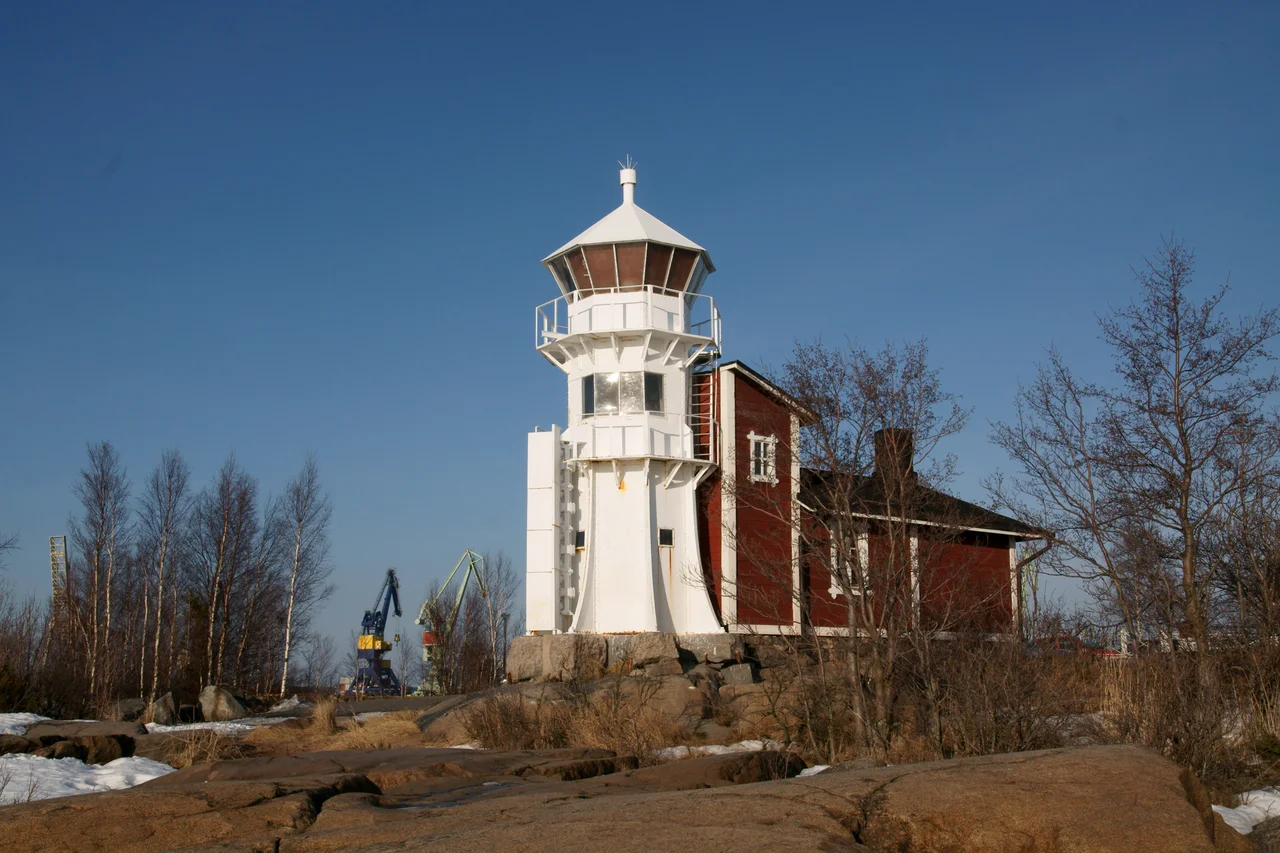

Kallo Lighthouse
The people of Reposaari had a phrase for anybody who bellowed: they screamed like the Kallo fog horn. It was not an exaggeration. From 1906 the horn on this small rock outside Mäntyluoto sounded three short blasts a minute, driven by a compressor and audible eight nautical miles out into the Bothnian Sea, which meant that on a thick day the entire western edge of Pori heard it every sixty seconds. The light beside it is modest - a white iron tower not quite ten metres tall, the sort of thing you could mistake for a water tank at distance. Its job was never to be seen from far away. Its job was to keep ships off one specific patch of rock.
The Trekanti Problem
The approach to the Port of Pori runs past a shoal called Trekanti, close enough to the fairway that a loaded timber ship feeling its way in at dusk had a real chance of finding it. A first beacon went up in 1851, but the Crimean War claimed it just three years later, and the shoal went unmarked again until a light shelter went up on the island of Kallo in 1884; that beacon was first lit on 15 September 1885. This was harbour lighting rather than landfall lighting - a short-range marker meant to define one channel, not to announce the coast of Finland to vessels sixty kilometres offshore. The distinction matters for understanding why Kallo looks the way it does. Everything about it is close-quarters work: modest height, a light showing white, red and green in fixed sectors so a helmsman could read his position in the channel by colour alone.
Nyström's Octagon
The structure standing today dates from 1903 and came from the drawing board of Gustaf Nyström, one of the leading architects working in the Grand Duchy of Finland at the time. That a designer of his standing was handed a navigation aid on a rock outside a timber port says something about how much the Port of Pori mattered in 1903. What he produced is an octagonal iron tower, painted white, with a wooden keeper's house beside it. The lantern sits about eleven metres above the sea and throws its isophase white-red-green signal on a two-second cycle out to roughly seventeen kilometres. For a lighthouse, that is a short reach. For the Mäntyluoto fairway, it is exactly enough.
Sound Before Light
In fog the light is useless, which is why Kallo's acoustic history is longer and stranger than its optical one. The first fog signal, installed in 1901, was a Hansen siren cranked by hand - somebody stood on the rock in the weather and turned a handle. In 1906 that was replaced by a mechanical arrangement of ball motors and a compressor producing the three-blast pattern that made the station locally notorious. When the light was converted to electricity in the 1930s, the compressed-air machinery gave way to an electric nautophone. Each upgrade made the horn easier to run and, in the way of these things, no quieter. Fog signalling has largely disappeared from modern navigation, displaced by radar and satellite positioning, but for half a century the sound of Kallo was how Pori knew the visibility had gone.
The Company It Keeps
Kallo does not stand alone. The Mäntyluoto area around it is a nearly intact working maritime settlement of the late nineteenth and early twentieth centuries: the Pori pilot station, the coast guard station, a cafeteria, and the clubhouse of Segelföreningen i Björneborg, founded in Pori in 1856 and reckoned both the oldest yacht club and the oldest sports club in Finland. Finland's oldest harbour crane survives here too, along with the red-and-white wooden beacon of 1902-03 known locally as the Russian Tower, an Art Nouveau oddity in timber. The Finnish Heritage Agency has designated the whole ensemble a nationally important built cultural environment, protecting not one landmark but the relationship between all of them.
The One You Can Drive To
Most Finnish lighthouses require a boat, a permit, decent weather, and a tolerance for being stranded. Kallo requires a car. It is one of only two lighthouses in the country - the other being Marjaniemi on Hailuoto - that you can park directly beneath, and that single fact has made it one of the most photographed navigation aids in Finland. There is something honest about its popularity. A tower that spent a century keeping timber freighters off a shoal is now mostly encountered by people carrying a coffee out from the cafeteria to sit on the rocks and watch the pilot boats work the channel. The ships still come in past Trekanti. The light still marks the turn.
From the Air
Kallo Lighthouse stands at 61.595°N, 21.462°E on a small island immediately outside Mäntyluoto, about 20 km northwest of central Pori. Best viewed at 1,000-2,000 feet - the tower itself is under ten metres and easy to lose, so navigate instead by the Mäntyluoto port cranes and quays just inland and the red-and-white Russian Tower beacon nearby. Reposaari lies a few kilometres north across the channel; Yyteri's dune beach runs south. The lighthouse marks the seaward end of the Port of Pori fairway past the Trekanti shoal. Nearest airport: Pori (EFPO), roughly 22 km southeast, elevation 45 ft, runway 12/30 at 2,351 m. Sea fog is common here in spring and early summer, which is precisely why the station spent a century in the fog-signalling business.
Nearby Stories
- Kokemäki Castle 12 km away
- Liinmaa Castle 14 km away
- St. Henry's Chapel 41 km away
- Finnish War 45 km away
- Kauhajoki School Shooting 68 km away
- Archipelago Sea 117 km away
- Battle of Bomarsund 162 km away
- Härnösand Cathedral 184 km away