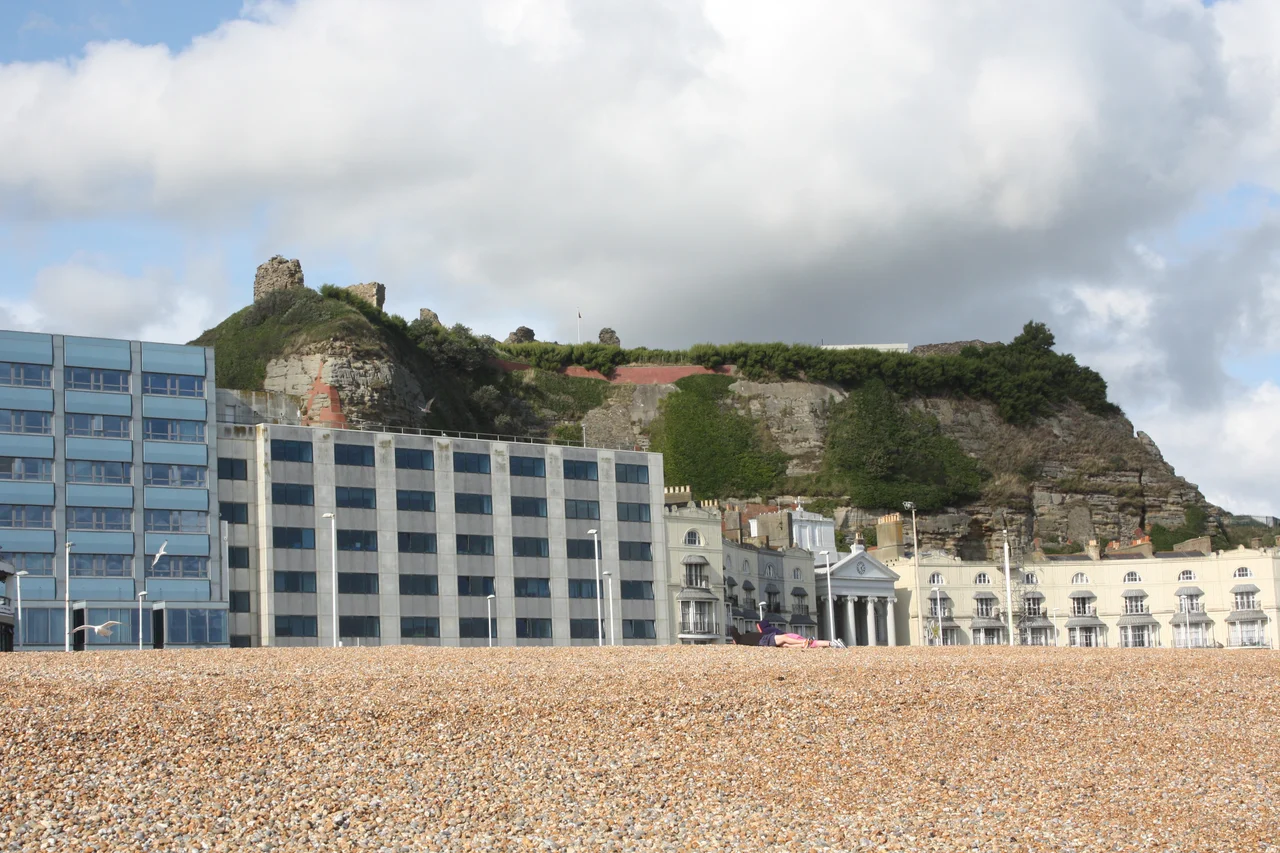

Hastings Castle
The castle is falling into the sea. It has been falling, slowly and unevenly, since at least February 1287, when a violent storm hit the south coast and tore great sections of the soft sandstone cliff away. The cliff went; the curtain wall went with it. Subsequent centuries have continued the work. Today what visitors see on the cliff above Hastings town is roughly half of what once stood there - the rest is on the seabed, or already eroded into the Channel. The fragment that remains is a Grade I listed ruin with a particular distinction: it is widely considered the first castle William the Conqueror built on English soil, raised in the first weeks of the invasion of 1066, before the Battle of Hastings was even fought.
Three Fortifications in 1066
After landing at Pevensey on 28 September 1066, William of Normandy ordered three fortifications built in quick succession to secure his foothold. The first reused the Roman walls of Anderitum (modern Pevensey Castle). The second went up here at Hastings, raised hurriedly as a wooden motte-and-bailey - an earthen mound topped by a timber palisade - on the high sandstone cliff overlooking what was then a sheltered anchorage. The third would be at Dover after the Conquest was secured. The Bayeux Tapestry shows men labouring at a castle described as "Hestengaceastra," probably this site. The famous battle that gives the town its name took place some miles to the north, near the present town of Battle, but its name attached itself to the seaside fortification William raised before the fighting started. In 1070, with England secured, William ordered the timber palisades of Hastings to be rebuilt in stone, along with a chapel dedicated to St Mary.
Counts of Eu and a Royal Confiscation
For most of the Norman period the castle was held by the Counts of Eu, a French ducal family beginning with Robert, Count of Eu. They held it in service to the English crown, which meant their fortunes rose and fell with the politics of the Channel. In 1216, with England torn by civil war and a French army under Prince Louis of France landing in Kent, King John ordered Hastings and Pevensey both to be slighted - deliberately destroyed - so they couldn't be used by the invaders. Four years later, with the French defeated, Henry III re-fortified Hastings. By the mid-13th century the Eu family was making a choice: their French lands or their English ones. The heir William chose France, and forfeited his English inheritance. In 1249 Henry III gave Hastings and its associated Honour of Eu to his wife's uncle, Peter of Savoy. Peter held it until 1254, when the rights passed to the future King Edward I; Edward sold them back to Peter in 1262 when he needed money, and Peter held them until his death in 1268.
The 1287 Storm
On a winter night in February 1287, a great storm hit the southern English coast with extraordinary force. The same storm reshaped the harbour at Romney further east, washed away the harbour at Old Winchelsea, and at Hastings tore the soft sandstone cliffs away in massive chunks. Large sections of the castle - including parts of the curtain wall and outbuildings - went over the edge. The English Channel takes a long time to digest a Norman castle, but it had patience. Throughout the following century erosion continued unchecked. French raiders attacked the town twice, in 1339 and 1377, burning many houses. By the late 14th century the castle was no longer militarily significant; by the 16th century it was a romantic ruin overgrown with brambles, half-forgotten.
Lost and Found
Thomas Pelham, a member of one of the great Sussex families, bought the site on 23 June 1591. The Pelhams used the land for farming, and the ruins gradually disappeared under hedges and grazing until they were lost from local memory altogether. In 1824 the then-owner, the Earl of Chichester, commissioned an archaeological investigation. The chapel floor was uncovered along with parts of the chancel arch; the loose stones lying about the site were reused to partially rebuild the chapel walls. The work was Victorian conservation rather than restoration in the modern sense - imaginative reconstruction as much as careful recovery - but it brought the castle back into public consciousness.
Bombs and Tourists
During the Second World War, Hastings was a regular target for Luftwaffe bombing - the town's seafront and harbour were strategically valuable, and the cliffs above the town were not spared. The castle ruins took further damage from blast and falling masonry during these years. In 1951 Hastings Corporation bought the site and opened it as a tourist attraction. In 1990 an audio-visual presentation called "The 1066 Story" was installed in a replica medieval siege tent on the cliff, an unusually atmospheric way to introduce visitors to the Norman invasion. The castle is open between March and October. Walk to the eastern edge of the surviving wall on a windy October day - hold onto your hat - and you look down a sheer drop of sandstone where chunks of masonry have peeled away over centuries into the Channel. Below, the surf of the same sea William and his army sailed across breaks against the rocks. Nine hundred and sixty years later, the cliff is still going.
From the Air
Located at 50.86°N, 0.58°E, on West Hill above the Old Town of Hastings, immediately above the town centre and pier. The ruins occupy a clifftop position with a sheer southern face overlooking the English Channel; the surviving walls form an irregular ruined pentagon clearly visible from the air. The Hastings railway station is about 800 m north-west. Nearest airfield is Lydd (EGMD) about 25 km east. Best viewed at 1,500-3,000 ft AGL; the cliff edge and the eroded southern face of the castle read most dramatically from out over the sea looking back inland.
Nearby Stories
- Battle of Lewes 1.5 km away
- Staplehurst rail crash 4.1 km away
- Canterbury Castle 14 km away
- The Carrington Event: The Solar Storm That Could Happen Again 15 km away
- Shorncliffe Redoubt 21 km away
- Le Paradis Massacre 113 km away
- Swanage Lifeboat Station 137 km away
- Cléon 150 km away