,_Old_Town,_Hastings_(IoE_Code_294063).JPG)
Hastings Fishermen's Museum
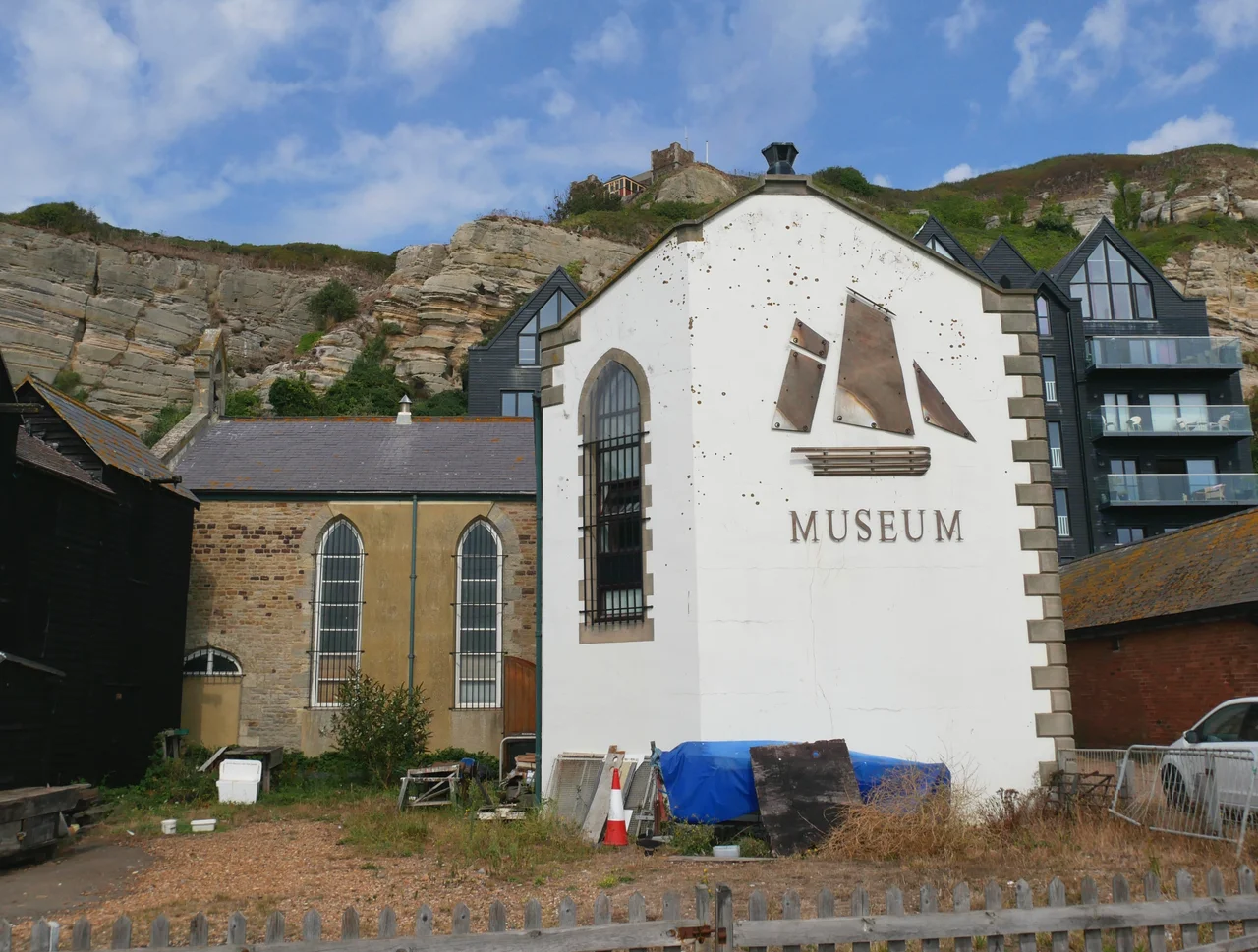
The architect William Gant designed a great many large houses in 1850s Hastings, but the building he is best remembered for is a small one. In early 1854 the rector of St Clement's, the Reverend J.G. Foyster, commissioned Gant to build a simple stone chapel at Rock-a-Nore, on the shingle of the Stade where the fishing fleet was hauled up. The cost was £529 - modest even by Victorian standards - and the building was deliberately plain. Its purpose was not to impress but to be welcoming: to draw the town's fishermen and their families, many of whom worked Sundays and worshipped rarely, into a church that sat in their own world rather than asked them to come up to the town to find it. The chapel today is the Hastings Fishermen's Museum, one of the most visited attractions in the town, with the painted hull of the Enterprise filling the small interior where pews once stood.
A Town That Lived from the Sea
Hastings has been a fishing town since the Saxons, and the boats have always launched from the Stade - a stretch of shingle below the East Cliff at the eastern end of the Old Town. Through the medieval period the fishery was prosperous; by the 19th century, when seaside tourism began transforming Hastings into a Victorian holiday resort, the fishing community was a stubborn enclave at one end of a town that was reinventing itself for visitors. Their tall black net huts (the unique three-storey wooden structures that still stand on the Stade today) became picturesque to the new arrivals. The men themselves were less picturesque to look at - sunburnt, calloused, gnarled by salt - and harder to draw into the polite town's churches. By the 1840s only two of Hastings' seven medieval parish churches still stood: All Saints, and St Clement's. The town was growing fast, and the rectors of both churches recognised that a population working seven days a week on the beach needed a church that came to them.
Rev. Dawes and the Reluctant Congregation
Tom Tanner, a missionary, was based at Rock-a-Nore to begin building relationships with the fishing community. Gant's small stone church was built in early 1854 and given the name St Nicholas - the patron of sailors - though it was never officially consecrated; technically it remained a mission chapel rather than a full church, designated as a "chapel of ease" to All Saints. The fishing community was initially hostile to this earnest piece of Anglican outreach. The chapel actually closed in the 1870s for lack of attendance. Then the church appointed the Reverend Charles Dawes, a chaplain who somehow had the right temperament for the work. He listened. He sat in the boats. He spoke the way fishermen spoke. By the 1880s the chapel - which could hold about 290 - was full at every service, and the fishing families had taken it as their own.
From Chapel to Museum
The chapel served the fishing community for nearly a century. The Second World War took a toll: Hastings was a coastal target for German bombing, and the building suffered some damage. The military requisitioned it for war use, and after 1945 it stood empty and decaying. In 1956 a local preservation society - the Old Hastings Preservation Society - took the building on a lease from the council and opened it as a museum dedicated to the local fishing industry. The choice of contents reflected what the community itself wanted to preserve. At the centre of the space they put the painted lugger Enterprise, a beach-launched Hastings fishing vessel from the early 20th century, hauled in through a wall opening enlarged for the purpose. She fills the nave like a stranded whale, her tarred timbers and red sails dominating the interior, and a generation of Hastings children has grown up clambering aboard her where their grandparents once sat in pews.
The Architecture
The building is small and architecturally modest - pale Kentish ragstone walls in a simple Gothic Revival style, with a steeply pitched roof and lancet windows. The interior is one large undivided space: there is no chancel arch or screen separating nave from chancel, so the whole becomes a single room of about 290 seats' capacity. William Gant, a relatively obscure architect who had moved to Hastings in 1852 after working with Sir William Tite in London, designed largely houses and estates; St Nicholas Church was an outlier in his portfolio and the building most people remember him by. English Heritage listed the museum Grade II in 1985, recognising it as nationally important - one of 521 Grade II listed buildings in the borough of Hastings.
A Fleet Still Launching
The most remarkable thing about the museum is that it is not a record of a lost industry. The Hastings fishing fleet still works from the Stade. It is now Europe's largest beach-launched fishing fleet, a community of small boats that put to sea without the benefit of a harbour, dragged up and down the shingle every working day by powerful tractors. The boats today catch sole, plaice, herring, mackerel and shellfish; the catch is sold from the wooden net huts and the small fish market beside them. The museum sits at the centre of this living industry, attracting around 140,000 visitors a year and connecting them - through the painted hull of the Enterprise, through the photographs and ship models and lifeboat records on the walls - to the boats actually launching twenty metres away. St Nicholas Church found its congregation eventually. They are still there.
From the Air
Located at 50.86°N, 0.60°E, on the Stade at Rock-a-Nore, directly below the East Cliff in the Old Town of Hastings. The museum is easily identified from the air by the cluster of distinctive black tall net huts on the shingle beach around it, with the East Hill funicular running up to the cliff just behind, and the small Hastings harbour and pier visible to the west. Hastings Castle ruins are on the higher cliff to the west-south-west. Nearest airfield is Lydd (EGMD) about 24 km east. Best viewed at 1,000-2,500 ft AGL; the painted blue and red fishing boats on the shingle are a striking detail from low altitude in clear conditions.
Nearby Stories
- Battle of Lewes 1.5 km away
- Staplehurst rail crash 4.1 km away
- Canterbury Castle 14 km away
- The Carrington Event: The Solar Storm That Could Happen Again 15 km away
- Shorncliffe Redoubt 21 km away
- Le Paradis Massacre 113 km away
- Swanage Lifeboat Station 137 km away
- Cléon 150 km away